- Home
- News & Events
- News
Third Award This Year: FTMC PhD Student Jorūnas Dobilas Recognised at an International Conference for Research on an Unusual Quantum Material
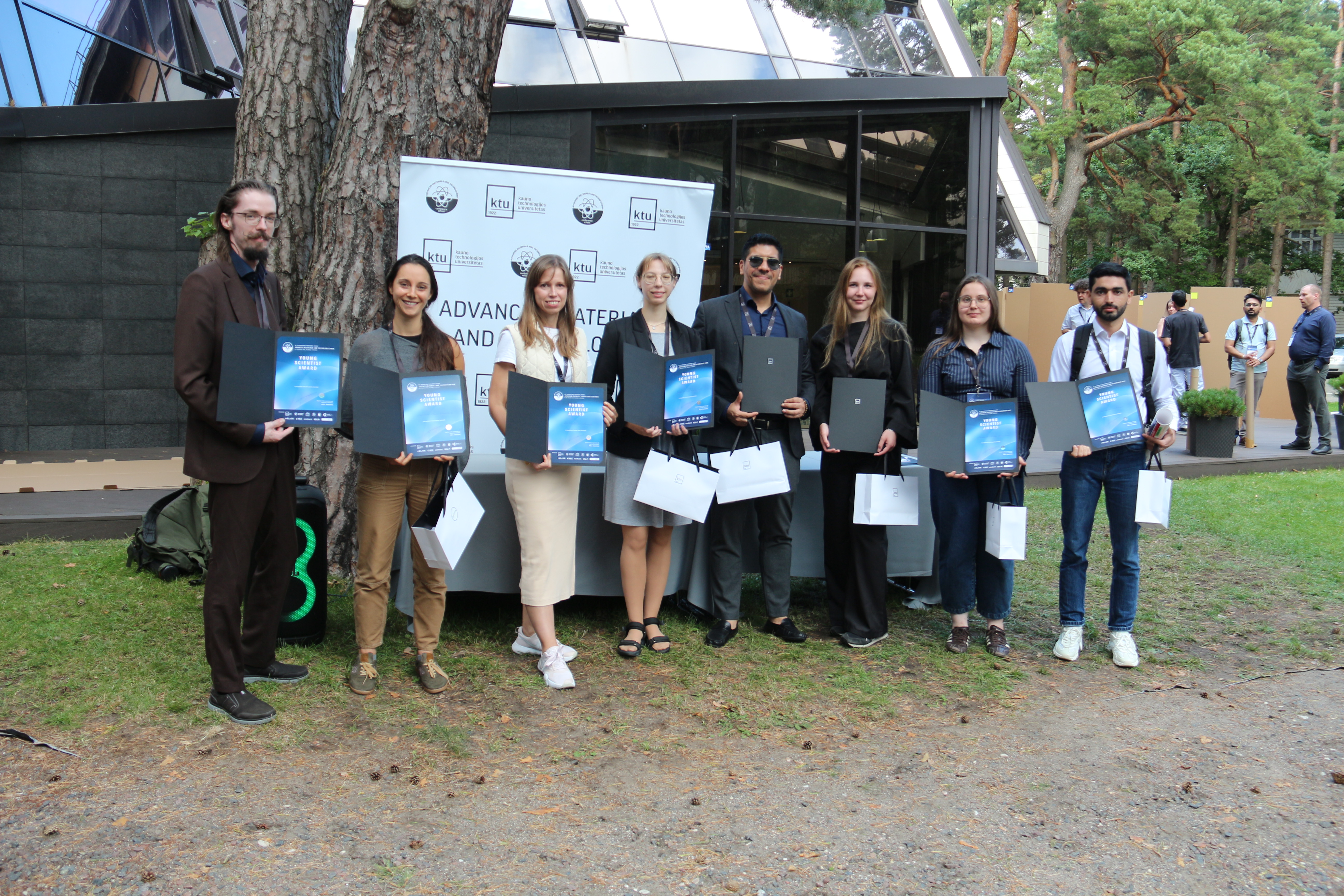
Theoretical physicist and PhD student Jorūnas Dobilas from the FTMC Department of Fundamental Research has received the „Young Scientist Award“ at the international conference „Advanced Materials and Technologies 2026“ in Palanga, Lithuania. This marks his third achievement this year: the young researcher was previously honoured at „Open Readings 2026“ in Vilnius and „DSQT 2026“ in Budapest.
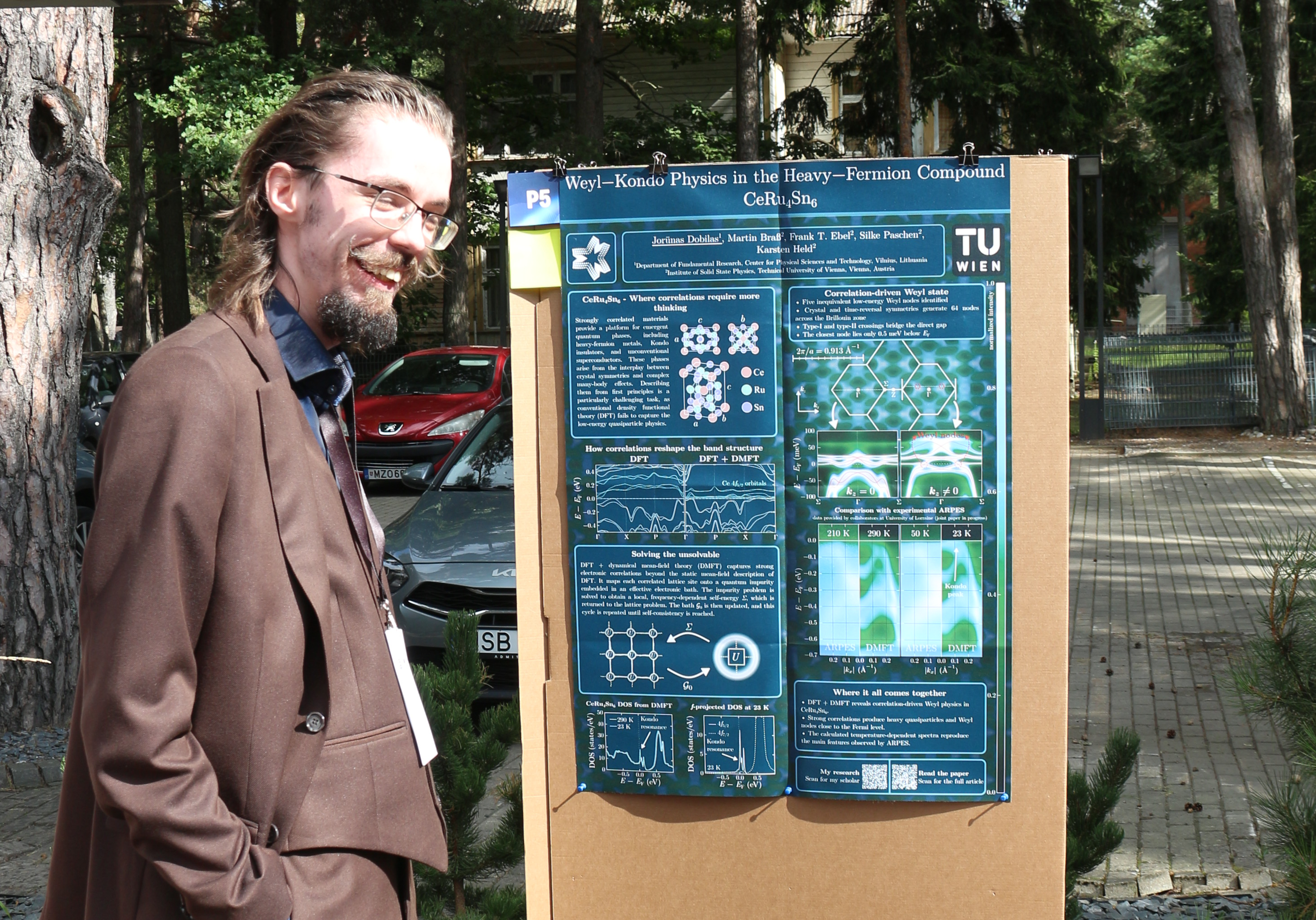
This time, Jorūnas was recognised for the best poster presentation, in which he presented his research on the unusual cerium-based material CeRu₄Sn₆, which exhibits remarkable quantum properties.
According to the FTMC PhD student, electrons in this material behave differently from those in most conventional metals or semiconductors. The electrons interact so strongly with one another that their behaviour can no longer be explained by considering each electron independently. As a result, the material's electronic properties become highly complex and can give rise to unexpected physical phenomena.
"Previous experimental and theoretical studies suggested that so-called Weyl nodes might exist in this material. These are special points in the electronic structure where two energy bands meet, with the electron energy varying almost linearly around these points. Such states are of great interest because they are associated with so-called topological materials, which exhibit exceptional electronic properties that are robust against disturbances.
However, it has remained unclear whether these Weyl nodes persist when strong electron-electron interactions are treated more accurately. Earlier theoretical studies employed Density Functional Theory (DFT) and its extensions, such as DFT+U and DFT+Gutzwiller, in which electron correlations were described using a static approximation. By employing a more advanced theoretical approach combining DFT with Dynamical Mean-Field Theory (DMFT), we demonstrated that the Weyl nodes persist even when strong electron correlations are treated more accurately, and that they are located very close to the Fermi energy,” explains Dobilas.
Jorūnas Dobilas at the international conference “Advanced Materials and Technologies 2026”. Photo from personal archive
This result confirms that CeRu₄Sn₆ combines two phenomena of particular interest to physicists within a single material: strong electron correlations and topological electronic states. Research on such systems allows us to better understand how strong electron interactions modify the topological properties of materials and what new quantum phenomena can emerge from the interplay between these two effects.
“I also presented a comparison of our theoretical calculations with new angle-resolved photoemission spectroscopy (ARPES) results. These new results complement our previous theoretical work and are expected to be published in the near future,” says the award winner.
The main theoretical results have already been published in „Physical Review B“.
“Advanced Materials and Technologies 2026” is an international conference-school that was held in Palanga for the 28th time this year. The conference is interdisciplinary, bringing together research in physics, chemistry, and biology related to novel materials, their properties, methods of investigation, and potential applications. Such a broad range of topics provides an opportunity not only to present your own work, but also to learn about research in other fields and interact with scientists from different disciplines.
Info: FTMC