- Home
- News & Events
- News
Eight FTMC Representatives Honoured at the Open Readings 2026 Conference
From 27 to 30 April, Vilnius hosted Open Readings 2026, the largest international natural sciences student conference in the Baltic States. The event was organised by the Vilnius University Faculty of Physics together with the FTMC, as well as the Vilnius University student chapters of the international scientific organisations Young Minds, OPTICA, and SPIE.
Young researchers presented oral and poster contributions on their ongoing research, attended lectures by invited speakers, and on the final day of the conference, awards were presented for the best presentations.
We are delighted to announce that FTMC representatives received eight awards. Below we present the winners and the categories in which they were recognised.
Applied Electrodynamics
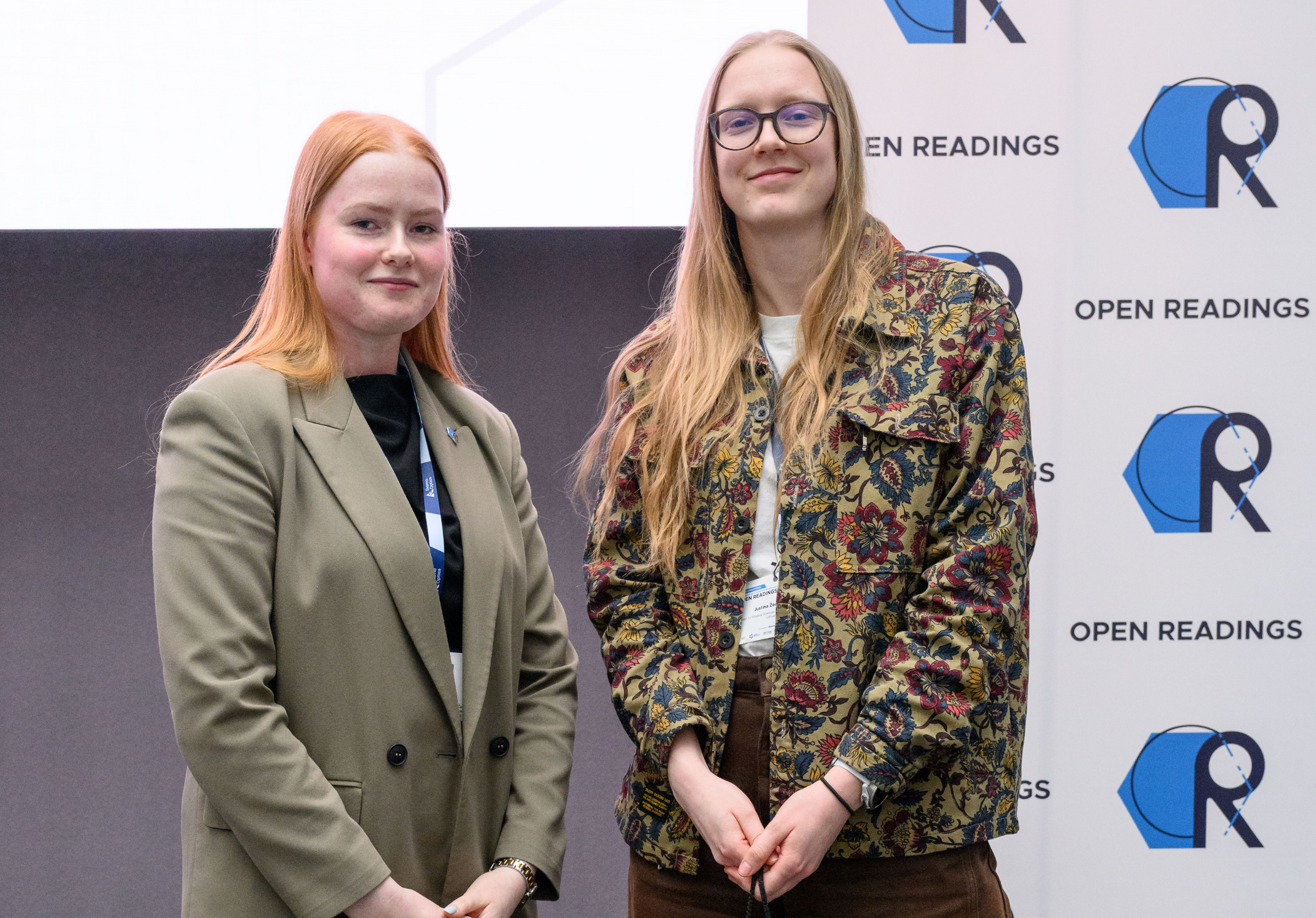
Best Oral Presentation. PhD candidate Justina Žemgulytė (Department of Physical Technologies): “Horizontally Oriented Low-Profile Dielectric Resonator Antenna with Extreme Temperature Stability for Radio Wave Energy Harvesting”
“My presentation focused on novel dielectric resonator antennas developed in collaboration with colleagues from the V. I. Vernadsky Institute in Ukraine as part of a NATO SPS project. These antennas were used to demonstrate radio wave energy harvesting systems and show how, in the future, this technology could reduce the need for batteries in ultra-low-power devices.
The award is seen as an important sign that the research is moving in the right direction and is of interest to the wider scientific community, providing encouragement to share the results more actively beyond FTMC.”
***
Best Poster Presentation. Barbora Škėlaitė (Department of Optoelectronics): “Comparison of Spectral Properties in the THz Range of Square and Circular Metasurface Structures on Conductor/Insulator/Conductor Structures”
“The poster focused on numerical modelling of thermal sources coated with metasurfaces. The research examined how the geometric parameters of metasurfaces influence spectral characteristics in the terahertz frequency range, as well as the distribution of the magnetic field formed in semiconductor structures.
The recognition motivates further scientific work at the FTMC Department of Optoelectronics, in collaboration with supervisor Dr Ignas Grigelionis.”
.jpg)
(PhD candidate Jorūnas Dobilas and Goda Grybauskaitė, Head of the Open Readings 2026 Organising Comitee. Photo: Nail Garejev / Open Readings)
Astrophysics and Theoretical Physics
Best Oral Presentation. PhD candidate Jorūnas Dobilas (Department of Fundamental Research): “Correlation-Driven Weyl Physics from Ab Initio DFT+DMFT Theory”
“My presentation explored the strongly correlated material CeRu₄Sn₆ and demonstrated how advanced DFT+DMFT calculations enable the identification of Weyl nodes arising from electronic correlations.
This research contributes to the understanding of quantum materials and topological states and may be relevant for the development of future quantum technologies. The presentation was prepared in an unconventional way, aiming to explain complex theoretical topics to a broader audience. Despite addressing theoretical physics, it did not include a single equation and received very positive feedback from listeners.”
Spectroscopy and Imaging
Best Oral Presentation. PhD candidate Austėja Trečiokaitė (Department of Optoelectronics): “High-Throughput Spatio-Temporal Optical Coherence Tomography for Enhanced Retinal Imaging Sensitivity”
“The presentation focused on optical coherence tomography (OCT), a technique that enables imaging of tissue interiors with micrometre-scale resolution using light.
A 3.5–5-fold improvement in the signal-to-noise ratio was achieved by optimally distributing the light budget within the interferometer. Although OCT systems use a single light source, optimal performance requires similar amounts of light returning from the reference and sample arms. In this system, the reference is a mirror and the sample is the eye, which reflects light much more weakly.
By directing approximately 90% of the light to the sample arm and only 10% to the reference arm, the system achieved automatic suppression of the reference signal and a stronger useful signal from the sample. This eliminated the need for additional attenuators and allowed the useful signal to significantly exceed fundamental photon noise.
The award was received with great appreciation, and it is noted that the presentation was prepared jointly with Dr Karolis Adomavičius, whose contribution was equally important.”
.jpg)
(Goda Grybauskaitė, Head of the Open Readings 2026 Organising Comitee, and Kasparas Stanaitis. Photo: Nail Garejev / Open Readings)
***
Best Poster Presentation. Kasparas Stanaitis (Department of Optoelectronics): “Development and Evaluation of a Hybrid THz Imaging System Based on 3D-Printed Diffractive Optics”
“My research focuses on a hybrid terahertz imaging system based on 3D-printed diffractive optics used for structured radiation formation. The method enables effective analysis of both thick and weakly absorbing objects, opening broad application possibilities ranging from medicine to security systems.”
Materials Science and Nanotechnology
Best Oral Presentation. Aivaras Špokas (Department of Optoelectronics): “Exploring the Group-V Limited Growth of GaAsBi Layers”
“The research presented new molecular beam epitaxy (MBE) growth regimes for gallium arsenide bismide (GaAsBi) intended for near-infrared optoelectronics. High optical quality GaAsBi layers were shown to be achievable not only under conventional stoichiometric conditions but also in a less explored arsenic-limited regime, which offers a narrower emission spectrum and reduced temperature-induced emission quenching.
These findings expand the understanding of metastable semiconductor alloy growth and open new opportunities for developing more efficient GaAs-compatible near-infrared light sources.”
.jpg)
(Aivaras Špokas and Goda Grybauskaitė, Head of the Open Readings 2026 Organising Comitee. Photo: Nail Garejev / Open Readings)
During the conference, FTMC also established the Open Readings Research Excellence Award. A €3,000 prize is awarded in two categories, Bachelor’s/Master’s and Doctoral students, in recognition of significant contributions made over the past two years. The competition was open to young researchers from various Lithuanian higher education institutions and research institutes.
Doctoral Research Award. PhD candidate Kernius Vilkevičius (Department of Laser Technologies)
“My work focused on a silver-gold coated plasmonic sensor used to determine glycerol concentration, demonstrating its ability to detect even small changes in liquids. The sensor is currently being further developed for the detection of low concentrations of proteins and biomolecules.
The award was received while the researcher was already abroad on a business trip, and it further confirmed the relevance and value of the research field, providing strong motivation to continue the work at a high level.”
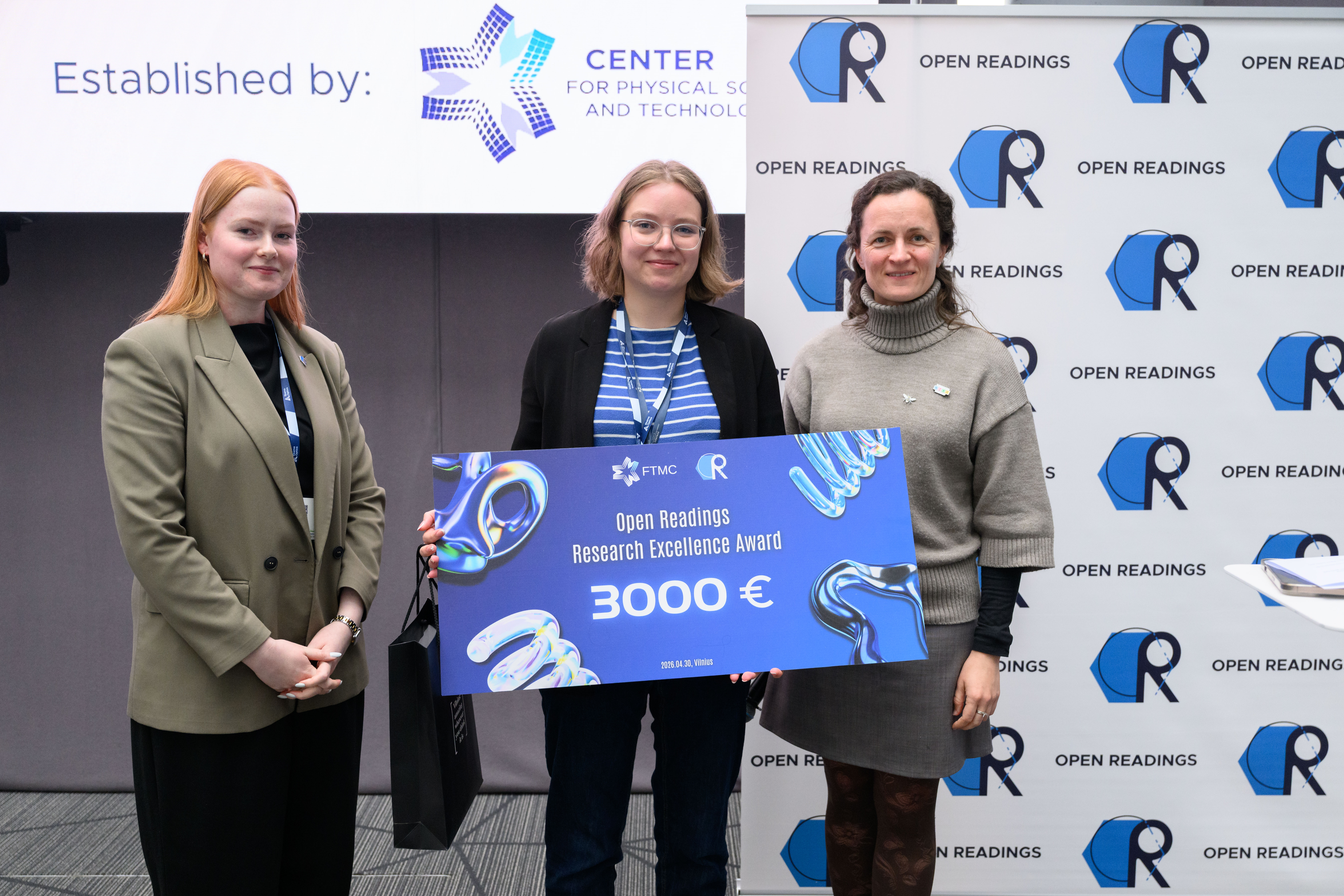
(Goda Grybauskaitė, Head of the Open Readings 2026 Organising Comitee, Aistė Štaupienė, and Dr Lina Mikoliūnaitė, FTMC Deputy Director for Science. Photo: Nail Garejev / Open Readings)
***
Bachelor’s / Master’s Research Award. Aistė Štaupienė (Department of Optoelectronics)
“The research focused on gallium arsenide bismide (GaAsBi), a semiconductor material suitable for near-infrared light sources. The work investigated the emission and efficiency of GaAsBi quantum structures, aiming to improve their quality and facilitate optimisation for optoelectronic devices.
The recognition highlights both individual and group research achievements and provides motivation to continue developing expertise in this field.”
“The aim of the Open Readings Research Excellence Award is to encourage young researchers to remain curious and continue their scientific careers. Part of the prize can be used to access FTMC’s research infrastructure, fostering new collaborations and supporting future scientific discoveries,” says Dr Lina Mikoliūnaitė, FTMC Deputy Director for Science.
We warmly congratulate all the winners and thank the organisers of Open Readings 2026 for a meaningful event!
Info: FTMC and Open Readings