- Home
- News & Events
- News
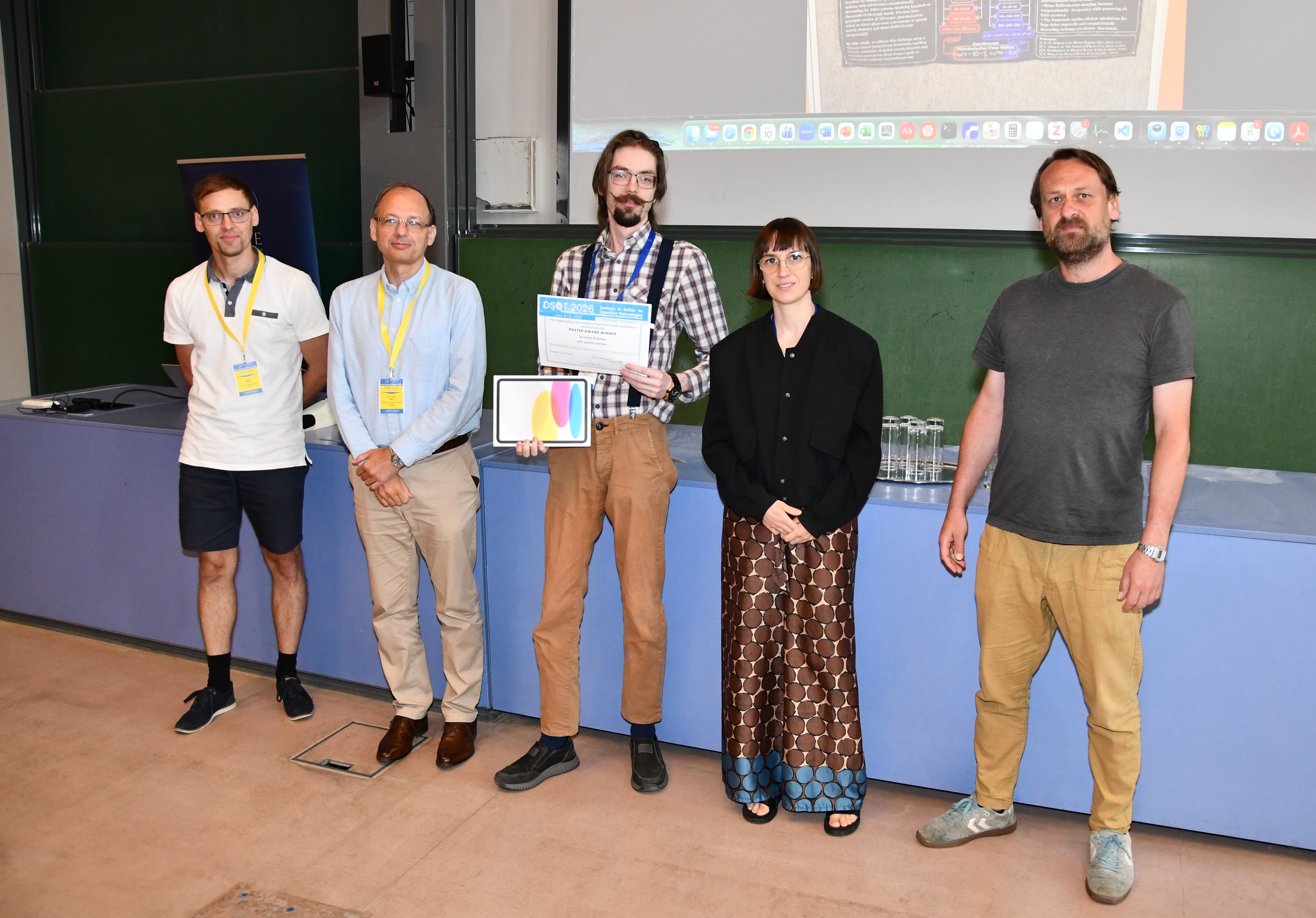
A Longstanding Scientific Challenge Solved by an FTMC PhD Student: Jorūnas Dobilas Wins Award at an International Conference
Jorūnas Dobilas, a PhD student in the FTMC Department of Fundamental Research, has received the award for best poster presentation at an international conference, Defects in Solids for Quantum Technologies, held in Budapest. His presentation, titled “Efficient First-Principles Modelling of Photoionisation Cross Sections: A Case Study of the NV Centre”, was co-authored by Dr Lukas Razinkovas.
Scientists worldwide are increasingly studying quantum defects – microscopic imperfections or irregularities in crystals. For example, if we imagine the structure of a diamond as a neatly arranged wall of bricks, a defect would be like a missing brick. Similarly, in crystals, atoms may be absent, creating such imperfections.
Although the word “defect” typically carries a negative connotation, in physics it can be highly beneficial. Due to their unique properties, quantum defects can absorb and emit light in distinctive ways, act as sensors, or serve as carriers of information. As a result, these imperfections are becoming integral to the development of advanced quantum technologies.
The FTMC team working on quantum defects consists of theoretical physicists who investigate and predict the behaviour of these defects and explore ways to control them more effectively. Without this fundamental theoretical knowledge, practical experiments would not be possible.
“At the conference in Budapest, I presented a new theoretical method in my poster that enables much faster calculations of the optical properties of quantum defects, and I applied it to one of the most well-studied defects – the nitrogen vacancy in diamond (where a nitrogen atom replaces a carbon atom and a neighbouring lattice site remains vacant).
This method allows for more advanced and significantly more accurate calculations of the electronic structure of quantum defects, which until now have required extremely large computational resources and were therefore rarely used. It can help predict the properties of new quantum materials more precisely, accelerate their application in quantum technologies, and deepen our understanding of the physics of these systems.
During the conference, my work attracted considerable interest from researchers in the field. Many emphasised that the proposed method addresses a problem the scientific community has faced for many years, and discussions at the poster were particularly active and engaging. It was especially gratifying that my work was recognised. The organisers also noted that this was an exceptional case – the Best Poster Award was granted to a theoretical study for the first time. Such recognition provides even greater motivation to continue research and develop new methods that could benefit the entire quantum materials research community,” says Jorūnas Dobilas.
Source: FTMC