- Home
- News & Events
- News
FTMC Physics Team Wins Challenge at Baltic Sea Security Hackathon
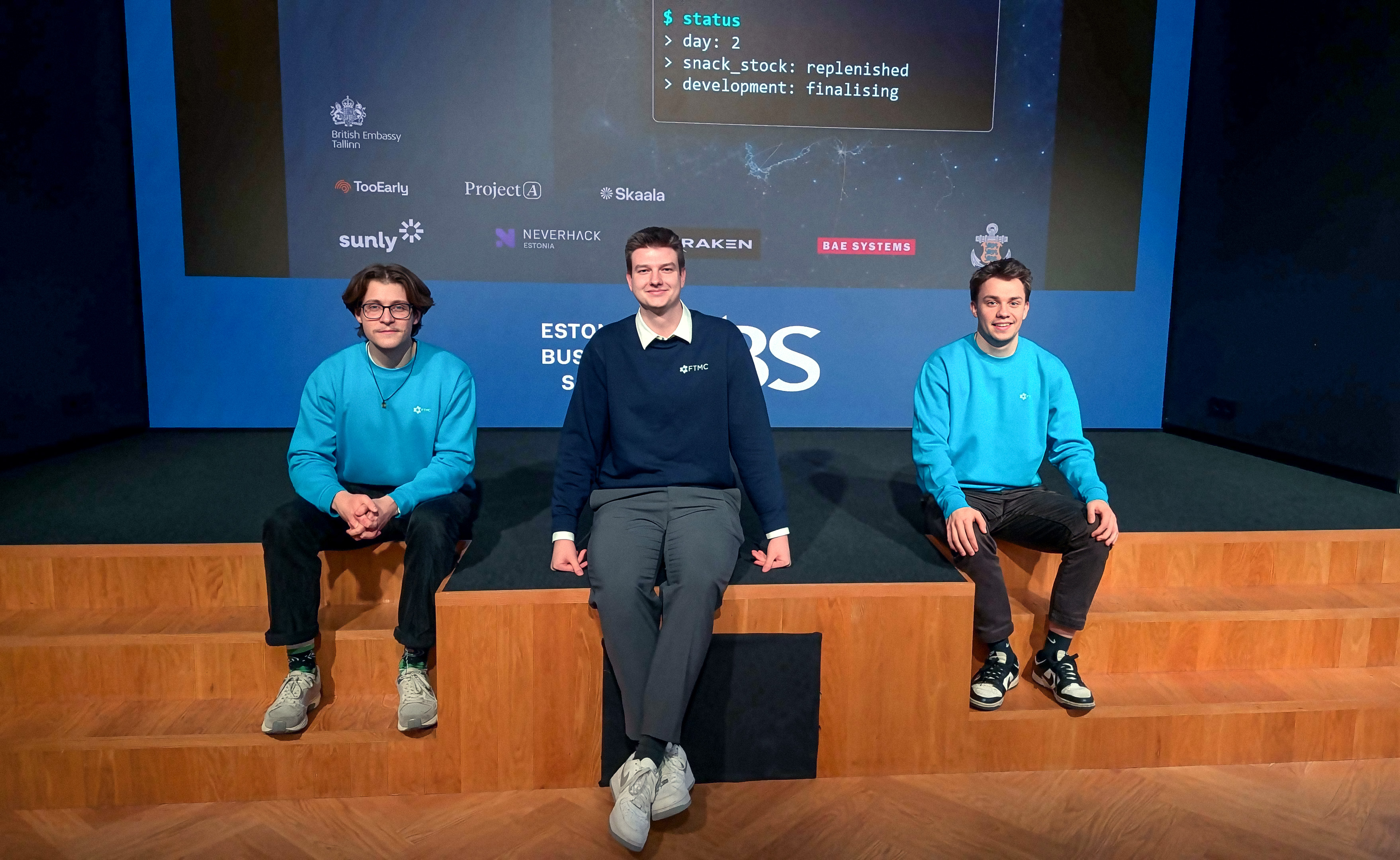
The FTMC team “SARdinės” has returned with an award from the Baltic Sea Security Hackathon organised by the British Embassy in Tallinn. Students Augustas Koklevičius, Mantas Krejaras and Justas Žuvelis won a challenge focused on the detection and interception of shadow fleet vessels in the Baltic Sea during the international event held in Estonia.
GPS/GNSS signal spoofing and jamming in the Baltic Sea are becoming increasingly serious issues, making vessels more difficult to identify and creating significant security risks. To address this challenge, the “SARdinės” team developed a solution that enables more accurate vessel identification. Their concept is based on Synthetic Aperture Radar (SAR) satellite data, which can detect ships regardless of whether they are transmitting Automatic Identification System (AIS) signals.
By combining SAR imagery with AIS data, it becomes possible to determine which radar-detected vessels are transmitting signals and which are not. The latter immediately become objects of interest, as they may belong to the shadow fleet, military forces, or vessels affected by signal interference. The team’s model provides preliminary information on the type, size, location, and direction of travel of such vessels. Demonstrating their solution using a SAR image of the Swedish coastline, the FTMC representatives showcased a system that clearly distinguished between identified vessels and those not transmitting AIS signals.
This marks the second victory for “SARdinės” in this type of competition. In October, they won the ship identification challenge at the Lithuanian Riflemen’s Union hackathon “Flaming Shield ’26: PROTECT THE SKY”. This time, however, the team enhanced its concept with an environmental dimension.
“When presenting the challenges, the organisers placed particular emphasis on the environmental threats posed by the uncontrolled activities of the shadow fleet. We therefore decided to expand our vessel detection system by using SAR imagery to identify oil spills in the Baltic Sea and to preliminarily determine which vessels may be responsible.
An oil spill alters the viscosity of seawater, making the surface smoother. In SAR radar imagery, an oil slick appears as an unusually dark area, while vessels located closest to the spill become the primary suspects.
Such evidence is especially important when a vessel is to be detained and held accountable,” explains team member Mantas Krejaras, Senior Laboratory Assistant at the Microwave Laboratory of FTMC Department of Physical Technologies.
(Video created by the “SARdinės” team explaining their concept)
Another team member, Justas Žuvelis, a Laboratory Assistant at the Semiconductor Optics Laboratory of FTMC Department of Optoelectronics, says that the victory came as an unexpected and very welcome surprise, while the event itself inspired new ideas:
“Over the course of two days, we had to learn a great deal very quickly, both about the problem itself and about how defence and security experts approach such solutions. Winning gave us confidence that our team can create something genuinely useful for solving real-world challenges within a short timeframe. It also generated several ideas for how we can further develop the project.”
“It is tremendously rewarding to work with such talented and hardworking young colleagues. Their curiosity sets an example for our entire laboratory,” says Dr Paulius Ragulis, Head of the FTMC Microwave Laboratory, commenting on the latest success of “SARdinės”.
“This recognition once again demonstrates that the issue is highly relevant not only to Lithuania but to all Baltic states.”
Source: FTMC