- Home
- News & Events
- News
Towards Safer Skies and Seas: All Three FTMC Teams Win Awards at the Defence Hackathon “Flaming Shield ’26”
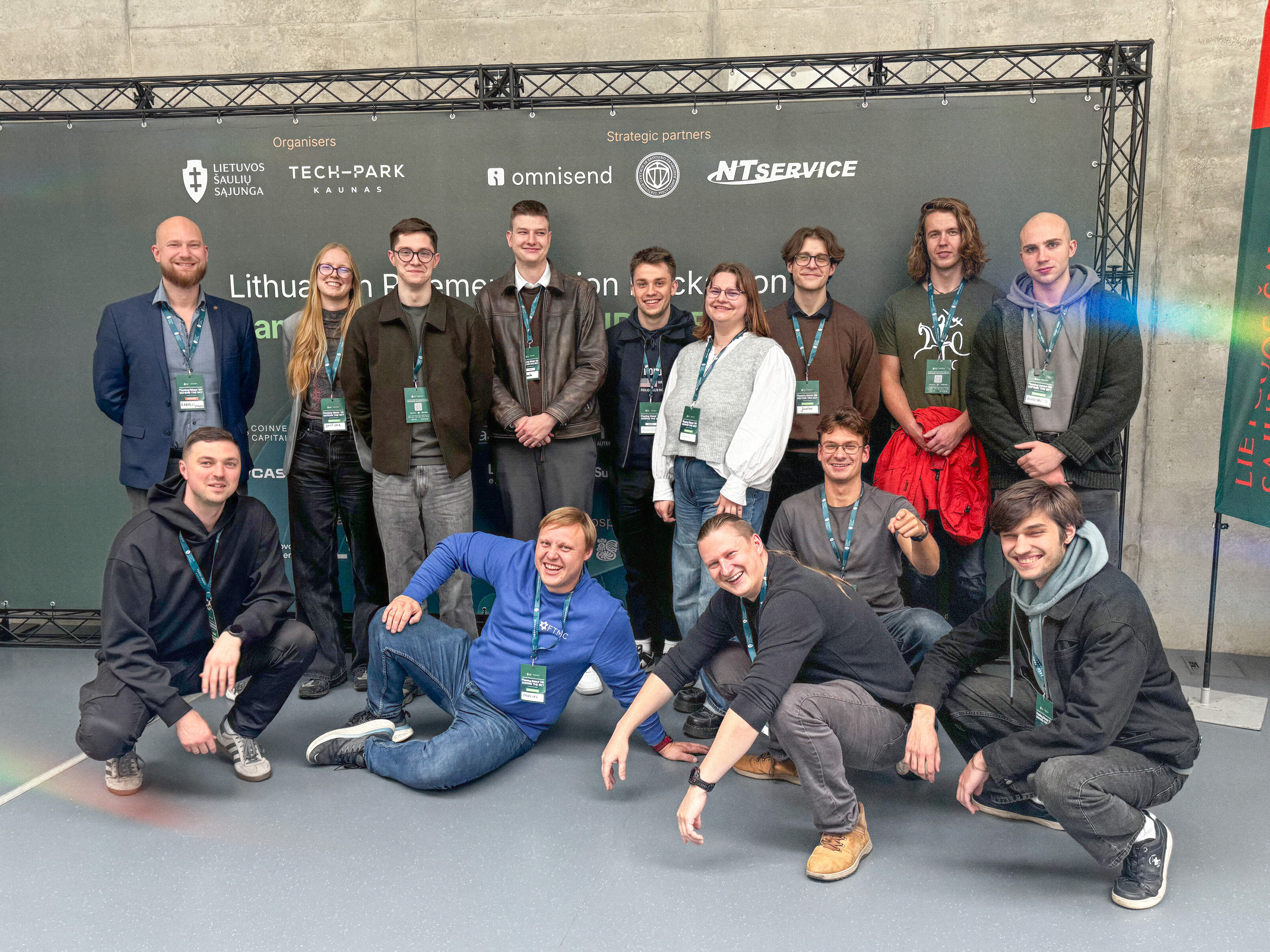
The hackathon “Fire Shield ’26: DEFEND THE SKY”, organised in Kaunas by the Lithuanian Riflemen’s Union and Tech-Park Kaunas, proved highly successful for all three FTMC teams taking part. Each secured either a winning or prize-winning position in their respective challenges.
Scientists and students from various departments of our Center, grouped into the teams Tx-Rx’ai, SARdinės and RADIS, developed, tested and presented defence technology solutions addressing current challenges in airspace management and maritime security.
All three teams received invitations to join Lithuania’s newly established specialised dual-use technology pre-accelerator. The programme is designed to help promising ideas advance further and find practical applications in both defence and civilian sectors. In addition, RADIS received a similar invitation to a European-level programme.
FTMC also contributed to the event through Dr Karolis Stašys, FTMC Defence Project Manager and innovation expert, who served as one of the hackathon mentors. Mentors helped teams refine their ideas more quickly, assess their potential and turn them into solutions capable of delivering real value.
Preventing Mid-Air Collisions
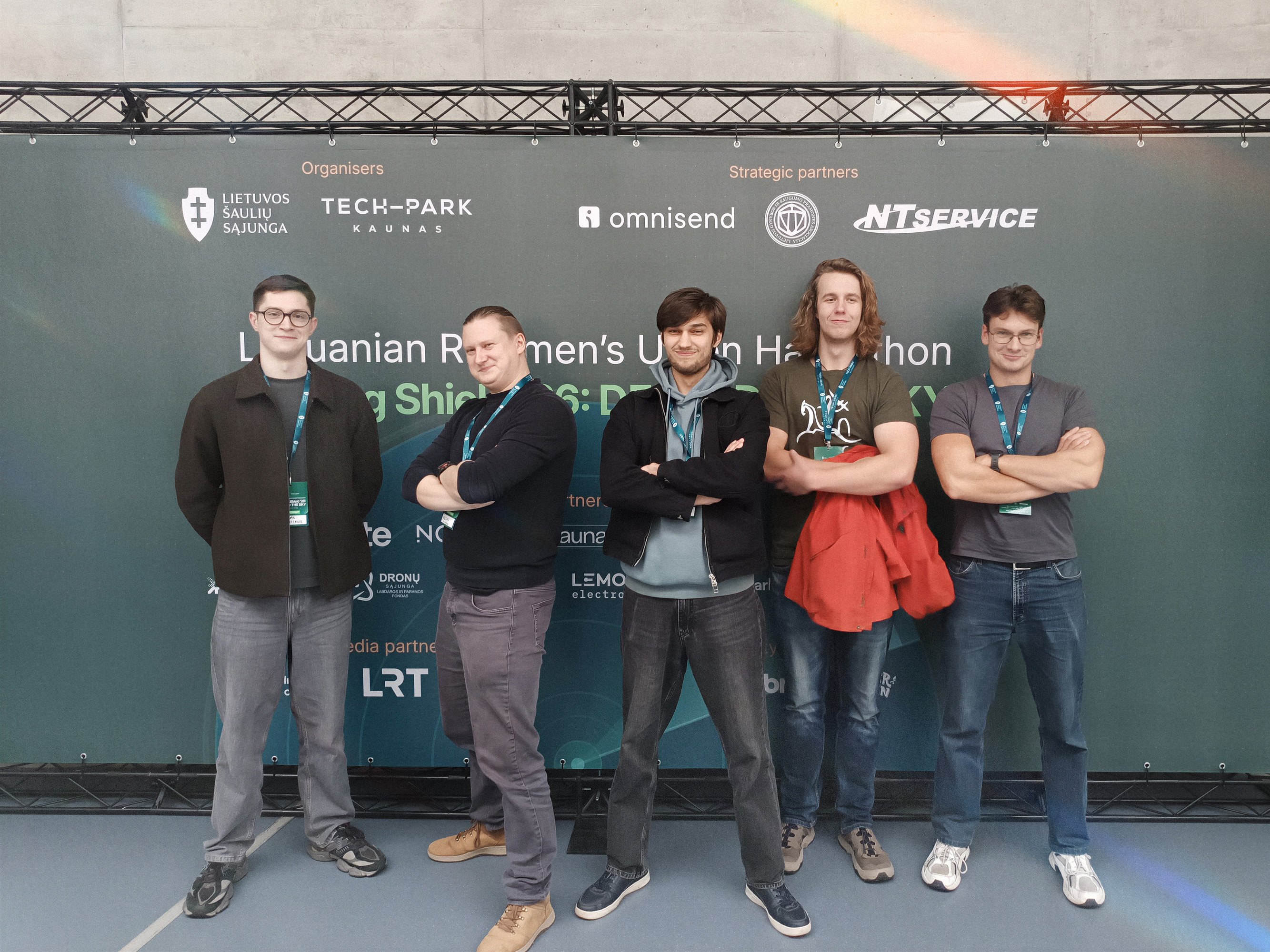
One of the hackathon challenges, “Drones and pilots in shared airspace: automated conflict management”, was sponsored by Oro Navigacija. First place was awarded to the FTMC physics team Tx-Rx’ai, consisting of Dr Vilius Vertelis, Dominykas Mačiulaitis, Jonas Petrokas, PhD student Šarūnas Mickus and Vakaris Šilys.
As the organisers noted, the use of unmanned aircraft is growing rapidly, increasing the risk of collisions with manned aircraft. At present, drones and conventional aircraft are largely managed separately, meaning there is neither a common situational picture nor an automated conflict-prevention mechanism. Participants were therefore tasked with developing a solution that would enable both manned and unmanned aircraft to operate safely within shared airspace, with potential conflicts identified and resolved before becoming dangerous.
Using AI-assisted programming tools, the winning Tx-Rx’ai team developed a prototype application that utilises publicly available flight data, similar to that provided by services such as FlightRadar. The system not only monitors current aircraft positions but also predicts where aircraft will be after a given period of time. It then calculates whether a drone and an aircraft may come dangerously close in the future. In aviation, this is known as a loss of separation, a situation that can ultimately lead to a collision.
“We demonstrated the solution through a simulation. Imagine a drone carrying out routine tasks such as inspecting power lines or monitoring forests and infrastructure. At the same time, a light aircraft such as a Cessna is flying in the same airspace. Our system continuously evaluates the trajectories of both aircraft and provides advance warning of a potential conflict.
Importantly, the system is not designed to control the drone automatically. Instead, it functions as a decision-support tool for the operator. If a collision risk is detected, the drone operator receives warnings and recommendations, such as altering the route, suspending the flight or descending to a lower altitude. This helps avoid hazardous situations before they arise.
Looking ahead, we also see broader possibilities. If the drone operator failed to respond to warnings, or if technical issues prevented further control of the drone, information about the drone’s location could theoretically be relayed to the aircraft pilot. The pilot would then be aware of the obstacle and could take additional safety measures,” explains team leader Dr Vilius Vertelis.
According to the scientist, the solution’s greatest strength lies in its prediction algorithm. Real-time data are not always accurate or continuous. However, by using previous coordinates and an aircraft’s direction of travel, the system can estimate future positions with sufficient accuracy. This allows potential risks to be identified earlier and gives operators more time to react.
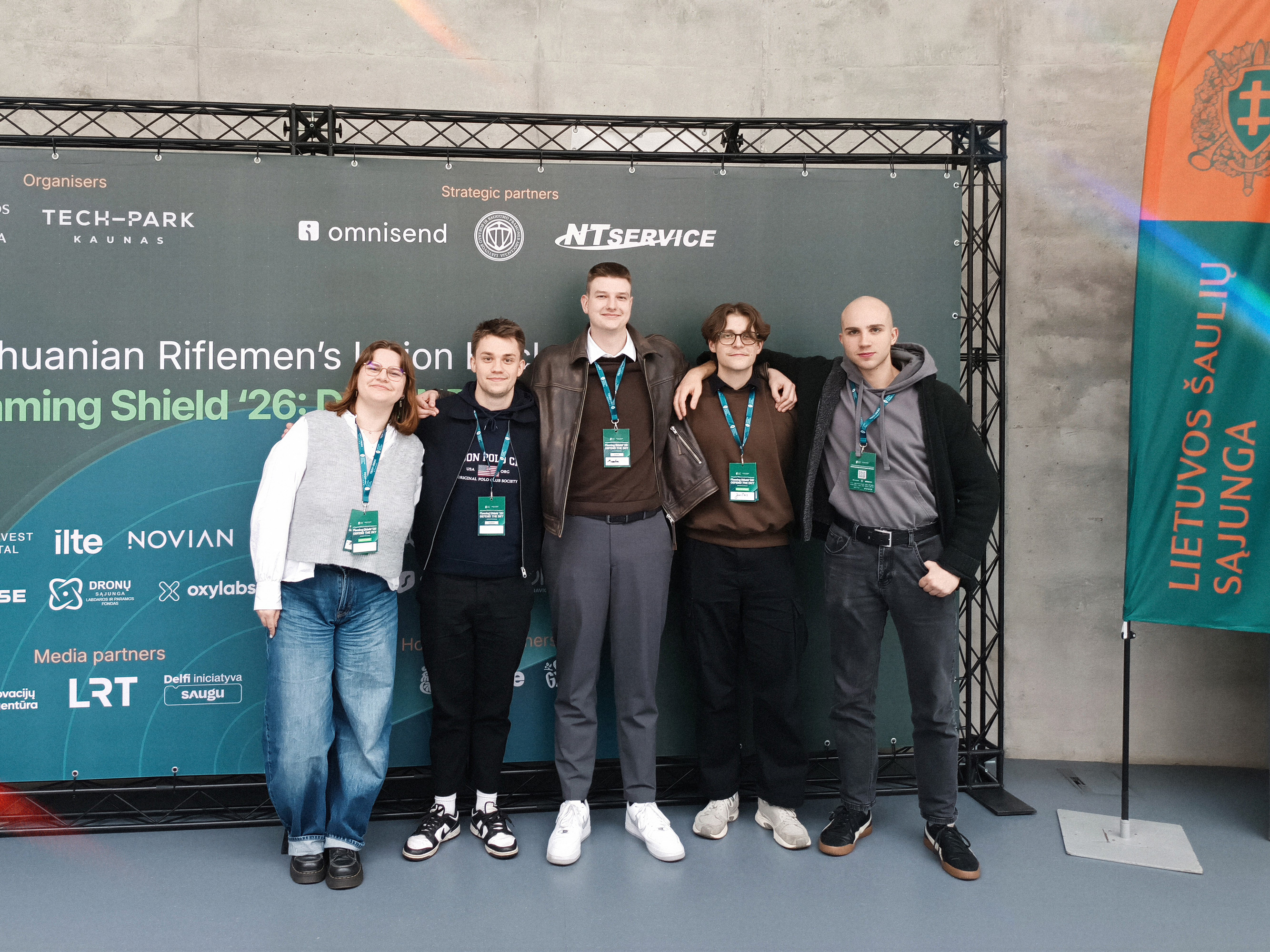
(SARdinės: Kristina Miliauskaitė, Augustas Koklevičius, Mantas Krejaras, Justas Žuvelis and Augustas Jonas Rastenis. Photo: FTMC)
A Dual Tracking System
Another hackathon challenge in which FTMC excelled was “Navigation without GPS: identification solutions”.
GPS / GNSS signal spoofing and jamming are becoming a genuine concern in the Baltic Sea. Hostile actors can disrupt maritime operations and even create security risks by making vessels difficult to identify. Problems may also arise when ships deliberately conceal themselves by manipulating the signals they transmit. Participants therefore had to develop a solution capable of accurately identifying vessels operating in Lithuania’s territorial waters and exclusive economic zone.
The challenge was won by the FTMC team SARdinės, comprising students Augustas Koklevičius, Mantas Krejaras, Kristina Miliauskaitė, Augustas Jonas Rastenis and Justas Žuvelis. The team’s name is derived from synthetic-aperture radar (SAR), a technology used on Earth-observation satellites. SAR systems transmit signals towards Earth’s surface, receive the reflections and use them to create images. By continuously scanning large areas, satellites provide imagery that reveals both land and maritime environments.
The SARdinės solution combines SAR satellite imagery with Automatic Identification System (AIS) signals. Team representative Mantas Krejaras, Senior Laboratory Assistant at FTMC Microwave Laboratory, explains:
“All ships are required to transmit AIS signals that provide information about their identity and location. However, some vessels switch these signals off, or the transmissions may be blocked by external interference, making conventional tracking impossible.
Our idea was to combine two sources of information. The first consists of SAR satellite data, which allow objects at sea to be detected regardless of whether they transmit AIS signals. In such imagery, the sea surface usually appears dark, while vessels stand out as bright points. The second source is an AIS database containing records of vessels transmitting identification signals.
By comparing these datasets, it becomes clear which radar-detected vessels are transmitting AIS signals and which are not. Ships with AIS transmissions can be used to train and improve the identification model. Meanwhile, objects visible in radar imagery but absent from AIS records immediately warrant additional attention. They may belong to the shadow fleet, military vessels, or ships that have disabled their signals for various reasons, including GPS interference.”
The team’s model generated preliminary information for such targets, including the likely vessel type, approximate size and coordinates at the time the image was captured. As Mantas notes, SAR imagery is not highly detailed, with a single pixel often representing around 15 metres. Nevertheless, it is more than sufficient to determine whether a vessel is present and to estimate its general category.
For their demonstration, the team focused on an area of the Baltic Sea near the Swedish coast. On the interface, vessels whose AIS signals matched radar observations were highlighted in green, while objects detected by satellite imagery but lacking AIS transmissions were marked in red. Clicking on such an object allowed operators to access preliminary information generated by the model.
A Technology Already Recognised by the Lithuanian Navy
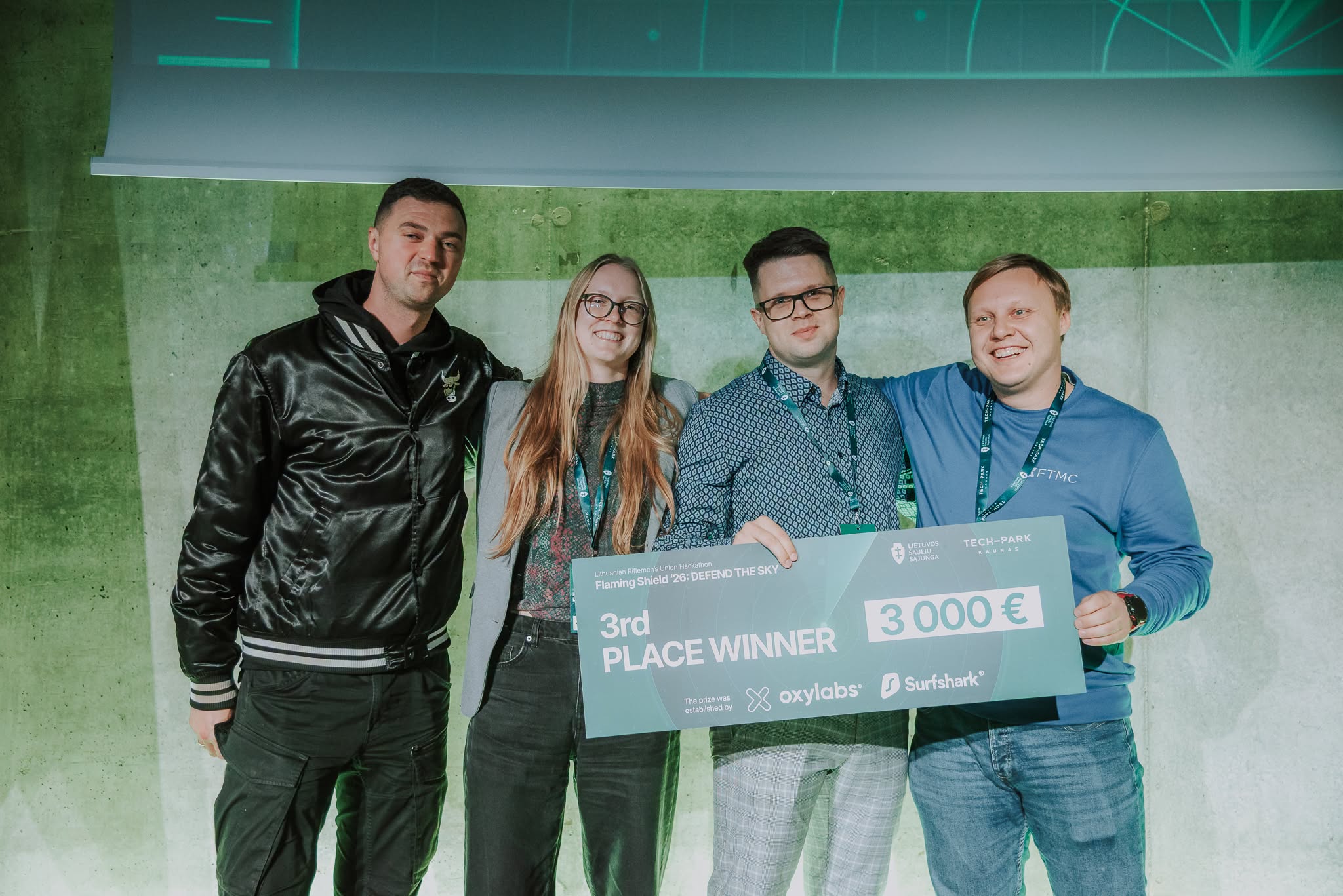
Another FTMC team competing in the same challenge was RADIS, consisting of Dr Paulius Ragulis, PhD student Justina Žemgulytė and Dr Audrius Drabavičius. RADIS (Radar Detection and Identification System) is a vessel radar-signal detection system previously developed at FTMC Microwave Laboratory to tackle the same issue of ships that spoof or suppress AIS signals.
Its approach, however, is different: RADIS detects radar emissions. All ships, including those operating covertly, rely on radar for navigational safety. These systems emit microwave-frequency radiation, leaving behind what can be described as an electromagnetic signature. The FTMC-developed system passively detects and collects these emissions. Once a radar signal is captured, a trained AI model is used to identify the vessel, displaying its name on screen together with a confidence score. If the signal originates from an unknown vessel, the system switches to a fallback mode and provides a parametric visualisation of the detected signal, enabling operators to determine the likely radar type involved.
As a result, even if an adversary transmits false AIS information, the system can reveal that the vessel in question is in fact a different ship. The capability has already been demonstrated to the Lithuanian Navy: the system was successfully tested aboard one of its vessels in the Baltic Sea.
Although RADIS did not surpass SARdinės in the challenge, the team was still recognised for its achievement, securing third place overall among the 43 teams participating in the hackathon.
“We brought RADIS to the event on the first day, when a technology exhibition was held alongside the hackathon. Visitors were able to see the system in operation. During the weekend, we demonstrated its capabilities through presentations and imagery,” says Dr Paulius Ragulis.
Most members of both teams competing in this challenge are representatives of FTMC Microwave Laboratory, led by Dr Ragulis. He praises the creativity and achievements of his colleagues:
“I believe one of the key factors behind our success is the large number of talented young people who have joined the laboratory in recent years. They have brought fresh ideas, energy and motivation to the team. We have young researchers who work highly professionally, rapidly and creatively, allowing us to complete many tasks far more efficiently than before.
Ultimately, it is a strong team and people who can learn quickly and collaborate effectively that make it possible to deliver projects like these successfully and achieve strong results in both science and technology.”
By Simonas Bendžius