- Home
- News & Events
- News
FTMC PhD Student Justina Žemgulytė Reaches NATO Competition Finale: “An Unforgettable Experience”
Justina Žemgulytė, a PhD student at the FTMC Department of Physical Technologies, took part in the finale of the NATO Science and Technology Organisation (NATO STO) competition Women and Girls in Science 2026 Challenge in Brussels. She became the first Lithuanian to reach this stage. The competition is aimed at young women – students, early-career researchers, and anyone interested in pursuing a career in science, technology, and defence.
In the finale, Justina presented a microwave-based wireless energy transmission technology that could help cities cope in emergency situations. Although she missed out on a prize-winning place by a small margin in the judges’ vote, the physicist says the event provided her with unforgettable impression and valuable experience.
“The organisers prepared a rich two-day programme for us. On the first morning, we met at NATO Headquarters, where we were introduced to NATO’s structure, departments, and voting procedures. We also learned in more detail about the NATO articles and what they mean – I was surprised there are so few of them.
We also had the opportunity to meet representatives from our own countries. I had the honour of chatting over coffee with Lithuania’s Ambassador to NATO, Darius Jauniškis, and seeing how Lithuanians work in Brussels,” Žemgulytė shares.
The programme continued with a visit to the Microsoft headquarters, where finalists took part in a Strategic Foresight workshop. Working in small groups with experts, they discussed scenarios titled “A Day Without…”. This was also the competition task – to describe how scientific solutions could help a city if, for instance, connections with space technologies were suddenly lost, there were widespread power outages, antibiotics became unavailable, the internet disappeared, or access to a vast area became impossible due to ionising radiation.
“We tried to better understand what happens in such situations – what stops functioning first and what the consequences are, including primary, secondary, and tertiary effects. Then we worked together to identify solutions that could help prevent disasters or allow us to be better prepared,” Justina recalls.
.png)
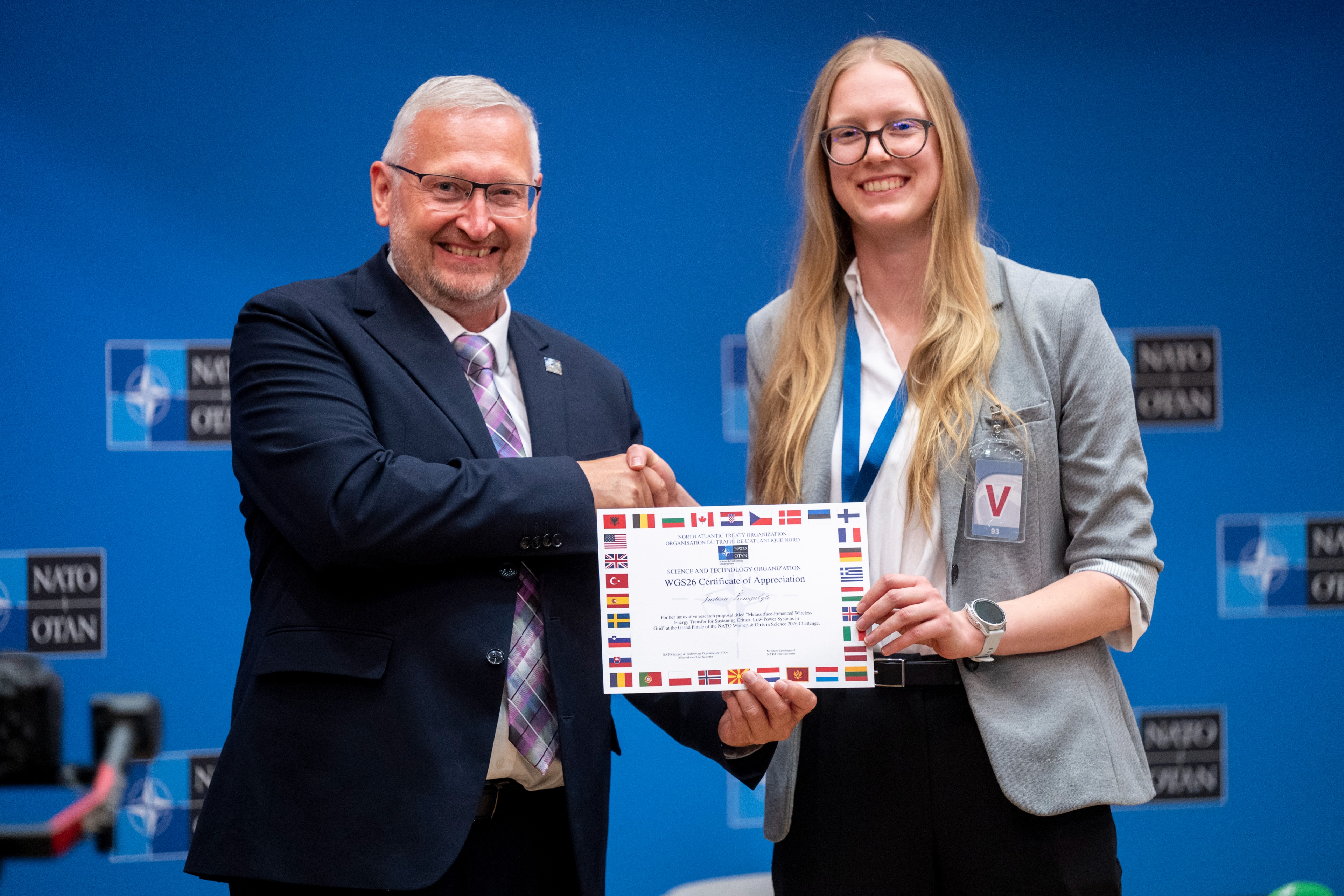
(PhD student Justina Žemgulytė. Photo: NATO STO)
The following day saw the NATO STO competition finale. The participants were welcomed by NATO Chief Scientist Steen Søndergaard, met the judges, and then presented their research ideas.
“It must have been the hardest for the judges, as all the presentations were strong. What impressed me most was the presentation by UK scientist Dr Ana Cooke on antimicrobial peptides that could replace antibiotics. I was also struck by the system cyber security assessment methods proposed by Germany’s Anica Krügger, which could help predict the next step of attackers in the event of a breach. Another memorable talk was by Sarah Burrows from the United States, who discussed restoring disrupted communications using terrestrial mobile stations and ensuring security with quantum technologies.
Although my presentation was not selected among the top three, I am still happy with my achievement. I felt that the audience found my idea interesting, and FTMC and my friends are proud of me – which is the greatest recognition.
This competition deserves much wider attention, and more women – especially younger ones – should be encouraged to take part, because the experience is truly unforgettable,” says Žemgulytė.
Source: FTMC