- Home
- News & Events
- News

Among the World’s Top 12: FTMC Physicist Justina Žemgulytė Reaches NATO Competition Final
Imagine that in your city or country one of five undesirable scenarios suddenly occurs: communication with space technologies is lost, electricity shuts down, antibiotics become unavailable, the internet disappears, or a vast area becomes inaccessible due to radiation.
How could scientific solutions help in such situations? The NATO Science and Technology Organization (NATO STO) invited ideas on this topic by launching the international competition “Women and Girls in Science 2026 Challenge”. The competition is aimed at students, early-career researchers, or anyone interested in pursuing a career in science, technology, and defence.
The final will take place on 9 June in Brussels, and for the first time, among the twelve selected top participants from around the world, there will be a Lithuanian – Justina Žemgulytė, a PhD student at the FTMC Department of Physical Technologies.
She will present to the WGS2026 panel a radio-wave transmission technology that would enable wireless energy delivery to low-power devices or sensors, which are critical for infrastructure during emergency situations. This concept is not only part of the competition but is also closely linked to Justina’s doctoral research.
A Bad Day for Northern Europe
“I must admit, I tend to view competitions exclusively for women somewhat sceptically, as I would prefer to be seen and evaluated first and foremost as a person and a professional – not as a man or a woman, especially in the workplace. However, my department head, Dr Virginijus Bukauskas, encouraged me to take part, and my colleagues were also very supportive,” Justina recalls.
She chose the scenario “A Day Without Energy”: on a cold January morning, Northern Europe is hit by an unexpected crisis – two major power transformers fail almost simultaneously. They stop supplying electricity to the Nordic grid, while the remaining system becomes overloaded. As a result, other parts of the network begin to collapse, disconnecting one after another.
Natural conditions worsen the situation. The sea is unusually calm, rendering wind turbines nearly ineffective. Winter days are overcast, so solar power provides minimal support. The outcome – 24 hours without electricity, communication, or emergency response.
The NATO STO challenge for this scenario is to design new decentralised energy generation and storage systems that are more resilient to local failures. It also involves considering the need for critical systems to operate on alternative (non-electric) energy sources, such as emergency transport and communication systems.
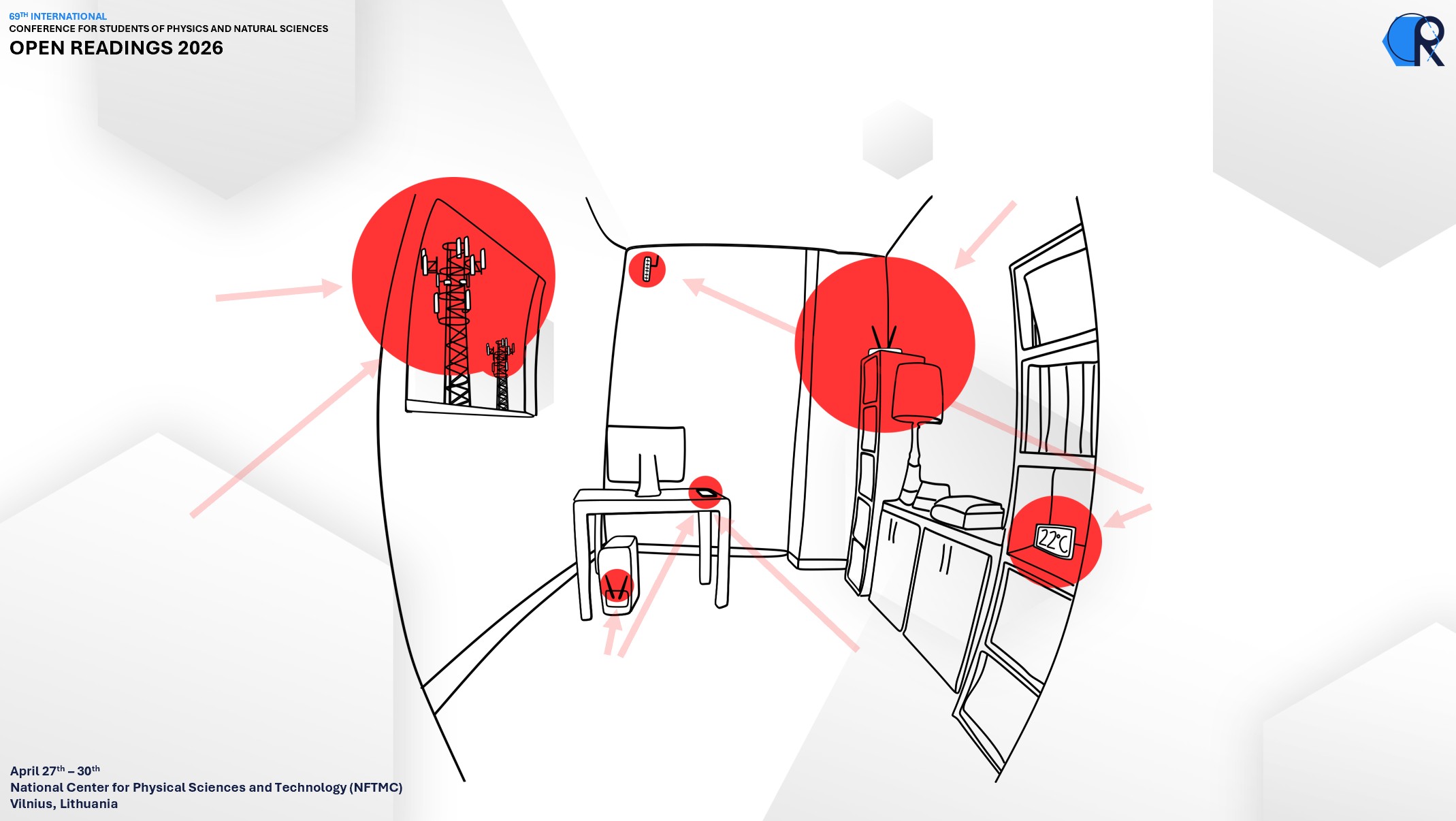
(Sources from which microwave signals reach us every day. Picture: FTMC / Open Readings)
Electricity “From the Air”
“I had the idea to apply my research field – harvesting energy from the environment using microwave radiation. Every day, hundreds of microwaves reach us from wireless routers, smartphones, or Bluetooth devices. These signals simply float in the air, so why not capture them and convert them into electricity?” says the physicist.
To achieve this, Justina developed (and continues to refine) a radio-wave energy harvesting system: microwaves emitted by various devices are captured by specialised antennas, converted into alternating current (AC), then into direct current (DC), and finally transmitted to a sensor or another low-power device.
The same principle can be used not only for collecting microwaves but also for transmitting them. For the NATO STO competition, Lithuanian scientist presented radio-wave energy transmission systems – here, more directional antennas are used. These can focus and narrow the beam, minimising energy loss as it travels from the source to the device. The energy reaching its target then powers the device.
Where would the “fuel” – microwaves – come from? According to Žemgulytė, possible sources include generators, car batteries, or other power supplies. However, given the efficiency limits of current energy systems, this may not always be sufficient:
“At the Earth’s surface, sunlight is often blocked by clouds, so solar collectors could be placed above Earth’s orbit. Since we cannot run a cable down to Earth, radio waves could be used to transmit the energy. In fact, such systems are already under development, and I believe they will become a reality within the next 20 years.”
The scientist emphasises that her technology cannot yet replace the power grid – when harvesting energy, the system captures only microwatts (although this is sufficient for sensors). On the other hand, when transmitting energy, higher power levels are possible depending on the microwave source.
“One possible application for radio-wave energy transmission systems is monitoring radiation levels after an accident: it is unsafe to send people, cables may be damaged, and information is unavailable. With small sensors equipped with our antennas, this problem could be solved. The sensors could operate, recharge, and transmit data back.
Another example is sensors on bridges, used to monitor structural stability and load,” says Justina.
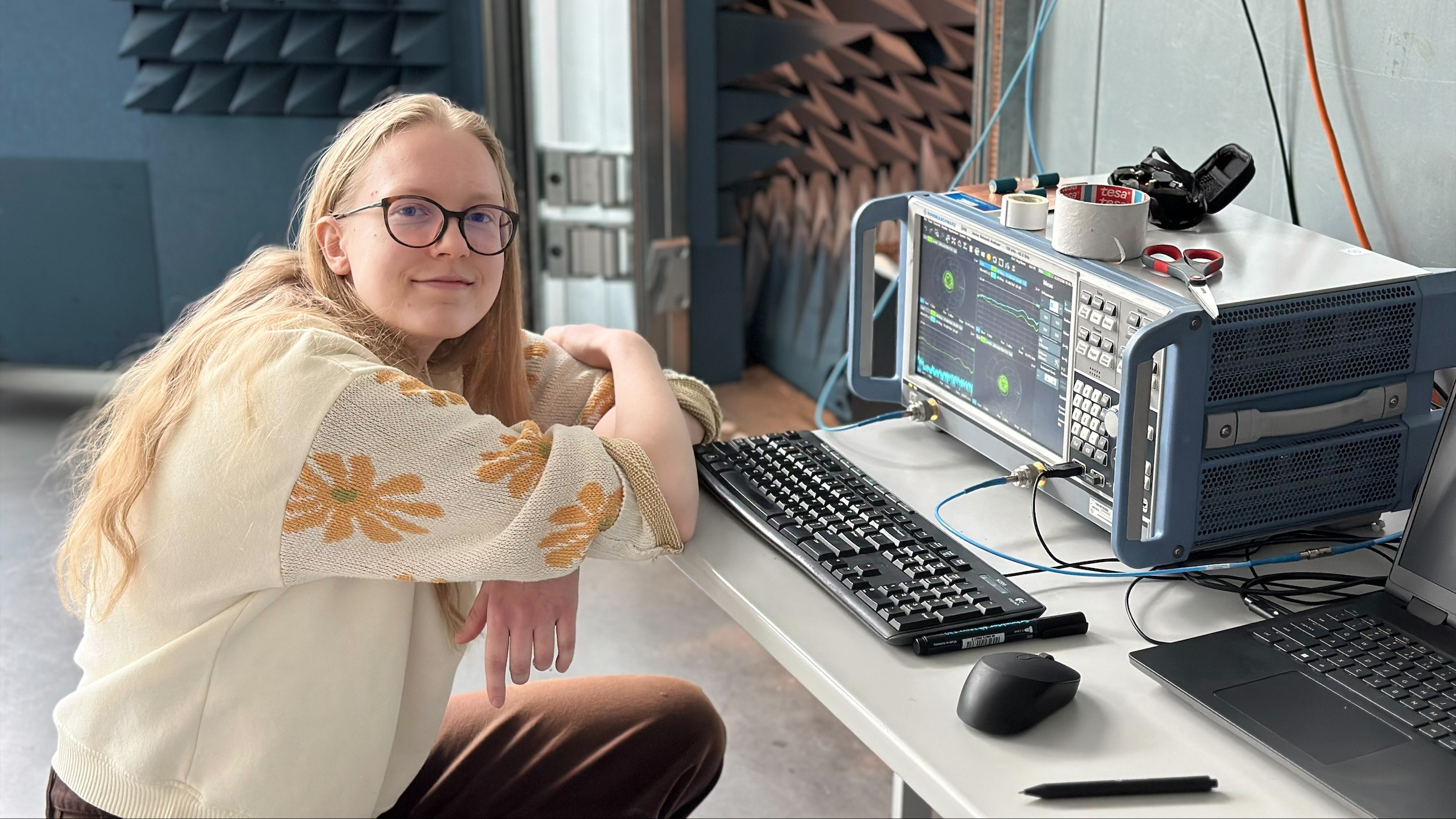
(PhD student Justina Žemgulytė. Photo: FTMC)
First Experiments Showing Results
What the physicist describes is not merely theoretical – the FTMC PhD candidate is developing radio-wave harvesting technology as part of her dissertation.
“We collaborate with Ukrainian colleagues from the V. I. Vernadsky Institute of General and Inorganic Chemistry, who produce special ceramic materials from which we build antennas. Interestingly, most researchers develop vertical antennas, but we came up with a flatter ceramic design. It takes up less space without compromising performance.
A single small antenna often does not collect enough energy, so we are developing antenna arrays – this increases the effective area and allows us to harvest more electricity,” says Žemgulytė.
Experiments are conducted in the Microwave Laboratory of FTMC Department of Physical Technologies – inside an anechoic chamber lined with carbon-fibre spikes on the walls, floor, and ceiling. These absorb microwaves, and external electromagnetic radiation does not enter the chamber. This allows precise testing and characterising of electronic devices.
In her experiments, Justina used a microwave source slightly more powerful than a typical wireless router and placed her radio-wave harvesting system with a dielectric antenna array one metre away. She measured an output of 56 microwatts of electrical power.
“This is not a lot, but there are already sensors that could operate with such power. Moreover, energy can be accumulated using power management modules. These gradually charge a capacitor, increasing its voltage. Once a set threshold is reached, the circuit automatically opens and allows energy to flow to the connected device.
Energy stored in the capacitor can power devices requiring higher output. During the experiment – under the same conditions, using a power management module and storing energy in a capacitor – more than 600 microwatts of power were generated. In this case, the capacitor was charged for 1.6 seconds. If the capacitor capacity were larger and charged longer – for example, several minutes or even tens of minutes – the generated power could be even higher,” explains the FTMC PhD student.
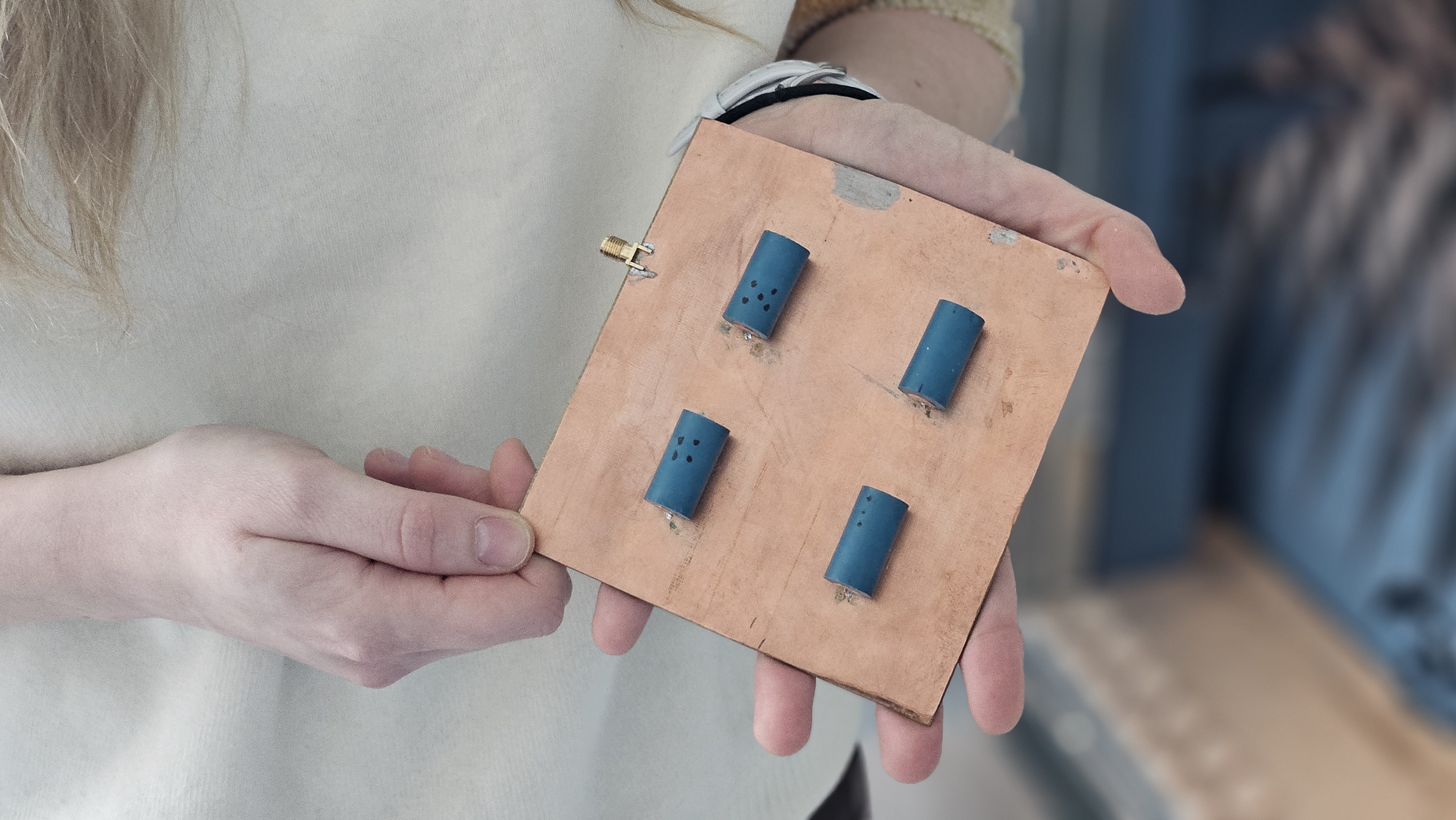
(An array of microwave-absorbing antennas. Photo: FTMC)
Initial Recognition
According to Žemgulytė, she and her colleagues are currently tackling several key challenges. The first is improving the conversion of AC into DC. Typically, low-power rectifying circuits use Schottky diodes, but few suitable options exist for such low-power, high-frequency conditions. These diodes act as switches – allowing current to flow in one direction while blocking it in the other – but some energy is lost in the process. Minimising these losses is crucial when working with low power.
Another issue is impedance mismatch between system elements (impedance – the resistance of a circuit or medium to alternating current or electromagnetic waves), which causes part of the energy to reflect, leading to additional losses. Justina is therefore improving impedance-matching circuits that effectively “trick” the waves into flowing further without reflection.
A further challenge is ensuring that energy harvesters can operate over longer distances from the microwave source. As distance increases, the signal weakens, spreads out, and some energy is absorbed by atmospheric moisture. Possible solutions include improving antenna design to better focus and narrow the beam and using metasurfaces – fine metallic structures that enhance antenna performance and direct energy precisely where needed.
The energy harvester concept was already recognised on 30 April at the largest natural sciences student conference in the Baltic States – Open Readings 2026, where Justina received the award for Best Oral Presentation in Applied Electrodynamics. On 9 June, at the NATO STO competition final, she will face her first international test – presenting her work to high-level experts from around the world.
“This invitation came as a surprise, as I wrote the application simply for my own enjoyment. I feel some pressure, as I am representing FTMC, Lithuania, and in a sense – all women. Still, I try not to take it too seriously – it is an excellent catalyst for my growth.
The greatest influence on who I am today has been the support and guidance of my supervisor, Dr Paulius Ragulis. His belief in me, genuine engagement, and ability to inspire me to aim higher have left a lasting mark on my professional path – for which I am deeply grateful,” says the physicist.
Written by Simonas Bendžius