- Home
- News & Events
- News

Where Does Harmful Black Carbon in the Air Come From? New Insights Earn Agnė Miderytė a PhD in Natural Sciences
Aerosols are tiny particles suspended in the atmosphere that can be transported over vast distances by air masses, travelling thousands of kilometres from their emission sources. As a result, they can have a significant impact on air quality, human health, and the climate.
In urban areas, a substantial proportion of aerosols consists of black carbon, which is produced through the combustion of fossil fuels and biomass. However, accurately determining how much black carbon originates locally and how much is transported from other regions remains a considerable challenge.
This question was tackled by Dr Agnė Minderytė, a physicist at the FTMC Department of Environmental Research, who successfully defended her doctoral dissertation entitled "Integrated Assessment of Long-Range Air Mass Transport Effects on SourceApportioned Aerosol Black Carbon and Aerosol Properties in Contrasting Environments" (academic supervisor: Dr Steigvilė Byčenkienė).
In her dissertation, Agnė investigates how long-range air mass transport affects submicron aerosol particles (roughly the size of a bacterium), particularly black carbon, across contrasting environments: the cities of Vilnius and Warsaw, as well as regional background sites by the Baltic Sea in Preila and Hyltemossa (southern Sweden).
“The study combines in situ measurements, black carbon source apportionment methods, and atmospheric transport modelling using the FLEXPART and HYSPLIT models in order to distinguish how much of the black carbon concentration measured in urban environments is generated by local emission sources and how much is transported over long distances by air masses,” says Dr Minderytė.
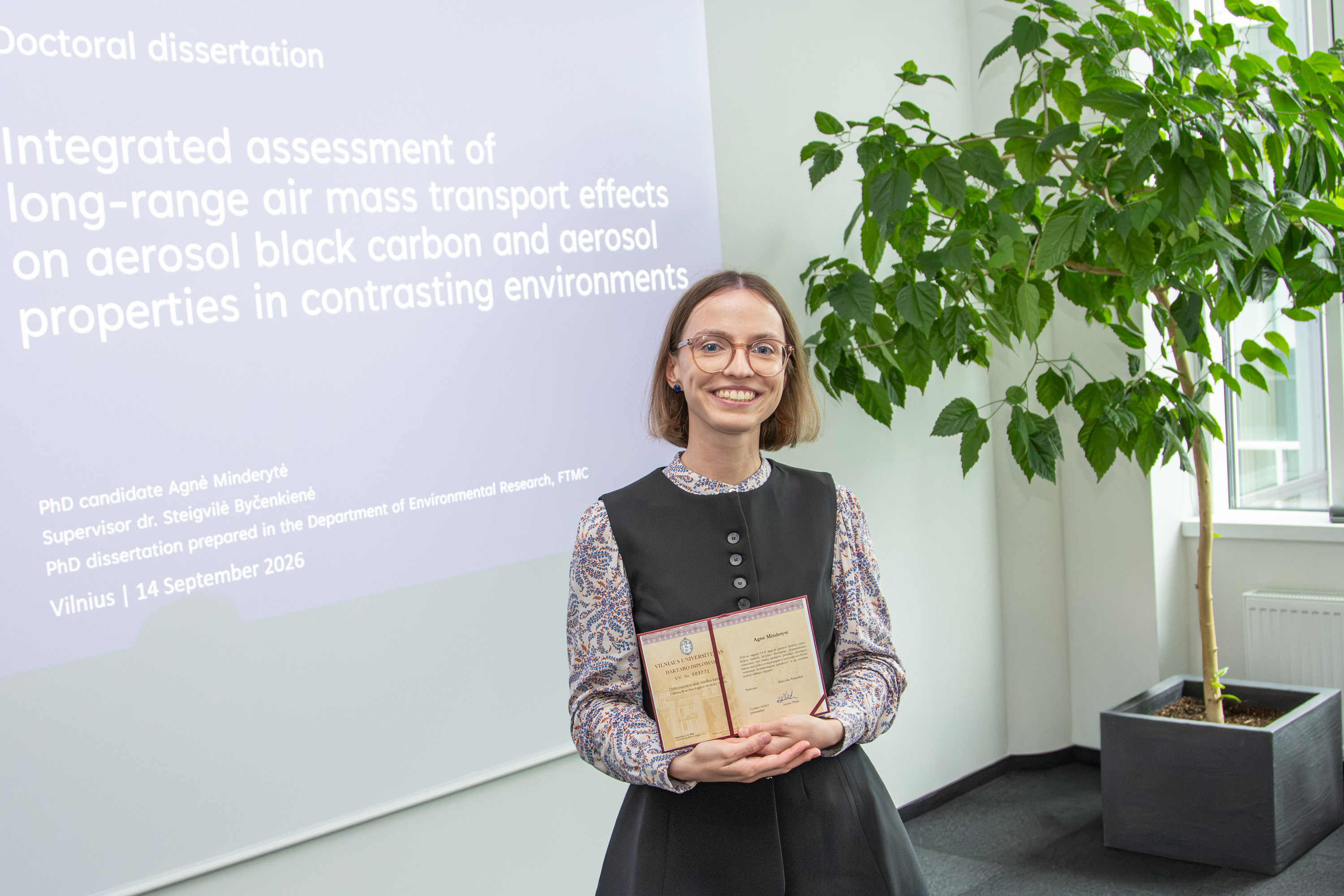
(Dr Agnė Minderytė. Photo: Gabrielius Mackevičius / FTMC)
According to the physicist, her research will not only expand scientific understanding of the influence of long-range air mass transport on particulate matter, but will also help the wider public better understand how aerosol particles released into the atmosphere can be carried great distances and affect air quality far away from their original sources.
“The results are directly relevant to air quality and public health. Black carbon is one of the most harmful components of aerosol particles, and this work demonstrates what proportion of urban pollution originates from local sources, meaning what can realistically be reduced through local measures such as regulating transport or residential solid-fuel heating, and what proportion arrives from other regions.
This is important both for municipalities and policymakers planning air pollution mitigation measures, and for the broader climate context, since aerosol particles, particularly light-absorbing black carbon, directly influence the Earth's radiative balance, one of the greatest uncertainties in climate projections. In other words, the study helps us better understand to what extent urban air quality depends on human activities within a city and to what extent it is influenced by processes occurring beyond its boundaries,” emphasises the newly graduated Doctor of Natural Sciences.
According to Minderytė, the study's main achievement and key novelty lies in the successful application of a method that combines experimental measurements with atmospheric modelling data. Together with her colleagues, she used this approach to determine which share of black carbon in cities is produced locally and which share is transported from other regions by air masses:
“I also consider it particularly valuable that our results demonstrate that, despite the considerable influence of local sources, urban air quality during the cold season is still strongly affected by long-range transport. On average, this contribution accounts for 46% in Vilnius and 53% in Warsaw.”
You can read Agnė's dissertation by clicking this link.
Source: FTMC