- Home
- News & Events
- News
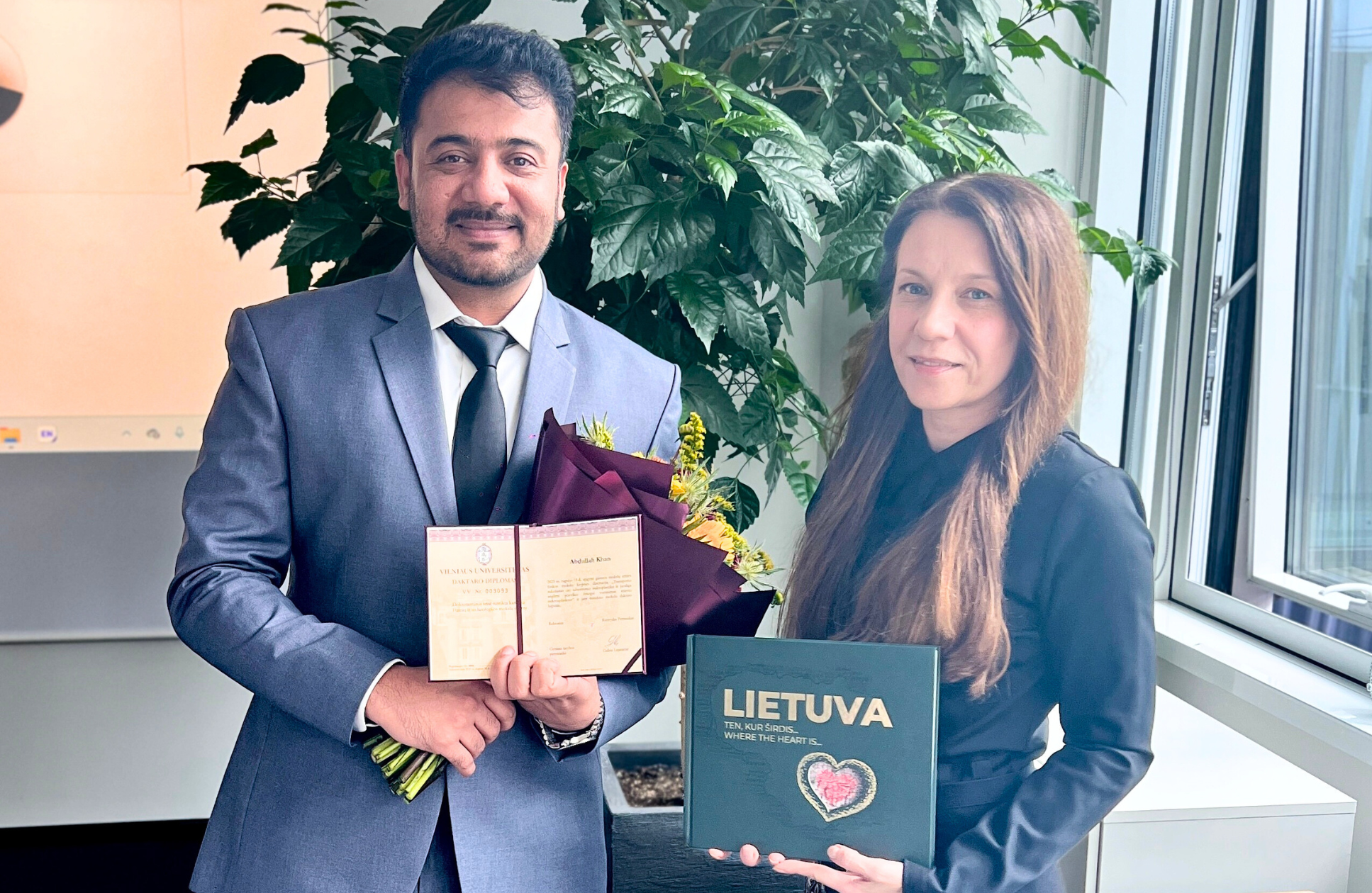
Thuja Trees Help Fight Microplastics: Environmental Researcher Abdullah Khan Defends His PhD
Another significant piece of work by our researchers has resulted in a successfully defended dissertation! On 18 September, the title of PhD was awarded to Abdullah Khan, physicist at the FTMC Department of Environmental Research.
The topic of his thesis is “Assessment of Human Exposure to Traffic-related Microplastics and Black Carbon in Urban Microenvironments” (academic supervisor: Dr Steigvilė Byčenkienė).
Congratulations to our colleague – we are proud of you and wish many more successful discoveries!
As highlighted in the dissertation, air pollution is one of the greatest threats to human health. Particulate matter is especially dangerous, which can cause respiratory, cardiac and vascular diseases. According to the World Health Organization (WHO), around 7 million people die every year worldwide due to this problem. The most critical situation is found in cities, where almost all residents (as many as 99%) breathe polluted air exceeding WHO standards.
The aim of Abdullah’s dissertation was to assess the extent to which people are exposed daily to particulate matter and microplastic pollution, arising not only from vehicle exhaust emissions but also from brake, tire and road surface wear. The study also explores how urban green infrastructure (e.g., trees and green spaces) can help reduce pollution.
What makes this research unique? For the first time, traffic-related microplastic pollution and the benefits of green spaces have been examined in an integrated manner. The FTMC scientist’s work combines the analysis of pollution sources with nature-based solutions to improve air quality.
.jpg)
(Dr Abdullah Khan. Photo from personal archive)
“My dissertation investigates personal exposure to particulate pollution, i.e., how much a specific person's body actually experiences contact with particulate matter in the air. I was interested in the exposure caused by traffic-related exhaust and non-exhaust sources in urban environments. It focuses on roadside emission hotspots, the role of urban green infrastructure in mitigating pollution, and how daily activity patterns such as commuting and office hours affect exposure.
Major findings of this research showed that fragment-shaped microplastics from non-exhaust traffic sources dominate urban air, with tire wear particles accounting for up to 71% in summer,” explains A. Khan.
The scientist offers a simple but effective solution to the problem: planting more Thuja trees (more specifically - Thuja occidentalis) in cities. The results of the observations showed encouraging figures:
“A Thuja occidentalis hedge removed on average 54% of airborne microplastics, reaching up to 94% for particles in the inhalable size range, and reduced the inhalation risk by 71% when the risk index was highest. This demonstrates that Thuja, beyond its ecological and aesthetic functions, can act as a natural defense mechanism against emerging airborne microplastic pollutants.“
.jpg)
(Leaves of Thuja occidentalis. Photo: Algirdas / Wikipedia.org)
The FTMC researcher also determined the significance of daily commutes to work. Personal exposure revealed that short commuting, although less than 10% of daily time, contributed up to 80% of daily exposure to fine particulate matter (PM1, PM2.5) and black carbon (soot). Some of these particles settle deep in the lungs, and the main source of black carbon is transport, which accounted for about two-thirds of total exposure during the commuting.
“This research is important to all of us because it reveals that urban air pollution, including microplastics and black carbon, directly affects the air we breathe every day. It shows that routine activities, such as commuting, can lead to disproportionately high exposure to harmful particles. Importantly, the study demonstrates that urban green infrastructure, such as hedges, can act as a natural shield, offering practical ways to reduce exposure to these pollutants and protect public health.
These findings underscore the urgent need to integrate scientific insight with urban planning to create cleaner, healthier, and safer cities for all,” says the new PhD.
You can read the dissertation by following this link.
Info: FTMC