- Home
- News & Events
- News
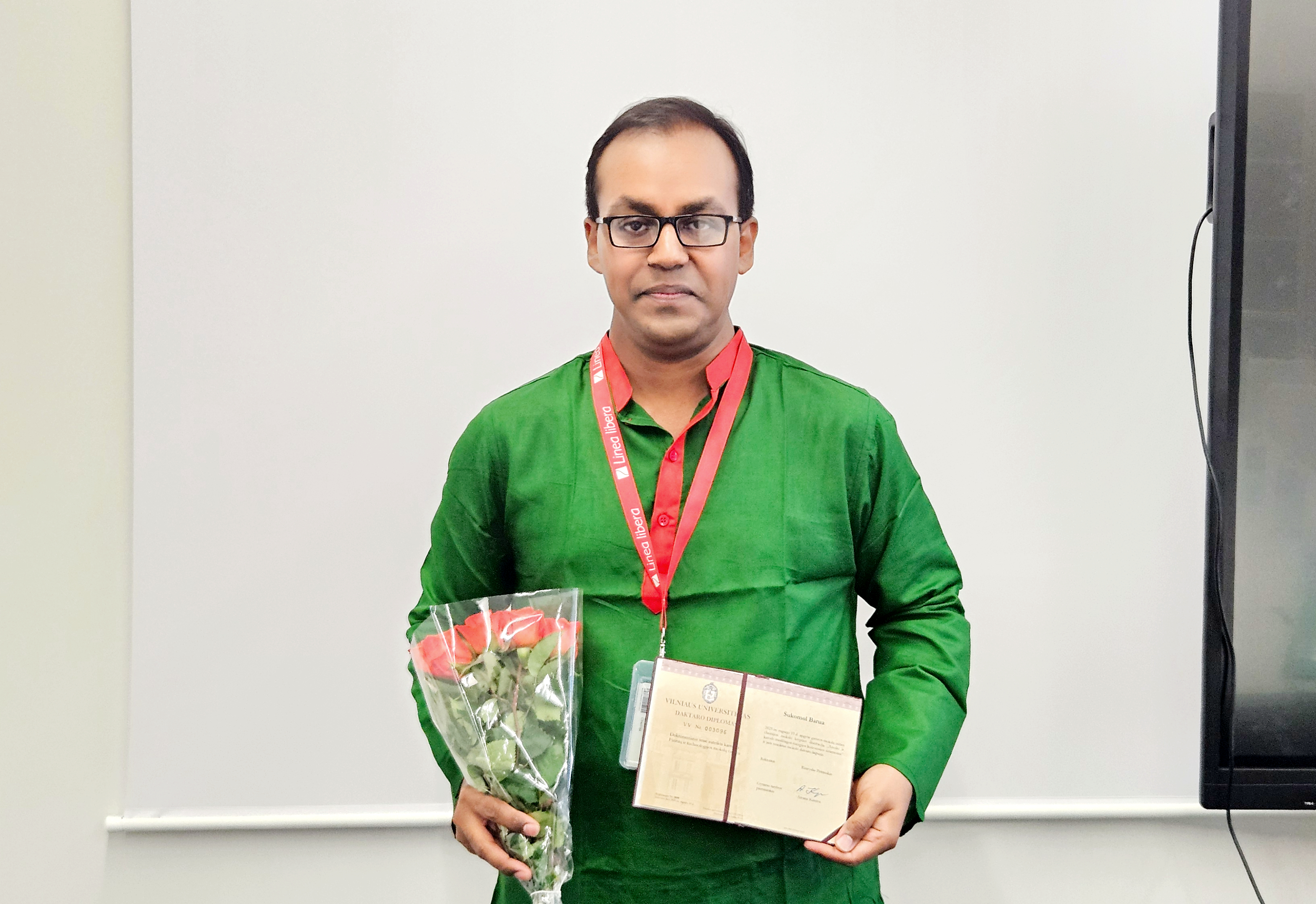
Sukomol Barua, Who Produces Hydrogen from Marine and Freshwater Sources, Is the New PhD
A healthier and more sustainable future is one of the key missions of FTMC, pursued by a dedicated team of our scientists. One of them, Sukomol Barua, a researcher at the Department of Catalysis, was awarded a PhD on 19 September.
He defended his thesis “Anode and cathode materials for energy conversion systems” (academic supervisor: Dr Aldona Balčiūnaitė).
Congratulations to our colleague – wishing him every success in continuing his important work!
As the author of the study points out, the world today is facing serious energy challenges – fossil fuels are running out, their combustion pollutes the environment and contributes to climate change. In addition, reserves of oil, gas and coal are limited and unevenly distributed, creating risks of supply disruption and geopolitical conflicts.
In the search for cleaner solutions, hydrogen is attracting increasing attention. It has a very high energy density, releases no carbon dioxide when burned, and can be applied in a wide range of fields – from transport to industry. Hydrogen can be produced in several ways, the cleanest being green hydrogen, obtained by splitting water using renewable energy (solar, wind or geothermal).
The biggest obstacle lies in the level of technology. Producing hydrogen via electrolysis (where electricity is used to split water into hydrogen and oxygen) requires a great deal of energy and efficient catalysts. Current catalysts are often made of expensive precious metals (such as platinum), which keeps the industrial process costly.
Together with his colleagues, Sukomol is developing cheaper and more sustainable solutions, using metals that are more abundant on Earth (e.g. nickel, manganese or cobalt). The aim is to create reliable catalysts that can operate efficiently in both freshwater and seawater. This is especially relevant since 97% of the Earth’s water is salty seawater, while freshwater resources are limited.
(Photo: Unsplash.com)
“My Doctoral studies was focused on the electrocatalytic water splitting technology for green hydrogen production and to do so, we required efficient, sustainable and durable electrocatalysts (both anodes and cathodes).
This scientific research was to develop and synthesize high-performance anode and cathode materials by using electrochemical deposition method via dynamic hydrogen bubble template (DHBT) technique and investigating their activity for hydrogen evolution reaction (HER), oxygen evolution reaction (OER) and overall water splitting in lab-scale.
Moreover, I also investigate the stability of my synthesized 3D binary (composed of two metals) and ternary (composed of three metals) electrocatalysts and characterize their microstructures and surface morphologies,” explains Sukomol.
As mentioned, seawater can be considered an almost unlimited resource - therefore, in his research on hydrogen production, the chemist also used natural seawater. It was collected from the Baltic Sea, near to Klaipėda seashore region, Lithuania.
What are the key results? Dr Barua developed a three-dimensional binary nickel-manganese electrocatalyst on a titanium substrate (NiMn/Ti-5), which performed very efficiently - it required only a low voltage to achieve the desired hydrogen production rate in both artificial and alkaline seawater. By combining this catalyst with another nickel-manganese electrocatalyst also developed by the scientist (NiMn/Ti-1), it was possible to construct an electrolyser - a device that uses electricity to split water into hydrogen and oxygen.
The electrolyser developed proved to be more economical than systems using expensive precious-metal catalysts, such as platinum.
.jpg)
(Green hydrogen for everyone – is it just around the corner? Photo: Canva.com)
Even more impressive results were achieved with a three-dimensional ternary nickel-manganese-cobalt electrocatalyst on a titanium substrate (NiMnCo/Ti-2). It required an extremely low voltage to produce hydrogen in both synthetic seawater and alkaline freshwater. Moreover, it remained highly stable - operating for up to 50 hours with insignificant fluctuations and retaining approximately 90–95% of its initial performance.
“This research is very crucial because the world is dealing with energy crisis and we need energy security. There is probably a misconception about hydrogen and let me break this here. Hydrogen is the best option for combustion with zero greenhouse gas (GHG) emission but not necessarily we have to use this hydrogen only for fuel purpose.
The value of hydrogen economy is above US$ 250 Billion by 2025 globally and green hydrogen production by seawater splitting method would definitely add new dimension and more value to this. This research also significantly ensures one of the 17 Sustainable Development Goals (Nr. 7. Affordable and Clean Energy),” says the new PhD.
You can read the dissertation by following this link.
Info: FTMC