- Home
- News & Events
- News
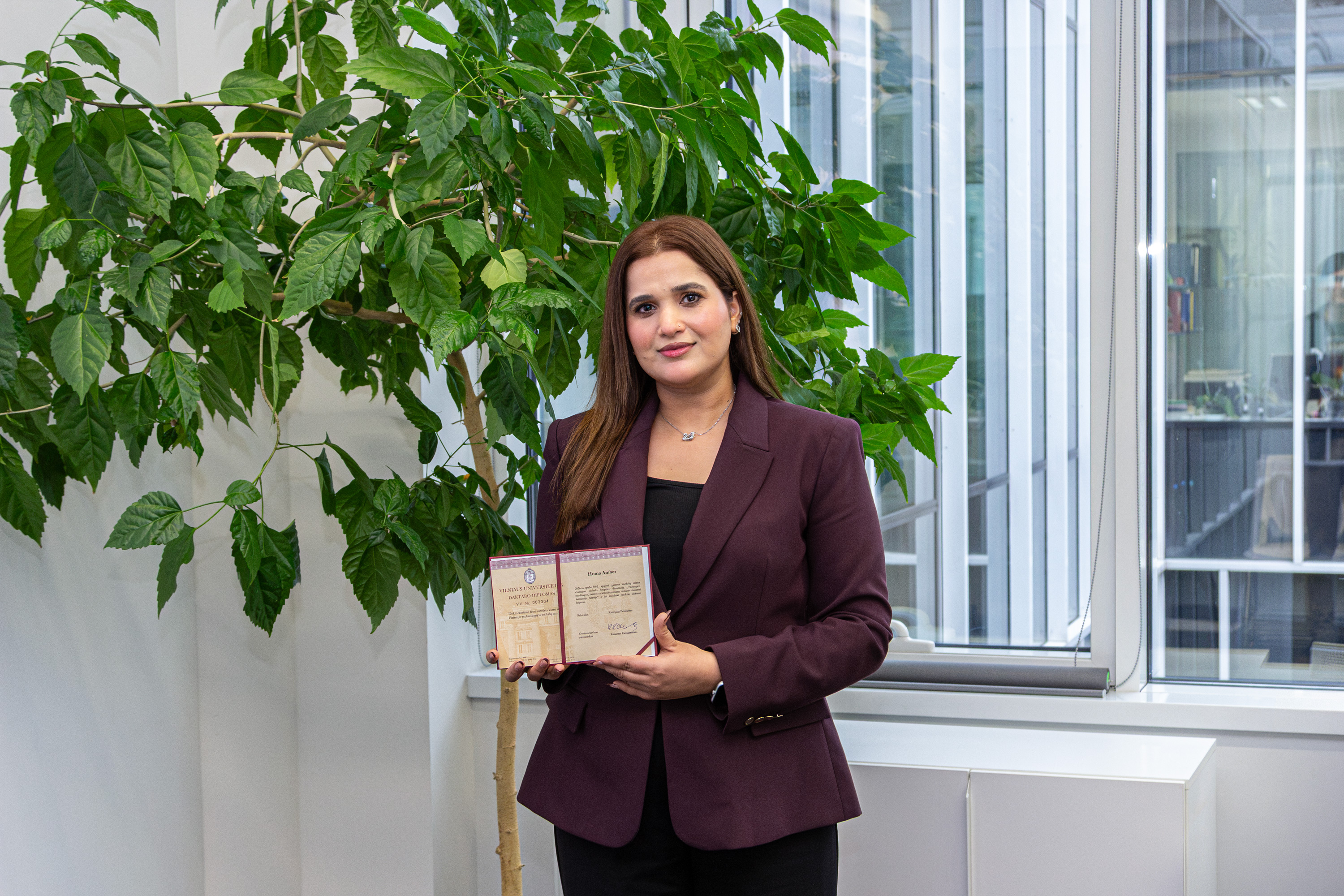
Solutions for Green Hydrogen Production: FTMC Chemist Huma Amber Awarded PhD in Natural Sciences
Huma Amber, a chemist at the FTMC Department of Catalysis, has been awarded a PhD in Natural Sciences after successfully defending her doctoral dissertation, “Advanced Materials for Electrochemical Water Splitting in Alkaline Media” (supervisor: Dr Loreta Tamašauskaitė-Tamašiūnaitė).
The researcher focuses on water electrolysis, a process in which electricity is used to split water into hydrogen and oxygen. This technology is considered highly promising because it enables hydrogen production without relying on fossil fuels, offering a pathway towards cleaner and more sustainable energy systems.
According to Dr Amber, one of today's most pressing global challenges is reducing dependence on fossil fuels and transitioning towards cleaner and more sustainable energy sources. Green hydrogen is considered a promising energy carrier because it can be produced from water using renewable electricity, without direct carbon dioxide emissions during the production process. It also has considerable potential for applications in industry, transportation and energy storage.
However, large-scale green hydrogen production still faces several challenges, including high energy requirements, the need for efficient and durable electrocatalysts, and the high cost and limited availability of precious metals such as platinum and iridium.
“In my research, I addressed these challenges by developing cobalt phosphide-based electrocatalysts on copper substrates using electroless deposition and galvanic displacement techniques. I investigated how phosphorus content and iron incorporation influence their catalytic properties and explored further improvements through surface modification with small amounts of precious metals, particularly platinum and palladium.
Ultimately, my research aims to contribute to the development of efficient and durable electrode materials that can improve alkaline water electrolysis and support the advancement of green hydrogen technologies,” says Huma.
The electrocatalysts she developed are designed to accelerate both the hydrogen evolution reaction (HER) and oxygen evolution reaction (OER). According to the researcher, one of the most significant outcomes of her work was their successful application in a two-electrode alkaline electrolyzer for overall water splitting (OWS).
“Among the unmodified catalysts, the cobalt phosphide coating on a copper substrate, CoP₁₁/Cu, exhibited excellent HER activity, while CoP₈/Cu demonstrated remarkable OER performance. Among the modified catalysts, platinum-modified cobalt phosphide on copper, PtCoP/Cu, showed outstanding HER activity, whereas platinum-modified iron-cobalt phosphide on copper, PtCoFeP/Cu, exhibited significant improvement in OER performance.
Importantly, the electrolyzer combining PtCoFeP/Cu as the anode and PtCoP/Cu as the cathode demonstrated excellent overall water-splitting performance across a temperature range of 25-75 °C, highlighting its potential for alkaline water electrolysis under both laboratory and industrially relevant operating conditions,“ explains Dr Amber.
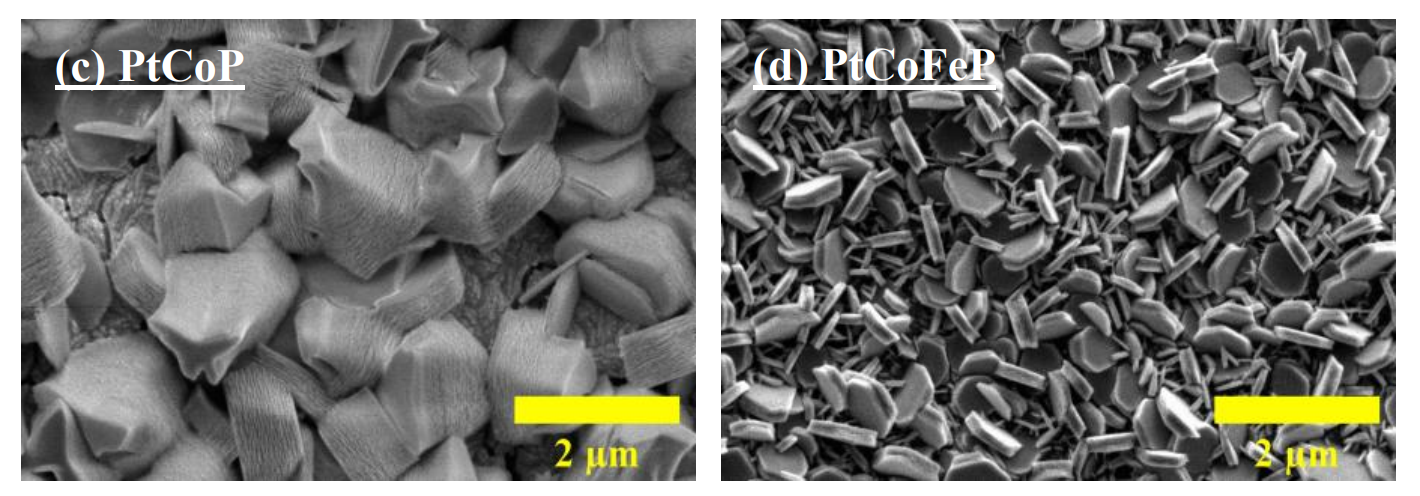
(Micrograph of the surface of the platinum-modified cobalt phosphide catalyst (c); micrograph of the surface of the platinum-modified iron-cobalt phosphide catalyst (d). Photographs from Dr Huma Amber's thesis)
According to the chemist, the importance of her research lies in its potential contribution to cleaner energy production. At present, most hydrogen is still produced from fossil fuels, meaning that advancements in green hydrogen technologies could help reduce greenhouse gas emissions and dependence on conventional energy sources.
“Making green hydrogen a more practical and accessible energy solution requires improvements in the efficiency and cost-effectiveness of its production. My research addresses this challenge by developing advanced electrocatalytic materials that can enhance the efficiency of alkaline water electrolysis while reducing reliance on expensive precious metals. Such developments could contribute to the advancement of more efficient and economically viable hydrogen production technologies.
The potential benefits of this research extend beyond the scientific community. Advances in hydrogen production technologies could support cleaner industrial processes, reduce dependence on fossil fuels and contribute to the development of more sustainable energy systems. Ultimately, I believe that scientific research is most valuable when it helps address real-world challenges. I hope my work will contribute to making hydrogen production technologies more efficient and accessible, supporting a cleaner energy future and a more sustainable world for generations to come,” says the newly awarded PhD.
The full dissertation can be accessed by clicking this link.
Source: FTMC