- Home
- News & Events
- News
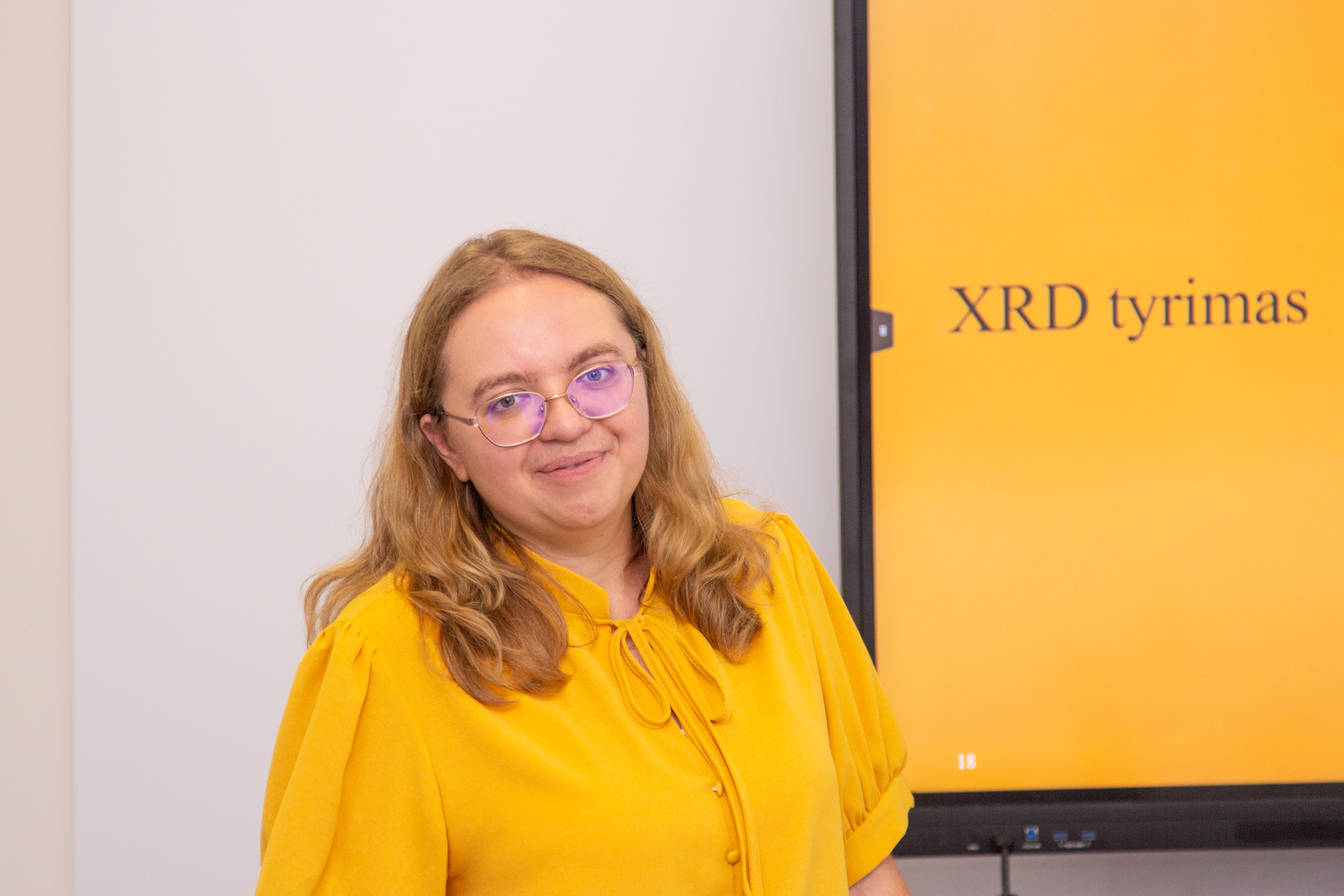
Simpler and More Affordable Hydrogen Production: FTMC Chemist Gitana Valeckytė Earns a PhD in Natural Sciences
Hydrogen is considered one of the most promising environmentally friendly energy sources. However, researchers around the world are still looking for ways to produce it efficiently, safely, and cost-effectively. One possible solution is to generate hydrogen from a sodium borohydride solution using special catalysts, materials that accelerate desired chemical reactions. This process produces exceptionally pure hydrogen suitable for use in energy generation, transport, and industry.
However, such catalysts are typically made from expensive precious metals, prompting scientists to search for more affordable alternatives.
One of them is Gitana Valeckytė, a chemist at the FTMC Department of Catalysis, who has been awarded a PhD in Natural Sciences after successfully defending her doctoral thesis, "Chemical Deposition of Nickel and Its Alloys and Application for Hydrogen Generation" (supervisor: Dr Zita Sukackienė).
“The main objective of my research was to find the fastest and most efficient way to generate hydrogen. To achieve this, I developed catalysts by coating a copper surface with a layer of nickel into which I incorporated varying amounts of other metals. I investigated which combinations were most effective at releasing hydrogen from a sodium borohydride solution and whether these catalysts remained effective after repeated use. Simply put, I was looking for the ‘best recipe’ for a catalyst,” explains Dr Valeckytė.
The researcher points out that the catalysts used in her work are made from relatively inexpensive metals, namely cobalt, manganese, molybdenum, and tungsten. In the future, this could prove important for the development of simpler and more affordable hydrogen production technologies.
What Gitana is most pleased about in her work is the successful development of catalysts that release hydrogen far more efficiently than a catalyst based solely on nickel.
“Two quaternary catalysts that I investigated demonstrated the best performance. The most active of them achieved a hydrogen generation rate of 23.57 mL/min, while the lowest measured activation energy was 38.22 kJ/mol. Equally importantly, after five usage cycles the catalysts retained more than 85% of their activity. This shows that they can be reused and that they are sufficiently stable,” says the new PhD.
The full dissertation is available here.
Info: FTMC