- Home
- News & Events
- News
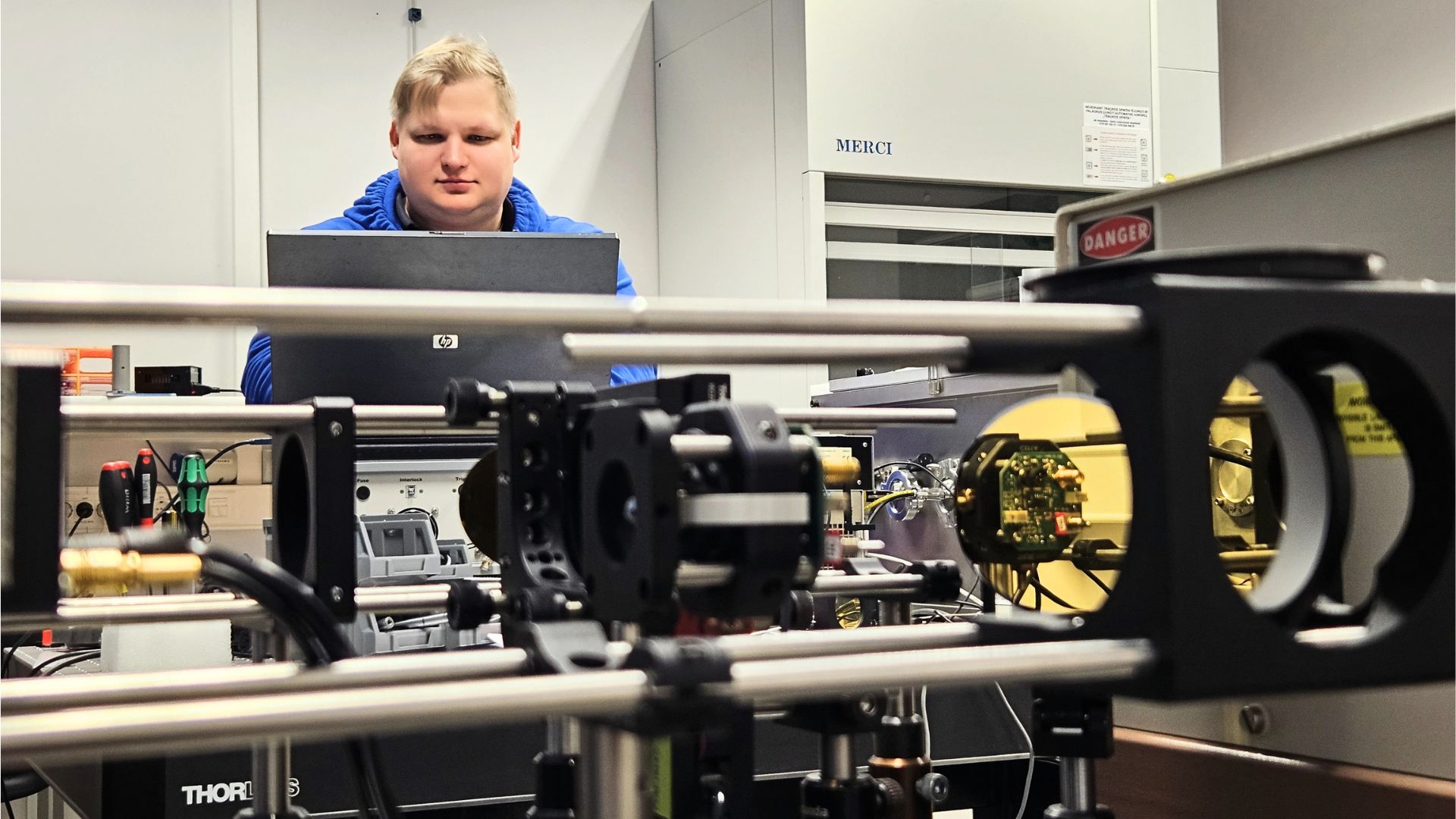
Sharper Images, Smaller Devices: FTMC Physicist Vladislovas Čižas Opens Up New Terahertz Opportunities
Terahertz radiation consists of electromagnetic waves that are invisible to the naked eye and that you may never even have heard of. Yet for scientists and technology developers, terahertz waves are becoming increasingly important, as they can be applied in areas such as security screening systems, next‑generation wireless communication, national defence, and medicine.
One of the world’s strongest research teams working in terahertz science is based in Lithuania. It operates at the FTMC Department of Optoelectronics, where physicist Dr Vladislovas Čižas works – the author of one of the best doctoral dissertations of 2024 in Lithuania.
He was the first in the world to apply the so‑called homodyne imaging method in the terahertz domain, enabling these electromagnetic waves to be used far more effectively for the detection of concealed objects. Thanks to this Lithuanian scientist’s improvements, the resulting images become sharper, while broad opportunities open to develop more versatile and more compact terahertz devices.
Finding a Way to Improve Image Quality
One of the main application areas of terahertz technology is imaging. In essence, it is like working with a camera, except that instead of a conventional photograph, scientists obtain rather different images on a computer screen – silhouettes that indicate what is hidden inside a package, a pocket or another type of container.
“Terahertz imaging allows us to see many things that would not be visible to the naked eye or in ordinary photographs. For example, people can be scanned: unlike X‑rays, this method is completely harmless to health, and it is already being used in some modern airports. It can also be used to inspect parcels for explosives, narcotics or other unwanted substances,” explains Čižas.
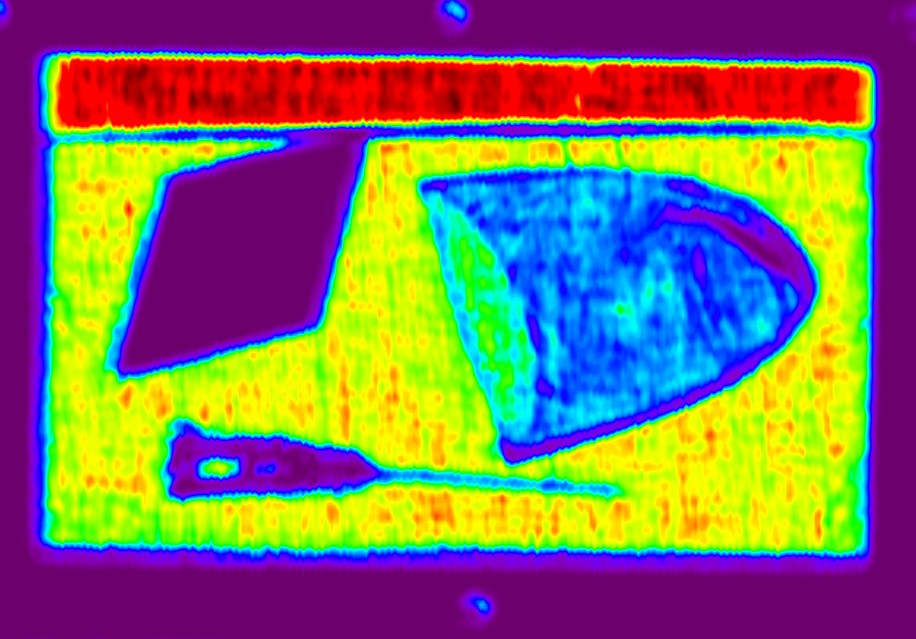
(One example of terahertz imaging used to reveal concealed objects: the image shows a steel blade, a needle and a piece of a nitrile glove, covered by six layers of cotton fabric. Photo: Dr Domas Jokubauskis / FTMC, 2017)
Although the technology is well developed worldwide, it still faces significant challenges. Terahertz waves struggle to ‘see’ inside human and animal tissues and other biological objects. According to the physicist, science would like to move towards using terahertz radiation for cancer diagnostics, but for now this remains at a very early stage.
“We can also talk about everyday materials such as paper. It absorbs terahertz waves very poorly – they simply pass through it with almost no interaction. As a result, using a conventional imaging system it would be practically impossible, for instance, to distinguish how many sheets of paper are stacked on top of each other,” he says.
The solution presented by the FTMC research team is an improved way of ‘photographing’ objects with terahertz radiation: a homodyne imaging method adapted to the terahertz frequency range, which has already proven effective in other parts of the electromagnetic spectrum.
Put simply, a terahertz wave – the main signal – is sent towards the object under investigation (for example, a stack of paper). A second, auxiliary signal is then introduced around the object. When these signals intersect, interference occurs – a specific type of wave interaction that makes it possible to highlight more details and significantly improve image quality.
The experiments carried out by the scientist and his colleagues were successful, and the results were published in the prestigious scientific journal ACS Photonics.
A Step Towards Smaller and Cheaper Devices
According to the FTMC physicist, the most important achievement of this research is the successful adaptation of an imaging method that has long been used in technologies such as radar, computed tomography, microscopy, and holography, but had never before been applied in the terahertz field.
“In other words, we transferred a well‑established idea into a completely new frequency range and demonstrated that it works there as well,” he says.
In addition, the researcher integrated special elements into the system – so‑called metalenses. These are tiny structures laser‑cut into metal foil, exhibiting properties not found in nature. They allow extremely precise control of terahertz radiation propagation, in much the same way that conventional lenses control light.
“One of the greatest advantages of metalenses is their size and weight. They are very thin, lightweight and take up little space, which means the entire imaging system can be made much more compact. This is particularly important if the device is intended to be portable rather than stationary. Moreover, metalenses are far cheaper to manufacture than many other terahertz optical components,” explains Vladislovas.
(Dr Vladislovas Čižas. Photo: FTMC)
Another significant advantage is directional light control, known as polarisation. It describes the direction in which an electromagnetic wave oscillates. Imagine window blinds: turning them in a particular direction changes how light enters a room. Similarly, the metalenses used by FTMC scientists can simply be rotated to adjust the polarisation of the terahertz radiation – without adding complex or expensive components.
This proves useful even when examining a single sheet of paper. To the naked eye it appears uniform, but under a microscope it becomes clear that it consists of fibres aligned in a specific direction. The system refined by Dr Čižas would allow the orientation of these fibres to be determined more precisely – a factor that affects paper strength, deformation behaviour, moisture resistance and print quality. Terahertz polarisation‑sensitive methods make it possible to do this quickly and without damaging the material.
The same principle applies to other materials, such as wood, which also has a clearly defined internal structure and directional properties.
Untapped Potential
The imaging system developed at the FTMC Department of Optoelectronics currently operates at frequencies of up to around one terahertz, and the team is aiming to work at higher frequencies. According to FTMC researcher, this is still a largely unexplored scientific field, and mastering it would allow for much higher‑quality investigation of a wide range of materials.
“Every material has its own characteristic spectrum – that is, it responds differently to different frequencies. At one frequency we may see a very clear image on the screen, while at another there may be almost no effect at all. That is why it is crucial to be able to operate precisely at the frequency where the strongest response is expected.
At lower frequencies, much has already been achieved worldwide. But at higher frequencies – between one and ten terahertz – there is still vast space for research. If we master this range, we will significantly expand both the capabilities of the system itself and the range of practical applications. Preliminary calculations show that our improved structures should be able to operate at frequencies of up to ten terahertz,” the scientist explains.
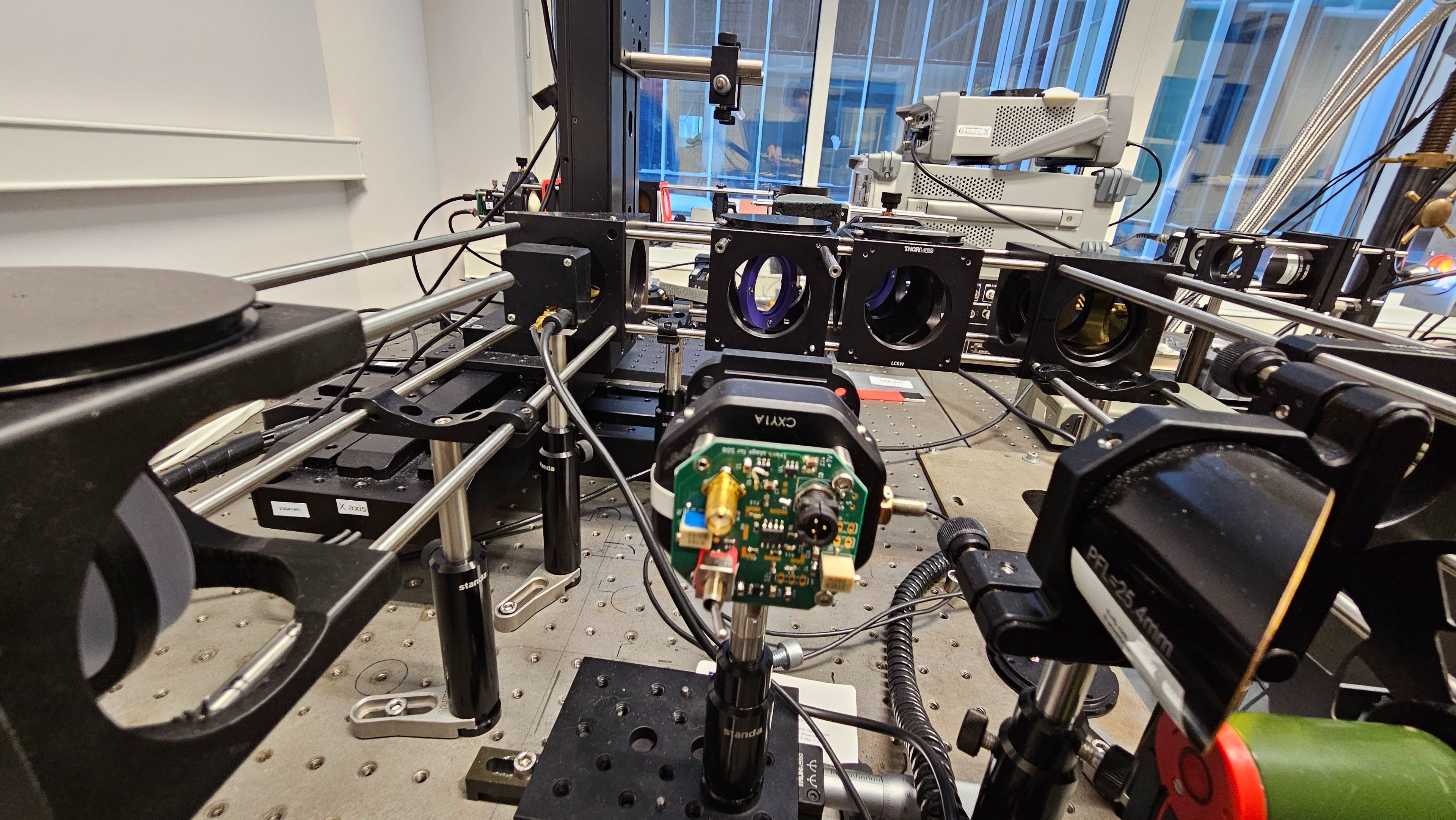
(Scientific equipment for terahertz imaging. Photo: FTMC)
‘Outrunning’ the Laws of Nature
Why has it been so difficult until now to push metalenses to higher operating frequencies? According to Vladislovas Čižas, the key obstacle lies in the laws of nature themselves. The higher the frequency of an electromagnetic wave, the shorter its wavelength – which means that the elements inside the metalenses (known as meta‑atoms) must be correspondingly smaller to interact properly with the incoming wave.
The most widely used technologies allow the fabrication of high‑quality meta‑atoms as small as about 10 micrometres – one hundred times smaller than a millimetre. However, even this is not sufficient for terahertz research to ‘break through’ beyond the one‑terahertz limit. In other words, even the most advanced and finest structures currently achievable are simply too large.
For this reason, Vladislovas and his team are exploring an alternative approach: exploiting so‑called higher‑order modes of metamaterials. Put simply, each meta‑atom can resonate not only at a single fundamental frequency, but also at higher ones. These additional operating regimes can be compared to harmonics in music: the fundamental note is the strongest, but higher overtones also exist.
“Thus, by using relatively large meta‑atoms – which can still be fabricated using inexpensive laser‑based technologies – we can reach higher operating frequencies. This means even higher data transmission speeds, even smaller objects detectable through imaging, and a wider range of materials that can be identified,” Dr Čižas concludes.
Something New Every Day
The young scientist has already achieved significant success in his field: he publishes in top‑tier journals, participates in international conferences, and three years ago patented an invention together with his colleagues – quantum superlattices that act as amplifiers of electromagnetic waves. This research later formed the basis of his doctoral thesis, which was recognised by the Lithuanian Academy of Sciences as one of the best dissertations of 2024.
Čižas invites students to come to FTMC for internships or doctoral studies and to discover themselves there – because being a scientist is a constant adventure, with something new emerging every single day.
“My work as a physicist is extremely exciting: I do things that no one has ever done before. In our laboratory, we work all the way from theory to fully functioning devices that could be sold and used in real‑world applications.
You could say that I am constantly overcoming new challenges – you never know what awaits you today. That unpredictability is what drives me. If you learn to enjoy it, everything becomes genuinely fun and fascinating,” says the FTMC scientist.
Written by Simonas Bendžius