- Home
- News & Events
- News
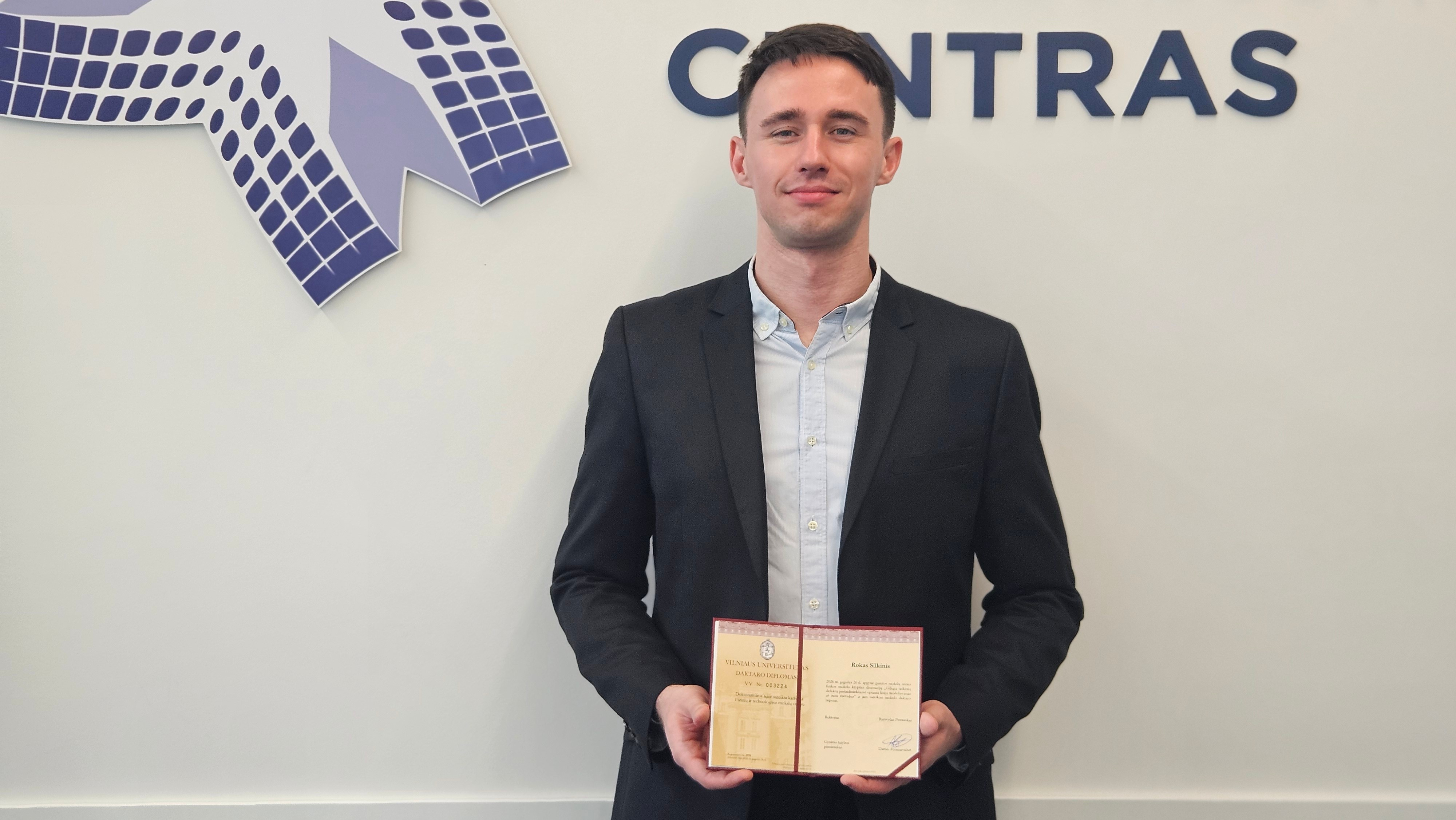
Rokas Silkinis, Contributing to Quantum Technology Research, Awarded a PhD in Natural Sciences
Rokas Silkinis, a physicist at the FTMC Department of Fundamental Research, has successfully defended his doctoral dissertation. Its title is “Ab Initio Optical Lineshape Modeling of Deep-Level Point Defects in Semiconductors” (academic supervisor: Dr Lukas Razinkovas; former supervisor (in memoriam): Prof. Dr Audrius Alkauskas, who supervised the work from 2020 to 2023).
In his research, Rokas investigated how the optical properties of so-called color centers in semiconductors – materials essential to modern electronics – can be modelled using computational methods. Color centers are atomic-scale defects in a semiconductor crystal which, when stimulated by light, emit light themselves. Each such defect produces a unique optical signal – much like its own “fingerprint”.
“The dissertation focuses on color centers in diamond and silicon, which are considered promising systems for solid-state quantum technologies, including quantum communication, sensing, and information processing. The core of my work was to model the properties of the light they emit using theoretical approaches and to compare the results with experimental measurements. As conventional computational methods are not sufficiently accurate for some of these systems, more advanced theoretical techniques were also employed,” explains Dr Silkinis.
According to the researcher, the dissertation contributes to the field of quantum technology research – an area that could significantly influence everyday life over the coming decades:
“The defects studied in this work represent one of the promising platforms for developing such technologies. They may be used in creating ultra-secure communication systems to protect transmitted information, highly sensitive sensors capable of detecting extremely weak magnetic fields or temperature changes, and quantum computers that could solve certain complex problems far more efficiently than today’s computers.
Although many of these technologies are still under development, in the future they could contribute to more secure communications, more accurate medical diagnostics, and faster scientific discoveries.”
Rokas highlights that the most significant achievement of his work is the ability to reproduce experimentally observed optical signals of color centers with very high accuracy through computational modelling: “This demonstrates that the methods we use can reliably predict certain properties of these potential quantum systems.”
Congratulations to our colleague, and best wishes for continued success!
You can read the full dissertation by following this link.
Source: FTMC