- Home
- News & Events
- News
Researchers’ Proposals to Help Lithuania Strengthen Its Semiconductor Sector Ahead of EU Council Presidency
How could Lithuania strengthen its position within the European semiconductor ecosystem? This question was explored during a special event organised by Lithuanian Chips Competence Centre, ChipsC²-LT, held at FTMC.
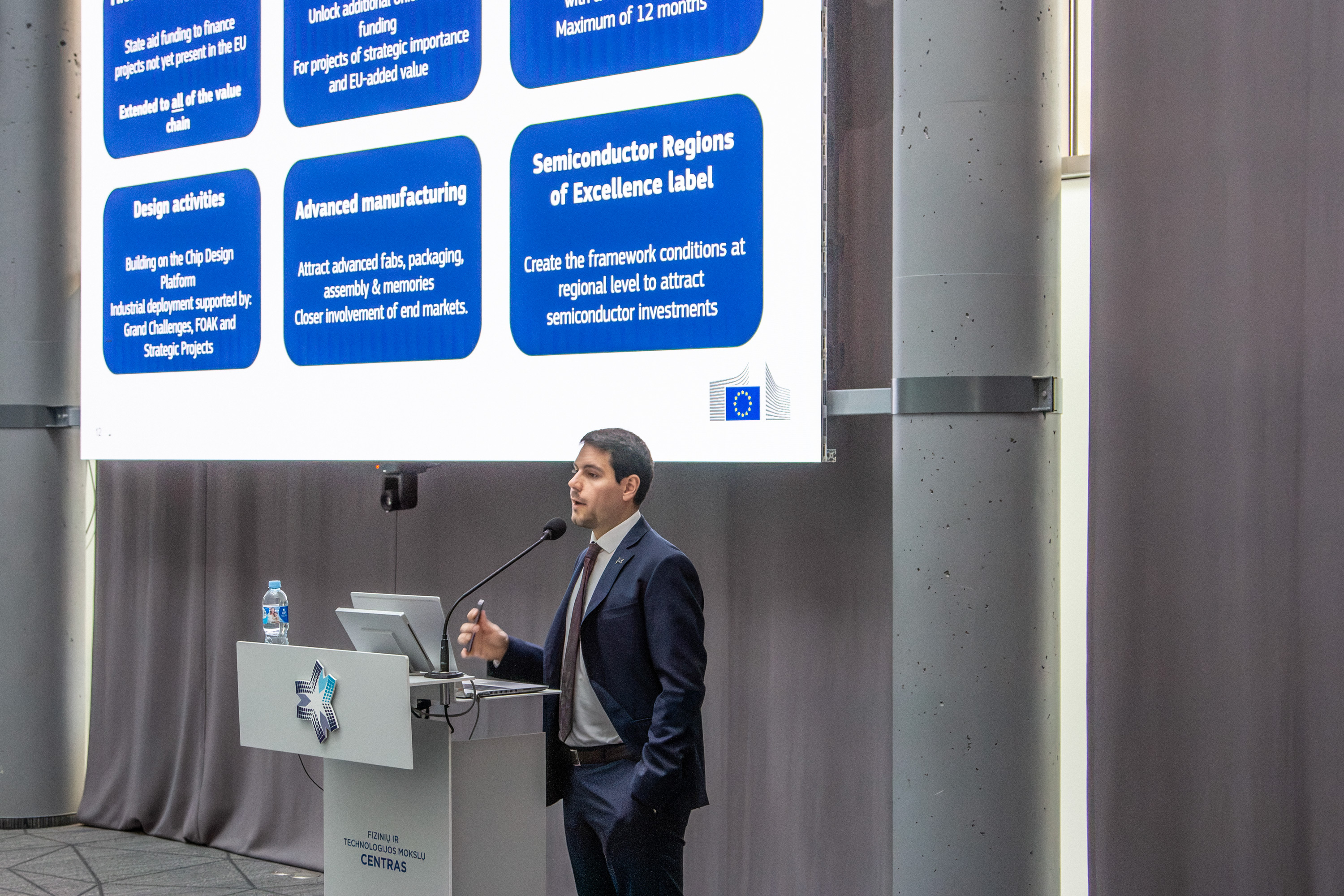
During the meeting, Zeno Tornasi, Policy Officer for Microelectronics and Photonics at the European Commission, presented the directions of the Chips Act 2.0 and engaged in discussions with representatives of Lithuania’s research, business and public sectors. More than 40 experts from companies, ministries, universities and Baltic chips competence centres took part in the event.
One of the most important outcomes of the meeting was the development of eight concrete Lithuania’s proposals. These focus primarily on improving access to European semiconductor infrastructure, chip design tools and pilot production lines, strengthening collaboration between science and industry, enhancing the role of photonics, and advancing the development of manufacturing equipment.
“Lithuania has a strong technological foundation. Our task is to connect these strengths into a functioning ecosystem and ensure that Lithuanian companies and researchers can play an active role in the European semiconductor value chain,” says Dr Saulius Tumėnas, Head of the ChipsC²-LT project and a researcher at FTMC Department of Optoelectronics.
The new Chips Act 2.0 is particularly important for Lithuania because it covers not only chip manufacturing, but the entire semiconductor value chain, from technology development and materials to manufacturing equipment, assembly and testing. Lithuania already possesses strong capabilities in lasers, photonics, electronics, materials science and other advanced technology fields.
In this area, FTMC brings together scientific research, technological infrastructure and collaboration with industry. The Center conducts cutting-edge research, while its infrastructure enables the development, testing and further advancement of new technologies.

(Dr Saulius Tumėnas, Head of the ChipsC²-LT project. Photo: Gabrielius Mackevičius / FTMC)
The meeting also featured presentations on the planned open-access chip assembly and testing infrastructure in Lithuania, as well as discussions on the potential of the Vilnius-Kaunas semiconductor region.
The Lithuanian position paper containing the eight proposals has been submitted to the European Commission and the Ministry of the Economy and Innovation of the Republic of Lithuania. It will serve as a contribution to shaping Lithuania’s national position ahead of the country’s Presidency of the Council of the European Union, which will begin in 2027.
ChipsC²-LT is an FTMC-led project establishing a dedicated Lithuanian Chips Competence Centre. The project brings together Lithuania’s leading research and higher education institutions: the Center for Physical Sciences and Technology (FTMC), Vilnius University, Kaunas University of Technology and Vilnius Gediminas Technical University (VILNIUS TECH).
The project's aim is to consolidate the capacities of Lithuania’s research and higher education institutions, strengthen research and experimental development infrastructure, promote the advancement of semiconductor technologies, and foster collaboration between science and industry.
The project also seeks to strengthen Lithuania’s integration into the European semiconductor ecosystem and create greater opportunities for Lithuanian researchers and companies to participate in the European chip design and manufacturing value chain.
Source: FTMC