- Home
- News & Events
- News
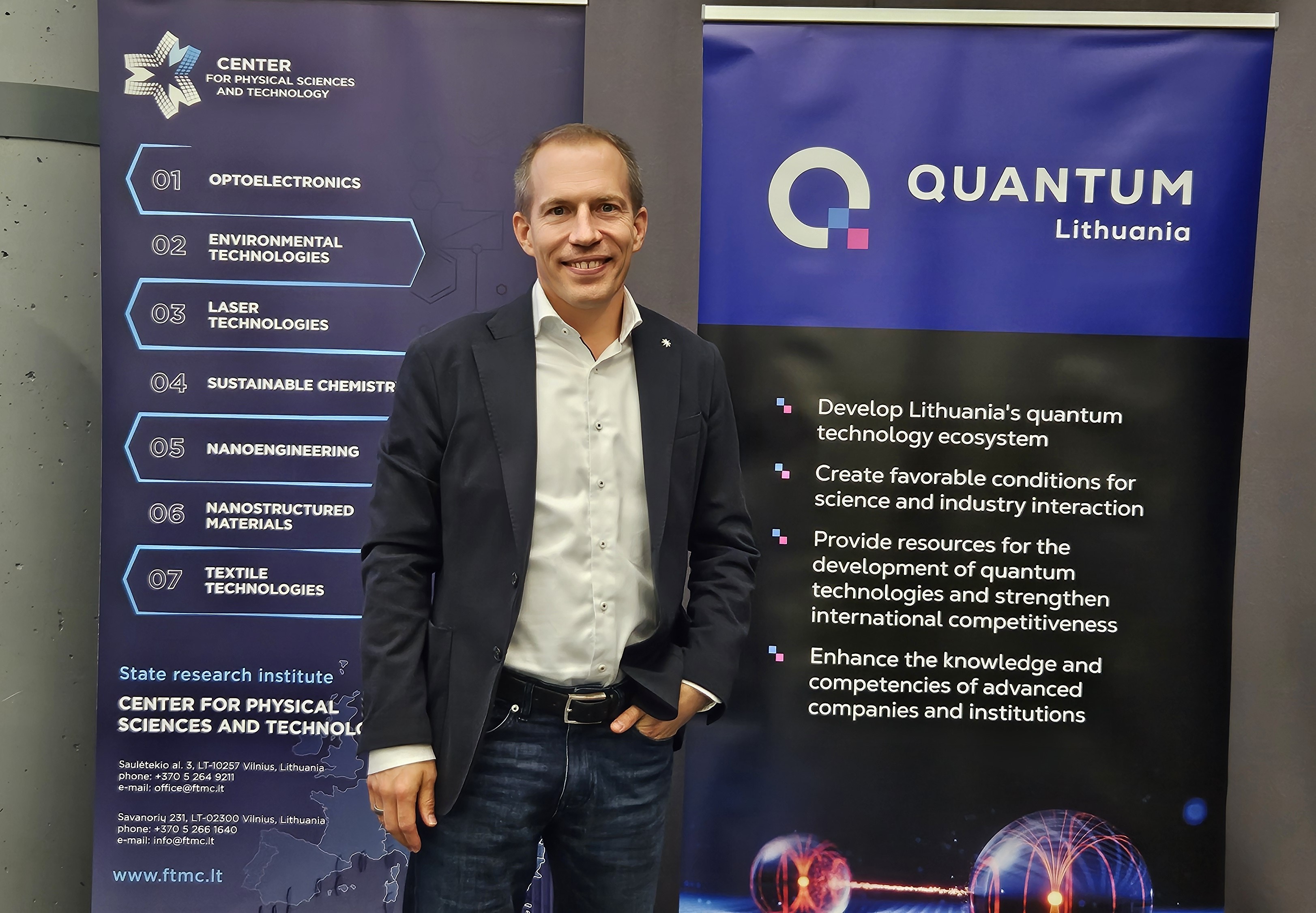
Professor Philip Walther, Creator of the First Space-Proof Quantum Computer, Visits Lithuania: The Possibilities in Our Field Are Rich
Today, it is impossible to imagine our daily lives without space satellites: the various devices orbiting the Earth are “responsible” for such essential areas as internet, TV and radio signals, navigation systems, climate and environmental monitoring, and even the functioning of certain ATMs. Yet there is always room for improvement – and an Austrian scientist is offering the world a new idea.
Professor Dr Philip Walther is one of the leading experts in quantum technologies and heads the Quantum Optics and Quantum Information Group at the University of Vienna. It is also worth noting that his academic supervisor was Professor Anton Zeilinger, the 2022 Nobel Prize laureate in Physics.
Prof. Walther combines complex questions of quantum physics with the development of real, practical technologies. His team’s latest breakthrough is the successful launch, in June, of the world’s first photonic quantum computer designed for use in space. This type of computer performs its calculations using individual particles of light – photons – making it exceptionally sensitive, stable and fast. Even more importantly, quantum computers could enable satellites to become significantly smarter.
On 14 November, Prof. Walther visited Vilnius and the Center for Physical Sciences and Technology (FTMC), where he was the keynote speaker at the quantum hackathon Quantum Boost 2025. Finalists of this first-ever event of its kind in the Baltic States had an excellent opportunity to hear insights from one of the top specialists in the field.
Here, the scientist shares his thoughts on the successful space-proof quantum computer, the potential of this technology, and the value of hackathons.
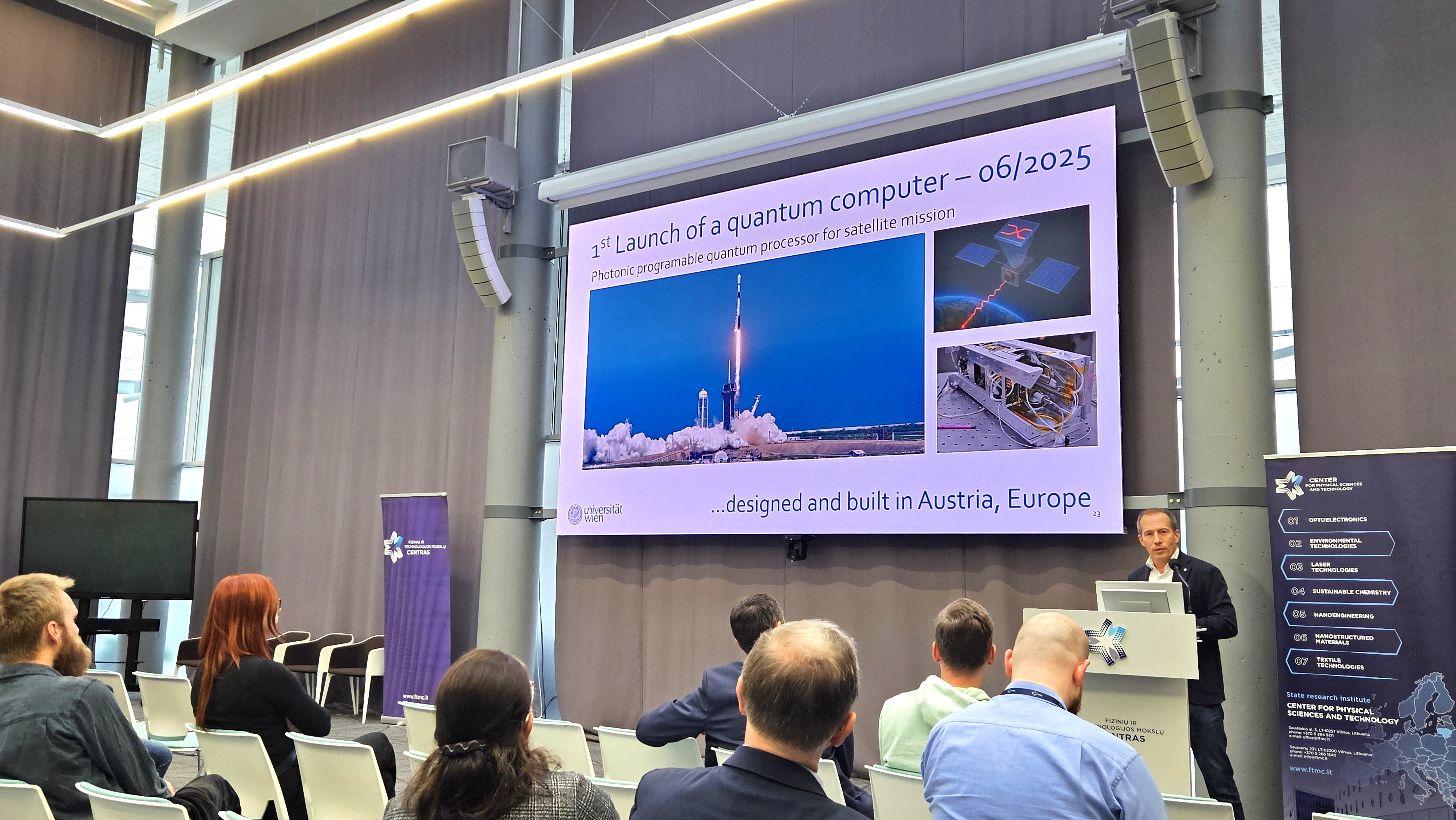
(Prof. Walther's presentation. Photo: FTMC)
In the summer, your team launched the first space quantum computer in history. So far, what are the main results, maybe the most surprising observations?
We are very happy because everything worked so far. We had the launch in June, and then we had to wait a couple of weeks to ensure the satellite was operating. That’s normal. We could check that every component – photon source, processor, detector – was working, and we have communication with them. It’s a very big relief because it's the first generation.
We learned that satellite missions often need several rounds to figure out how to fix things so that they all work together. We are now at the stage of operating the system, aligning the parameters, and investigating performance. The chip works, and we are now in the process of demonstrating interesting applications.
Even though we haven’t finished everything, we learned that space missions are still harder than expected. For example, being in the sun versus out of the sun makes a difference. We work with singular photons, so even a single “wrong” photon matters. We also learned that temperature cycles in space are different from what can be simulated or experienced on Earth.
It’s a learning curve for us, and it’s very valuable to see and anticipate how to operate the system. At the moment, I can only ask everyone to keep their fingers crossed that things continue to go well. We are now at the stage of operating the system, and we hope to have the first results ready for publication by the end of this year.
Why do we need quantum computers in space?
There are two reasons – one direct and one indirect. Directly, we have around 1,000 satellites, soon to increase to many thousands, that could benefit from onboard computers for tasks such as Earth observation. These computers need to be very efficient due to harsh conditions, limited power, and reliance on solar panels. Sending only processed results instead of large raw data is essential.
Indirectly, the computers designed to operate under harsh space conditions are immediately useful for other applications where efficiency and independence matter, like drones and automotive systems. That's the motivation behind that.

(Photo: NASA)
In your view, how could hackathons, like Quantum Boost, help bring quantum technologies into real-world applications?
Hackathons are very helpful because they raise awareness of quantum developments. Currently, we have different avenues. We have academic research, which is important and necessary to gain new insights. This research should be free and not always focused on applications.
The insights from academia should then be taken by startups or technology branches, who can say: okay, that’s a good idea we developed. Maybe we can improve something – like camera sensors, for example. Startups then evaluate these opportunities and decide: we believe in this and can bring it to the market.
All these elements need to come together. For me, a hackathon is one method to bring these people together with a typical challenge or problem to tackle. Very often, they come up with great ideas that can immediately justify founding a company after the hackathon, solving what could be a dream solution.
We have now reached the stage where all these elements must come together, which is basically the ecosystem we talk about – from academia up to customers and industry, establishing a value chain. There’s huge potential. Quantum is still so rich, with so many ongoing developments, making it a very exciting field. It’s exciting because it’s not obvious that there’s only one way forward, which also allows diversity. Some things will probably fade out and not be as successful as others, while other ideas will emerge that no one else had on their radar yet. These are very exciting times.
Interview by Simonas Bendžius, FTMC Public Relations and Communication Specialist