- Home
- News & Events
- News
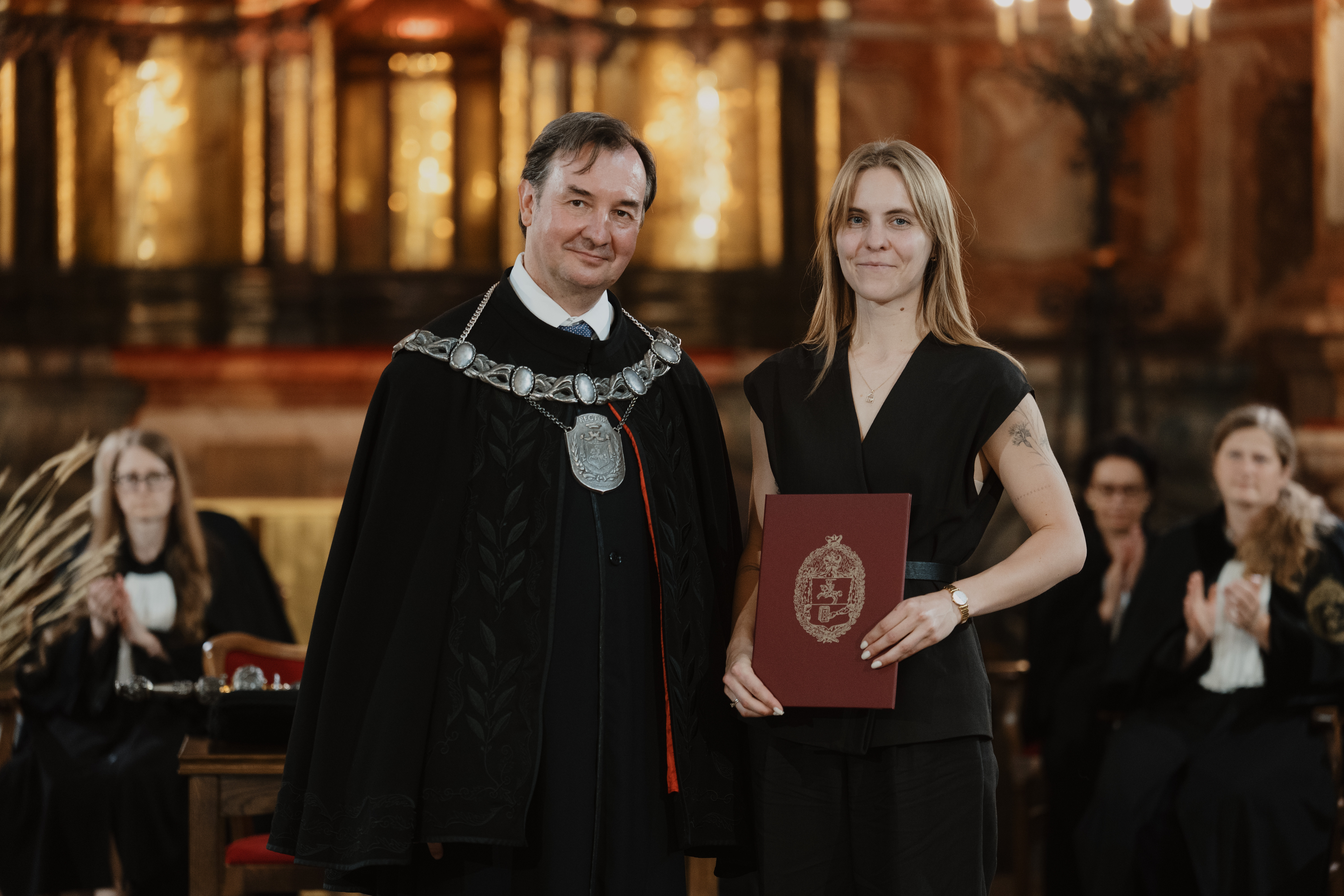
Paving the Way for Next-Generation Electronics: FTMC Laser Researcher Augustė Grigaravičienė Awarded the A. P. Piskarskas Scholarship for the Best Master's Thesis
Augustė Grigaravičienė, a researcher at the FTMC Department of Laser Technologies, has been awarded the Prof. Algis Petras Piskarskas Scholarship. Each year, it is awarded to a student of the Faculty of Physics at Vilnius University for the best master's thesis in the field of laser science. The €3,000 scholarship aims to encourage talented students to engage in scientific research and pursue careers in laser science.
Augustė’s career at FTMC will continue as the young scientist has chosen to undertake doctoral studies at our Center and will carry on her work in the FTMC Solid-State Lasers Laboratory.
Her master’s thesis focused on laser pulses whose development could contribute to more advanced electronics, next-generation data storage technologies, and improvements in medical research.
Short and Powerful Lasers Become Even Faster
In the laboratory, Augustė sought to generate ultrashort laser pulses operating in the 2-micrometre wavelength range – a region of infrared light invisible to the naked eye.
To achieve this, she employed a phenomenon known as stimulated Raman scattering – a process in which laser light enters a material and causes its molecules to vibrate. Through this interaction, part of the light changes its colour, or more precisely, its wavelength. In her experiments, the young scientist used this approach to investigate compressed hydrogen gas.
According to Augustė, the most significant result of her work was demonstrating that the process becomes several dozen times more efficient when an additional so-called seed pulse is introduced – a weak light pulse that initiates and guides the process in the desired direction.
The research also revealed that by precisely synchronising the arrival times of the main laser pulse and the seed pulse, the newly generated light pulse can be made even shorter. This removes the need for additional expensive equipment that is normally used to shorten such laser bursts.
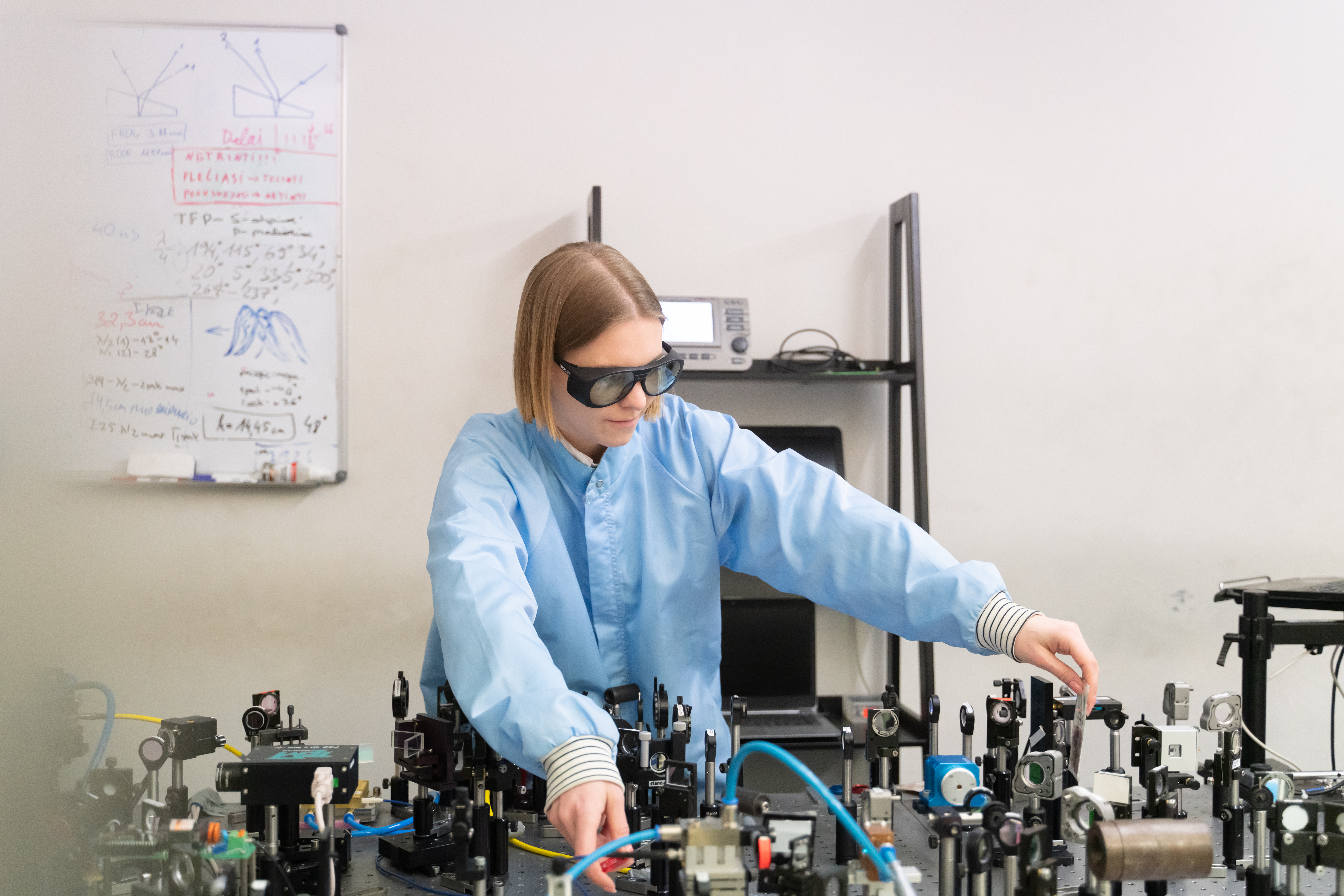
(Augustė Grigaravičienė. Photo: Hernandez & Sorokina / FTMC)
The researcher emphasises that short-wave infrared (SWIR) and mid-infrared (mid-IR) lasers have considerable potential for applications in industry, medicine, and scientific research. For example, they are highly relevant to the bulk processing of semiconductor materials such as silicon, which are essential for electronics. This enables modifications to be made inside the material without damaging its surface.
“This opens the way to next-generation microelectronics and 3D optical data storage, where information is recorded not only on the surface, as in compact discs, but throughout the volume of the material, allowing significantly greater amounts of data to be stored on a single medium. Waveguides formed within a microchip can also transfer data between different parts of the chip much faster than conventional electrical conductors.
Furthermore, this spectral region is far safer for the human eye because it does not reach the retina, the most sensitive part of the eye. This makes it highly suitable for free-space optical communication systems and LIDAR equipment – a technology that uses laser light to measure distances and create 3D maps of the surrounding environment.
These lasers are also important in medicine, as they enable the efficient generation of X-rays that can be used to study biological samples, including applications such as ultra-early breast cancer diagnostics that remain inaccessible to conventional clinical X-ray systems. The method we investigated makes it possible to create much more compact, efficient and cost-effective SWIR and mid-IR laser sources than those produced using conventional approaches,” says Augustė.
She has already received recognition for her promising work both in Lithuania and internationally. For example, in 2024 she won the Best Oral Presentation Award at an international conference held in Spain. However, according to Augustė, this latest award carries a very different emotional significance:
“Professor Piskarskas was one of the founders of Lithuanian laser physics, so receiving a scholarship bearing his name for the best master’s thesis in laser science is an exceptional honour. This recognition reflects a long and consistent journey that began in the FTMC Solid-State Lasers Laboratory in 2021.
It confirms that our research direction is both relevant and promising and provides immense motivation to continue my scientific career and contribute, even in a small way, to the future of Lithuanian laser science.
I am deeply grateful to my master’s thesis supervisor, Dr Paulius Mackonis, and the Head of the laboratory, Dr Aleksėj Rodin, for guiding me in the right direction, providing opportunities, and engaging in countless fascinating discussions.”
.png)
(FTMC Solid-State Laser Laboratory team: Dr Paulius Mackonis, PhD student Augustė Grigaravičienė, Rugilė Pečiulytė, and the Head of the Laboratory, Dr Aleksėj Rodin. Photo: FTMC)
Pushing the Boundaries of Science
Now a doctoral student, Augustė continues her work at the Solid-State Lasers Laboratory within the FTMC Department of Laser Technologies. The Head of the laboratory, Dr Aleksėj Rodin, who has also become Augustė’s doctoral supervisor, says that the recognition of the young researcher’s work reflects the combined efforts of three generations of scientists.
“An experienced laboratory or project leader identifies directions where, in their view, science still contains ‘blank spots’. Nonlinear optics is one such field, where nature still has the capacity to surprise us.
A young scientist such as Dr Paulius Mackonis can approach a problem without preconceived templates, seek unexpected solutions, and open up new opportunities for the development of the field. Meanwhile, the perseverance and creativity of his master’s student Augustė ultimately allowed us to observe a unique physical process that provides a way to achieve challenging laser radiation parameters more simply, reliably, and cost-effectively than had previously been possible.
This is a story of how different experiences, perspectives and generations can come together in a single creative impulse that pushes the boundaries of science.
It was virtually impossible to predict in advance that we would succeed in generating laser pulses lasting only one hundred femtoseconds in the difficult-to-access wavelength region around 2 micrometres, especially through self-compression, meaning without the use of additional equipment. For our small group, this result came as a significant surprise.
I am delighted that Augustė has chosen to continue this research through her doctoral studies, and as her supervisor I sincerely wish her curiosity, innovative ideas and many exciting discoveries along the way,” says Dr Rodin.
Augustė Grigaravičienė’s master’s thesis was carried out within the framework of the Lithuanian Research Council-funded project EXPULSSIVE (S-MIP-25-17), “Investigation of the Nonlinear Scattering Threshold Compression Effect for the Development of Next-Generation Femtosecond Lasers”.
FTMC information