- Home
- News & Events
- News
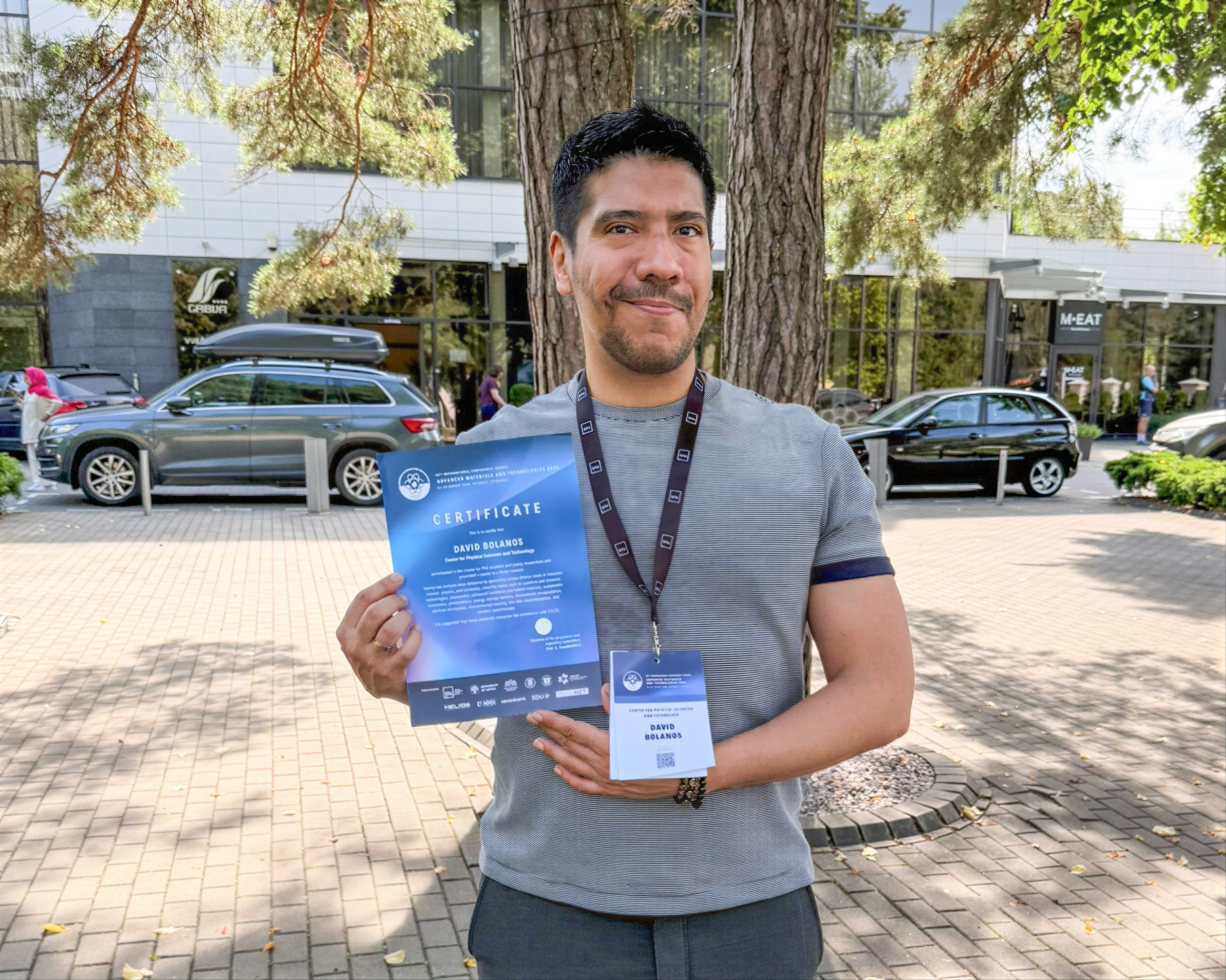
Opening the Path to More Sensitive and Affordable Sensors: FTMC PhD Student Jorge David Bolaños Calvo Recognised at an International Conference
At the international conference-school Advanced Materials and Technologies 2026, held in Palanga, Jorge David Bolaños Calvo, a PhD student at FTMC Department of Laser Technologies, received the Young Scientist Award for the best poster presentation.
The work was titled “Laser-Induced Graphene Fabrication on Kevlar Composite at the Picosecond Laser Regime”. His academic supervisor is Dr Romualdas Trusovas.
Calvo's research focuses on laser-induced graphene (LIG), a graphene structure produced from carbon-containing materials using laser processing. This technology offers a promising route towards the development of low-cost, highly sensitive, and easily manufacturable sensors. Such devices could help detect disease-related biomarkers, monitor environmental contaminants, and contribute to the advancement of personalised healthcare.
“Although my research focuses on laser-induced graphene, the broader significance lies in its potential as a low-cost and scalable platform technology. Beyond biosensing, LIG is being investigated for healthcare diagnostics, environmental monitoring, energy storage, wearable electronics, smart infrastructure, and sustainable technologies.
Because it can be manufactured rapidly and directly on various substrates, it offers a practical route toward technologies that are more affordable, accessible, and environmentally sustainable. These applications address major societal challenges related to health, environmental protection, energy efficiency, and digitalisation, which is why this research has relevance beyond the scientific community.
By combining innovative materials with practical applications, the research aims to bridge the gap between laboratory discoveries and technologies that people can use in their daily lives,” says the FTMC doctoral researcher.
This is the first award of its kind in Jorge's career. According to the laureate, he was pleasantly surprised by the interest his research attracted during the event, as well as by the engaging discussions it generated.
“I really appreciate we have got positive results in relatively short period of time,” adds Calvo.
Source: FTMC