- Home
- News & Events
- News
MIT Professor Markus Buehler on Human-AI Collaboration: Exciting Opportunities Lie Ahead for Lithuanian Science
Artificial intelligence (AI) will not only help develop advanced, previously unimaginable materials, but will also raise new and meaningful scientific questions of its own. This is the future envisioned by Professor Markus Buehler of the prestigious Massachusetts Institute of Technology (MIT), who is optimistic about a world in which AI agents become indispensable partners to humanity.
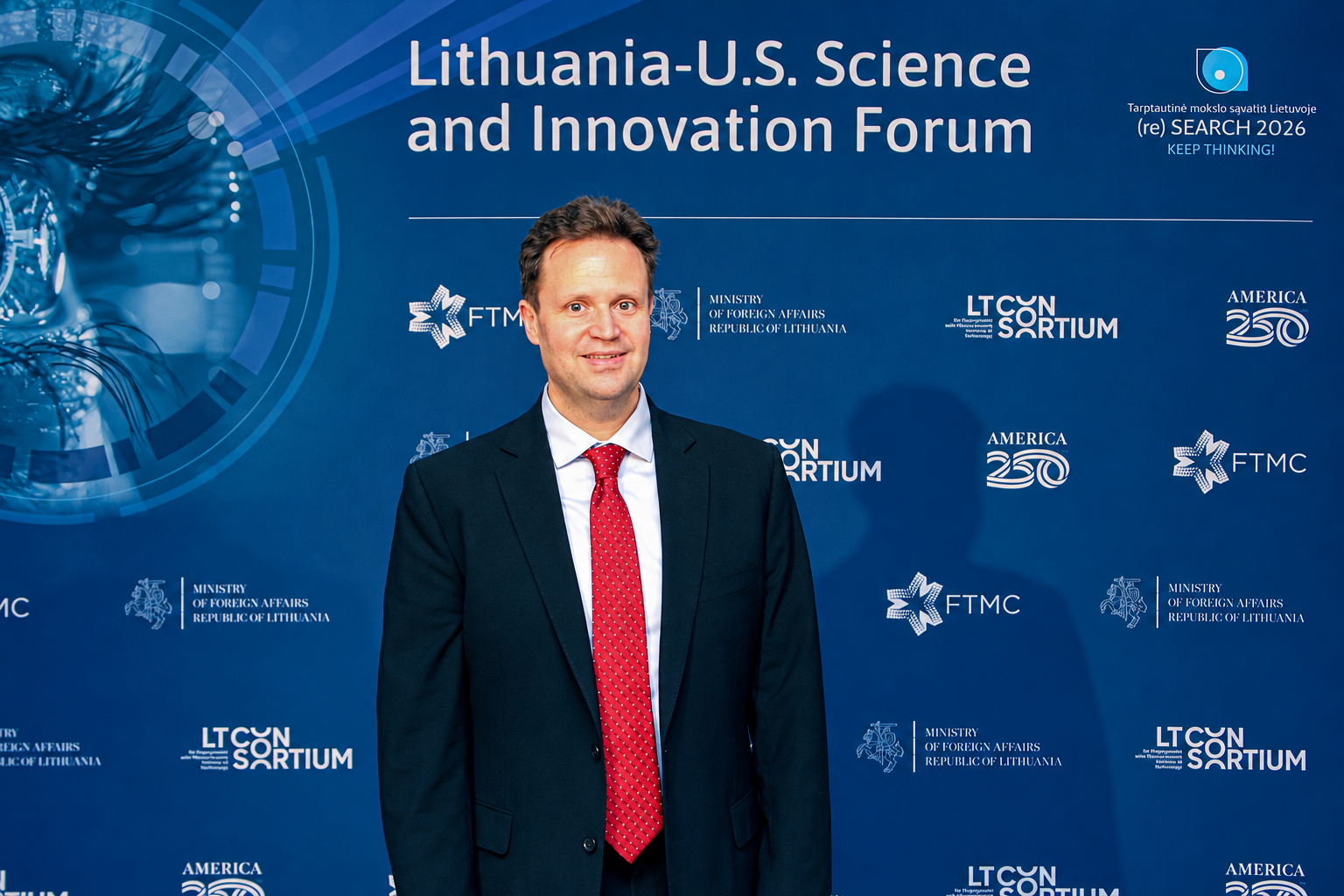
The renowned scientist shared his insights and discoveries at the Lithuania-U.S. Science and Innovation Forum held at FTMC. As one of the event's keynote speakers, he delivered a presentation entitled "Materials Intelligence: AI, Creativity and the Future of Scientific Discovery".
“I'm really excited about open-ended problems. The question is: how do we make agents creative enough to come up with new questions themselves? Many of the early accomplishments of AI involved problems that humans had already defined, with artificial intelligence being used to solve them. One of the things I'm most interested in is figuring out how to make AI ask new questions and generate new ideas on its own.
The second part of this is: how does human civilisation interact with these AIs? As I mentioned in my talk, we'll have growing populations of AI agents living alongside us and within our devices. They're going to become part of our daily lives, so how do we create truly effective interfaces between humans and machines? These interfaces probably won't be limited to keyboards. They'll involve voice, and perhaps robotics and physical AI as well, integrating the intelligence, the "brain" of AI, into the world we experience as humans. So I think there are a number of possibilities,“ says Prof Buehler.
And when discussing this topic, the MIT researcher also sees considerable opportunities for Lithuania.
“We toured Northway Biotech yesterday, and this morning I've also learned a lot about lasers. So I'd say that anything you do in the physical hardware space, whether it's biology, biotechnology, lasers, or similar technologies, presents exciting opportunities. Deep tech, I think, offers particularly interesting prospects for AI because it needs problem spaces to work in. It also often requires experimental validation. So connecting your infrastructure, industries and visions for the future with AI presents a really exciting opportunity.
I can see significant potential in opening up your laboratories into what we call cloud labs. If you make these labs accessible to AI agents, you'll not only accelerate the pace of innovation, but you'll also open up a much larger market. AI agents from around the world will be able to utilise your facilities and contribute to innovation here. It's mutually beneficial to different countries,“ the researcher emphasises.
The Lithuania-U.S. Science and Innovation Forum is organised by the Ministry of Foreign Affairs of the Republic of Lithuania together with its partners, FTMC and the Lithuanian Consortium for Engagement with MIT.
The event forms part of the programme of International Science Week in Lithuania, “(re)SEARCH 2026”. For more information, please visit scienceweek.lt.
Source: FTMC