- Home
- News & Events
- News
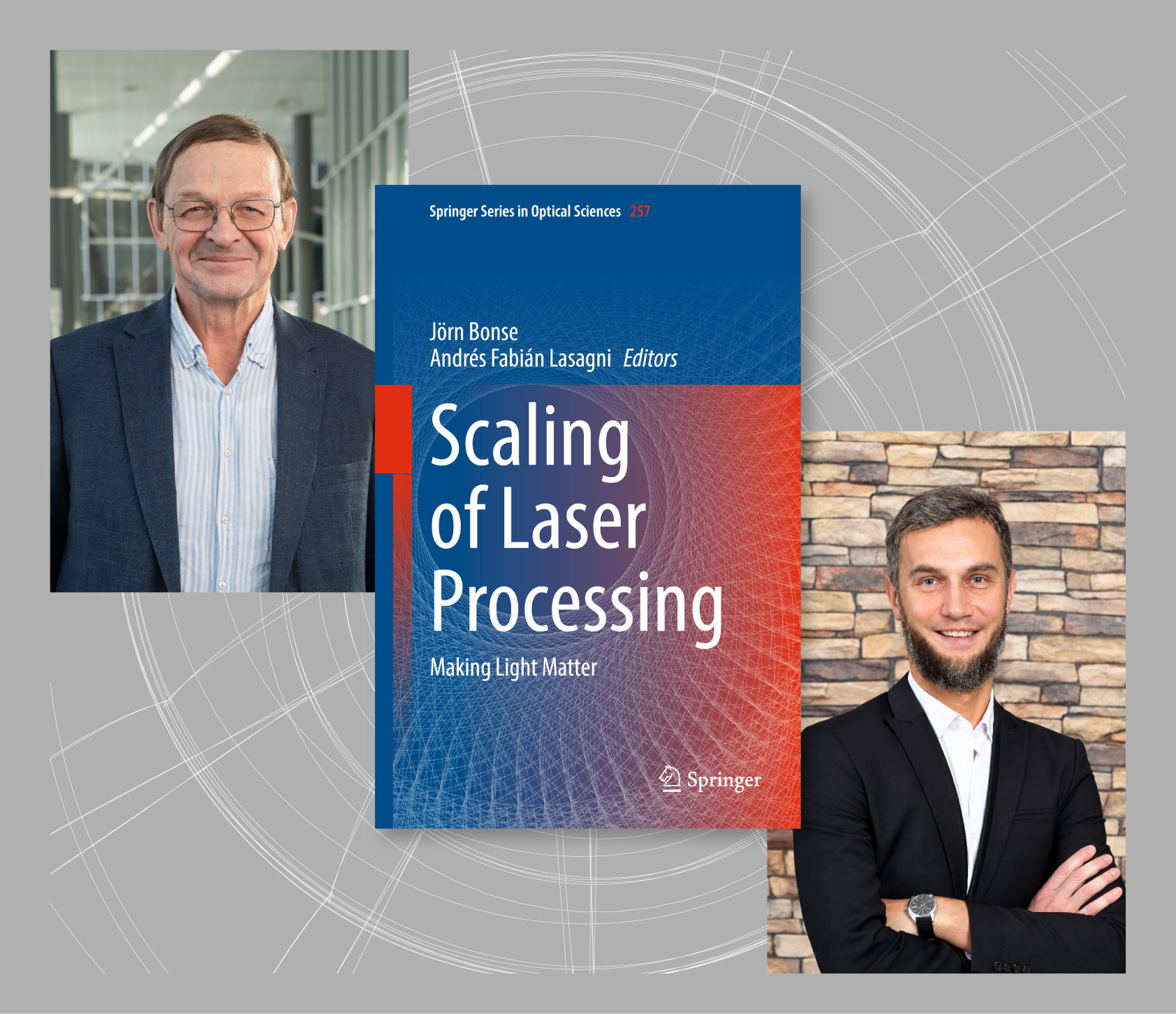
Lithuanian Contribution to Laser Processing Technologies: Chapter by FTMC Researchers Featured in a Prestigious Springer Volume
FTMC Researchers Dr Gediminas Račiukaitis and Dr Mindaugas Gedvilas from the Department of Laser Technologies have authored one of the chapters of the international book Scaling of Laser Processing: Making Light Matter. Their chapter is entitled “Ultrashort Pulse Laser Processing: From Science to Industry.”
It explores the transition of ultrashort-pulse laser technologies from scientific research to industrial applications. One of the main topics is the efficiency of laser ablation (the removal of material using laser radiation): how pulse energy can be utilised to maximise material processing throughput.
The authors review burst mode-processing, in which groups of laser pulses are emitted in rapid succession with extremely short intervals between them. They also discuss the incubation effects, whereby repeated pulses induce changes in the material that reduce the ablation threshold (the minimum laser energy density required for material removal to begin), as well as residual heat accumulation, which occurs when the material does not have sufficient time to cool between successive pulses. The paper examines how these processes influence both processing quality and productivity.
The authors also discuss semi-empirical models of laser ablation and their application to three-dimensional micromachining, surface texturing, and other high-precision processes.
“Increasing the productivity of laser processing is not simply a matter of using higher laser power. What matters most is how efficiently the energy of each pulse is utilised. We are pleased to be able to present this expertise in an international volume published by Springer, thereby introducing the research carried out at FTMC to a wider audience of scientists and industrial practitioners,” says Dr Gedvilas.
The book was edited by Jörn Bonse (Federal Institute for Materials Research and Testing, BAM, Germany) and Andrés Fabián Lasagni (Technische Universität Dresden). It was published by Springer Nature, one of the world's largest and best-known scientific publishing groups, whose publishing heritage spans more than 180 years. The book, part of the Springer Series in Optical Sciences (Volume 257), comprises 41 chapters and more than 2,100 pages covering the fundamentals, technologies, productivity scaling, and industrial applications of laser materials processing.
This contribution highlights FTMC researchers’ longstanding expertise and ongoing efforts to develop more precise, efficient, and industrially relevant laser material processing methods.
Source: FTMC