- Home
- News & Events
- News
Laser System That Fits in the Palm of Your Hand: Technology Developed in FTMC Promises Breakthroughs in Defence, Industry and Medicine
How can we accurately determine whether specific gases are present in our environment? In everyday settings, the cheapest detectors are often used, but their capabilities are insufficient for industrial applications: they cannot always detect small quantities of toxic or other gases. Moreover, they can make mistakes, for example by confusing one gas with another and generating false alarms.
FTMC offers a solution. Its researchers have developed a tiny quantum cascade laser that is both highly accurate and compact. The matchbox-sized device emits infrared light, enabling the detection of individual gas molecules, a capability that could prove valuable both in factories and on the battlefield.
The idea behind this technology was brought to Lithuania by Dr Jan Devenson, a physicist working in FTMC Department of Optoelectronics. The research was later further developed together with Dr Karolis Stašys, Jan’s former PhD student and former Head of FTMC Department of Innovation, who now serves as Head of Defence Projects at the Center.
“With the emergence of more advanced scientific infrastructure in Lithuania and the acquisition of additional equipment, we gained the opportunity to further develop this technology. Eventually, we reached the point where the first Lithuanian quantum cascade lasers were switched on in Lithuania, having been manufactured entirely at our Center from start to finish,” says Dr Stašys.
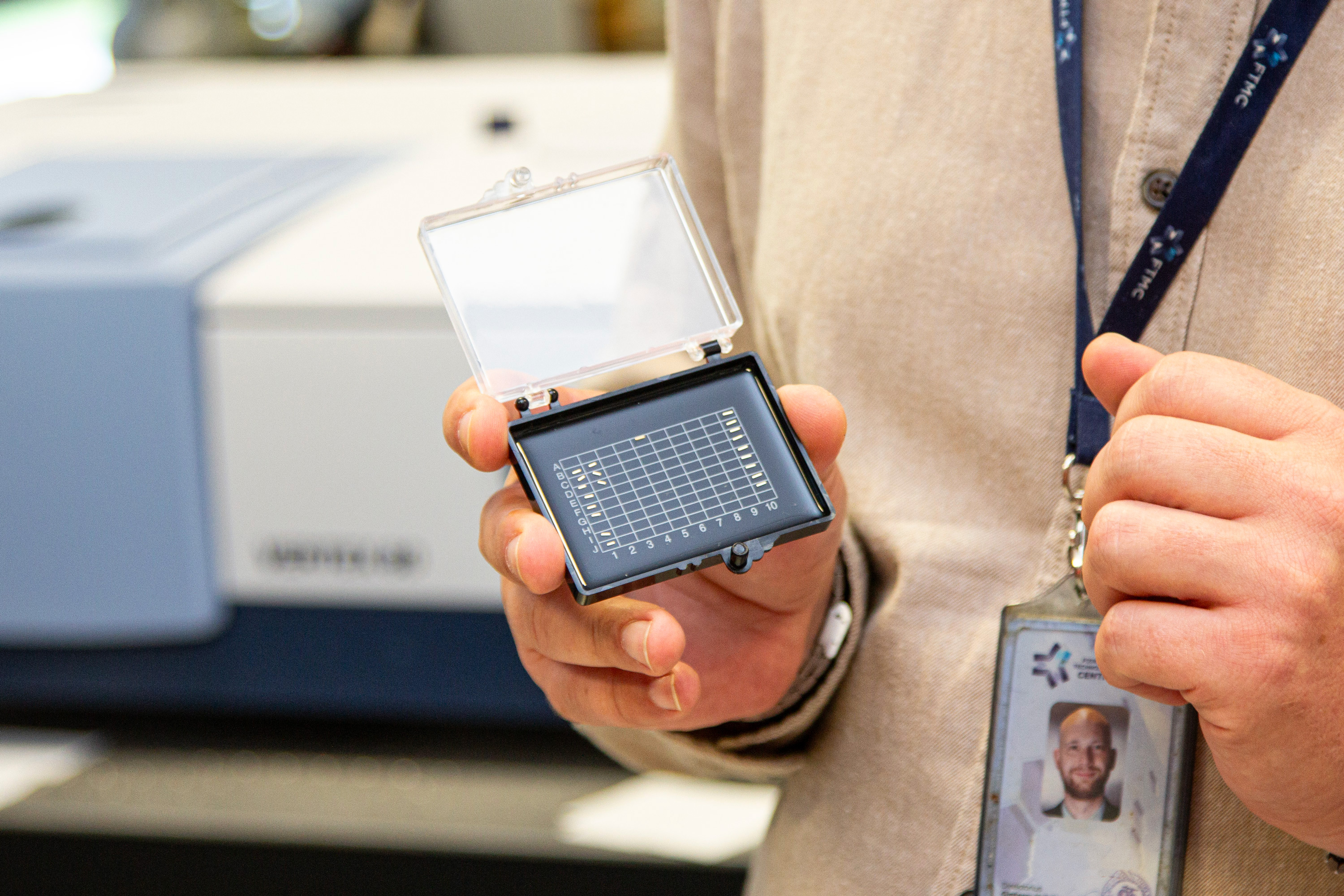
(The highlighted sections show the main components of the quantum cascade laser: laboratory-grown crystal structures. Photo: Gabrielius Mackevičius / FTMC)
A Smaller and More Accurate Device
The key component of the laser is a laboratory-grown “sandwich” of two semiconductor crystals, specifically indium arsenide and aluminium antimonide, small enough to fit on a fingernail. The thicknesses of the crystal layers determine the quantum properties that enable the laser to emit infrared light.
Almost all chemical substances have their own “optical fingerprint” within the infrared region of the spectrum. As a result, when a laser operating at a specific wavelength encounters a particular gas molecule in the environment, it can identify that molecule and report its presence to the system.
“The operating principle is very simple: there is a light source, the laser, and a detector that records how much light has been absorbed. In practice, however, there are several challenges.
One of the ways to detect gases with very high precision is to use a Fourier-transform spectrometer. The problem is that such an instrument is enormous, heavy and expensive: a single unit costs at least €100,000, and additional accessories, such as a gas cell, are also required. As a result, the overall system becomes even more costly.
Furthermore, these instruments do not always provide sufficient sensitivity for detecting extremely low concentrations of gases. There are hazardous substances, such as phosgene, where even a very small concentration can cause harm.
Transporting such a large device to the scene of an incident, for example after an accident at a chemical plant or in other emergency situations, is highly impractical. Smaller systems are available, roughly the size of a large jar, but they are still relatively bulky, and some cost as much as half a million euros.
Our goal was to create a cheaper and significantly smaller system capable of operating within a very specific frequency range. For example, our entire laser crystal ‘sandwich’ is only two millimetres long and half a millimetre wide, while the complete device housing is about the size of a matchbox,” explains Karolis Stašys.
He compares the concept to a household smoke detector. It contains small openings through which air enters, while an internal system analyses the incoming substances. The FTMC device could operate according to a similar principle.
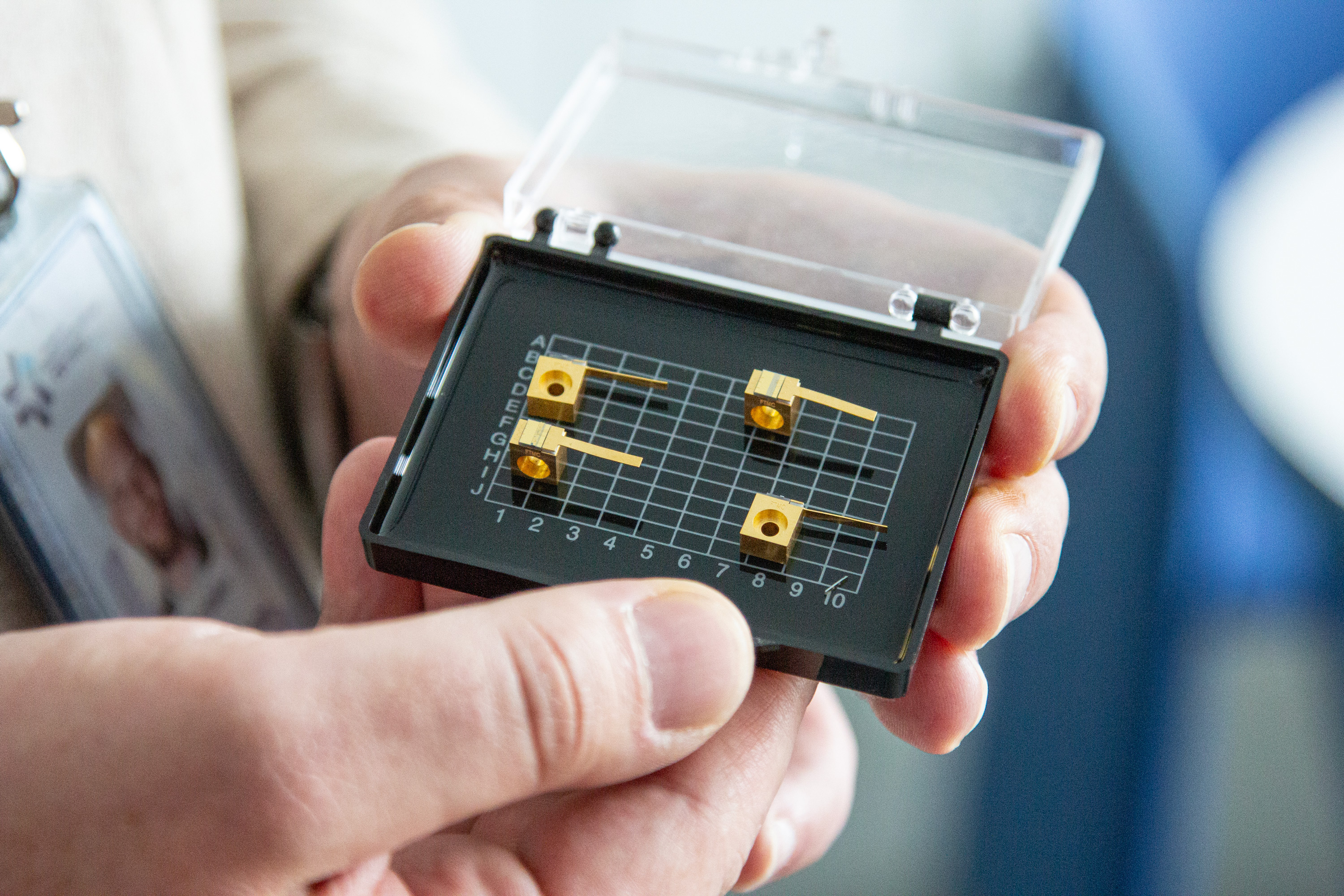
(The finished quantum cascade lasers are shown here. Photo: Gabrielius Mackevičius / FTMC)
From the Battlefield to Disease Diagnostics
Discussing the potential applications of the system, FTMC Head of Defence Projects first points to situations involving armed conflicts or hostile provocations. The invention would be capable of detecting even very small quantities of hazardous gases both outdoors and indoors.
Quantum cascade lasers could also be highly useful in industry:
“For example, in a factory producing aerosol paints or other spray products, it is important to know whether the packaging equipment seals containers properly. If sealing is inadequate and the product leaks, particularly when hazardous or toxic substances are involved, the consequences can be serious.
Such a system could be installed above a production line and inspect every aerosol can, determining whether it has been properly sealed based on the specific gases being monitored.”
Another important field is medicine. The researcher speaks of an “artificial nose” capable of non-invasively detecting certain diseases through compounds present in blood or skin emissions. It would simply require placing the device against a person’s hand or another part of the body.
According to Stašys, discussions with businesses are currently under way to help transform the technology into a widely used commercial product. He stresses that achieving this objective requires time and sustained effort, as different applications require crystals operating at different frequencies, and growing such crystals is a complex process.
“If businesses are interested, they can contact FTMC Department of Innovation. We continue to advance research and development in the field of quantum cascade lasers. Progress would be even faster if we had an industrial partner.
Companies should certainly not be afraid of deep technologies. Although their development takes time, they tend to deliver substantial returns in the long term,” says the expert.
By Simonas Bendžius