- Home
- News & Events
- News
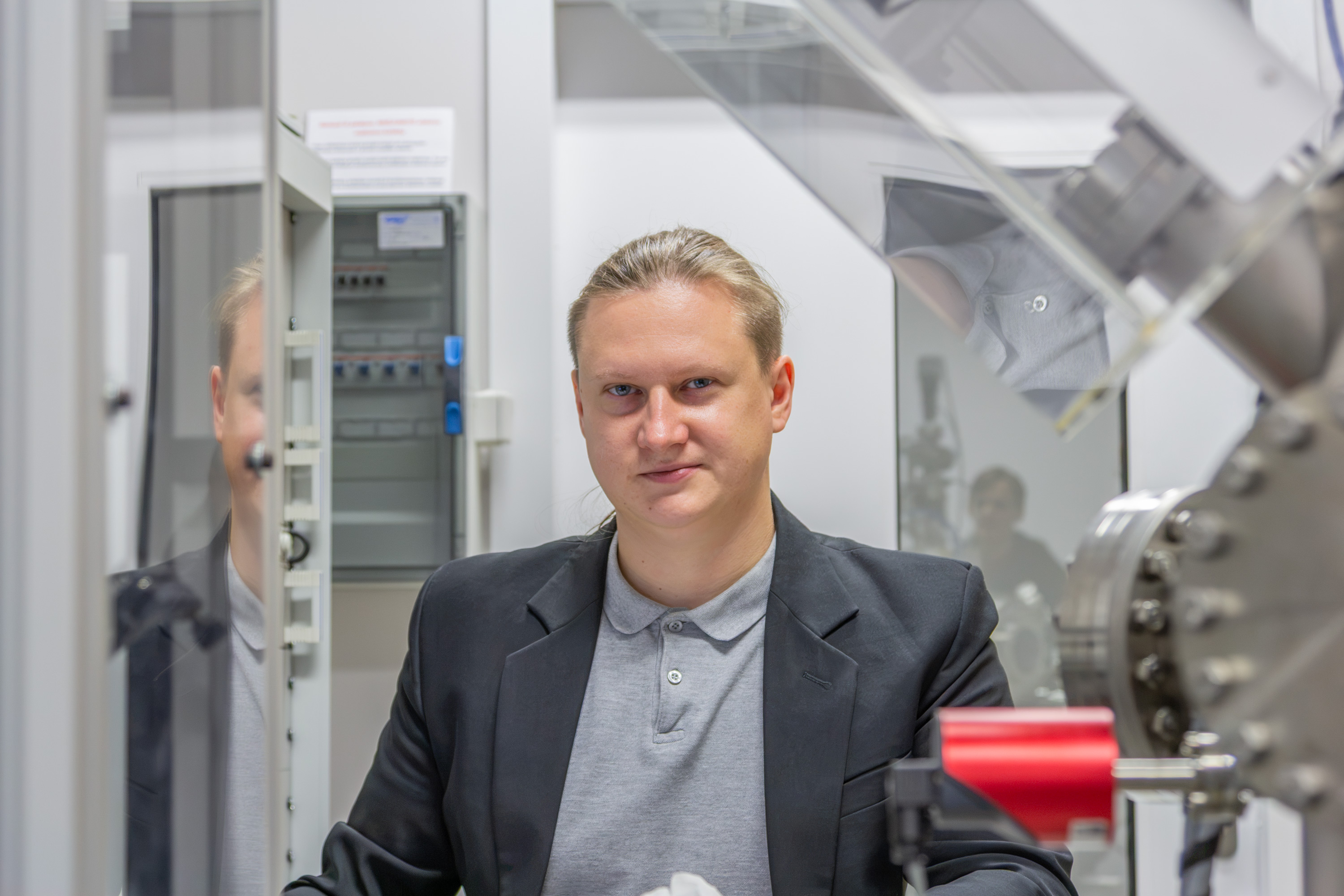
Invisible to the Naked Eye, These Materials Could Power Future Technologies: FTMC Physicist Dr Vilius Vertelis to Lead Promising New Project
When a material becomes only a few atoms thick, its properties can change so significantly that entirely new technological possibilities emerge. Over the next three years, FTMC researcher Dr Vilius Vertelis will investigate precisely such materials while leading a research team for the first time. The project's goal is to bridge the gap between fundamental discoveries and practical technologies that could one day be used in sensors, memory devices and next-generation electronics.
The path from a scientific discovery to a working device requires more than understanding a material's properties. Researchers must also learn how to apply the material reliably and reproducibly on a larger scale.
That will be the task facing the FTMC team.
A Vital Property of the Electron for Developing New Technologies
Physicists from the Nanostructured Materials and Sensors Laboratory of FTMC Department of Functional Materials and Electronics have launched a project funded by the Research Council of Lithuania. The project will focus on ultra-thin two-dimensional (2D) magnetic materials, namely chromium ditelluride (CrTe₂) and iron gallium telluride (Fe₃GaTe₂), as well as structures built from these materials.
"2D ferromagnetic materials are layered crystals composed of atomic sheets, each only a few atoms thick. Magnetic atoms, such as iron or chromium, are located in the middle of the sheet, while layers of other elements, such as tellurium, cover them on both sides. These sheets are held together by very weak van der Waals forces, which means they can be separated using nothing more sophisticated than adhesive tape.
A large crystal looks like a greyish, metallic flake. The thinnest isolated layers are so thin that they can only be seen under a microscope, where they appear as tiny coloured spots on the substrate used to transfer them," explains Dr Vertelis.
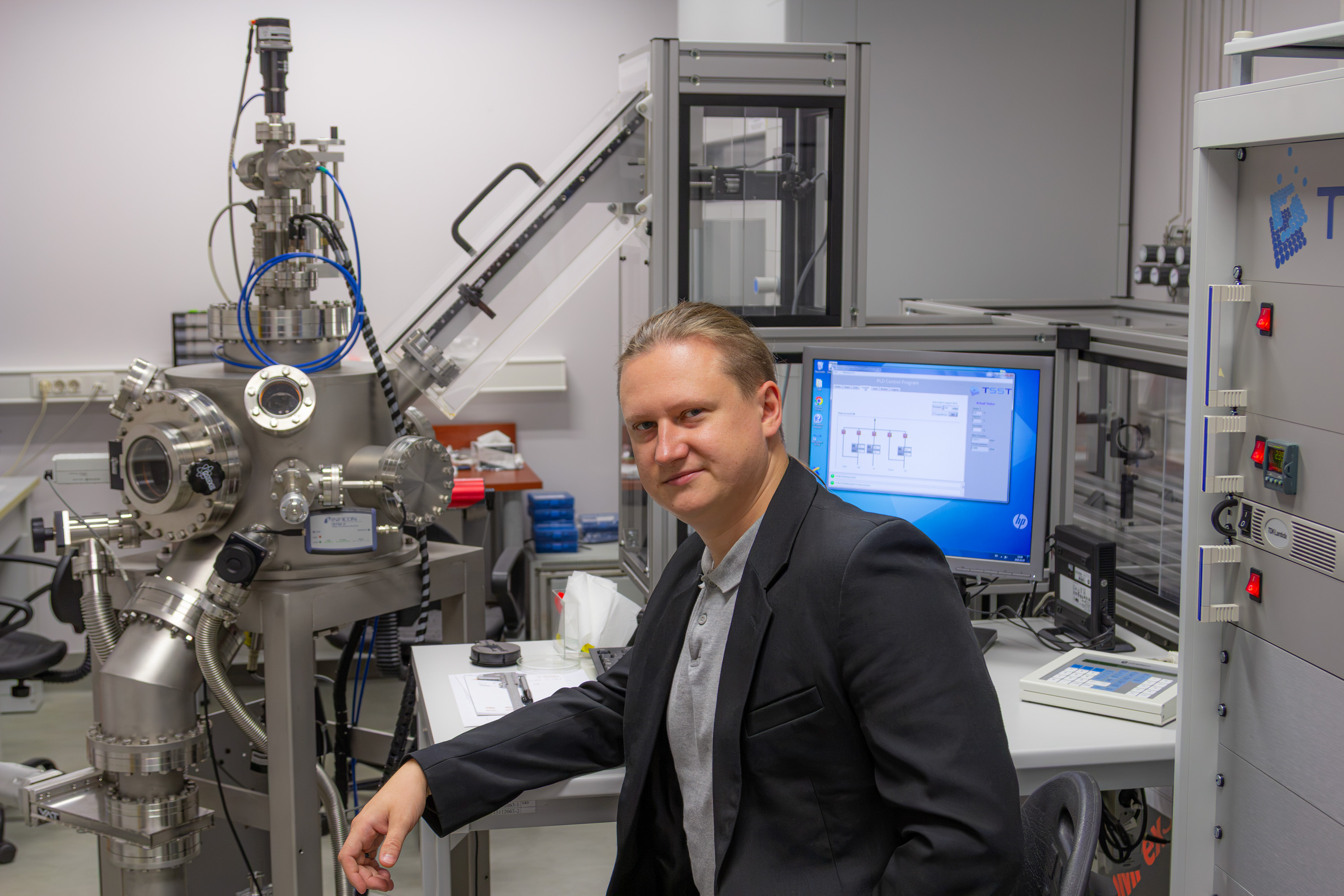
(Dr Vilius Vertelis. Photo: Gabrielius Mackevičius / FTMC)
Together with his colleagues, he will combine atomic layers with different properties in ways that allow electrical current and magnetic characteristics to be controlled through interactions between the layers. According to Vertelis, such structures could play an important role in spintronics, a field of technology that uses an intriguing quantum property of electrons known as spin to process information.
The term originated because electrons behave as if they were spinning around their own axis. In reality, spin can be thought of as an internal "compass" that points either up or down.
This property is of fundamental importance. Not only are magnets possible because of electron spin, but so is the entire world around us. According to the laws of physics, only two electrons can occupy the same atomic orbital, and only if one electron's "tiny magnet" points up while the other's points down. Without this rule, different chemical elements would not exist, chemical reactions would not occur, and all matter in the Universe would collapse into a uniform, lifeless dense sphere.
"To me, electronics is a bit like draughts, whereas spintronics resembles chess," says the FTMC scientist. "The pieces in draughts are largely identical, while chess pieces have additional characteristics and behave differently. The same applies to electrons in spintronics: not only their electric charge matters, but also the additional property of spin, which allows them to behave in different ways."
According to the physicist, if stable large-area systems based on 2D magnetic materials can be developed, they could provide the foundation for new magnetic sensors, memory technologies and other low-power electronic solutions.
"One example is magnetic random-access memory (MRAM). In MRAM, information is stored not as electrical charge, as in today's computer memory, but through the direction of magnetisation. As a result, data remain stored even when power is switched off. The device can enter a complete sleep state without consuming energy and instantly resume operation afterwards.
Memory cells made from atomically thin two-dimensional ferromagnets could be thinner and more efficient than current technologies, while requiring less energy for data writing. This is particularly important for the Internet of Things and wearable devices that must operate for long periods on small batteries," the researcher explains.
He adds that the greatest success of the project would be the creation of a centimetre-scale 2D magnetic structure capable of operating stably at room temperature. Although one centimetre may sound small, achieving this would represent a major step forward in the field, moving from isolated experimental samples towards technologies that could eventually be manufactured on a much broader scale.
"Even smaller achievements that help move us towards that goal will still be important," says Vilius.
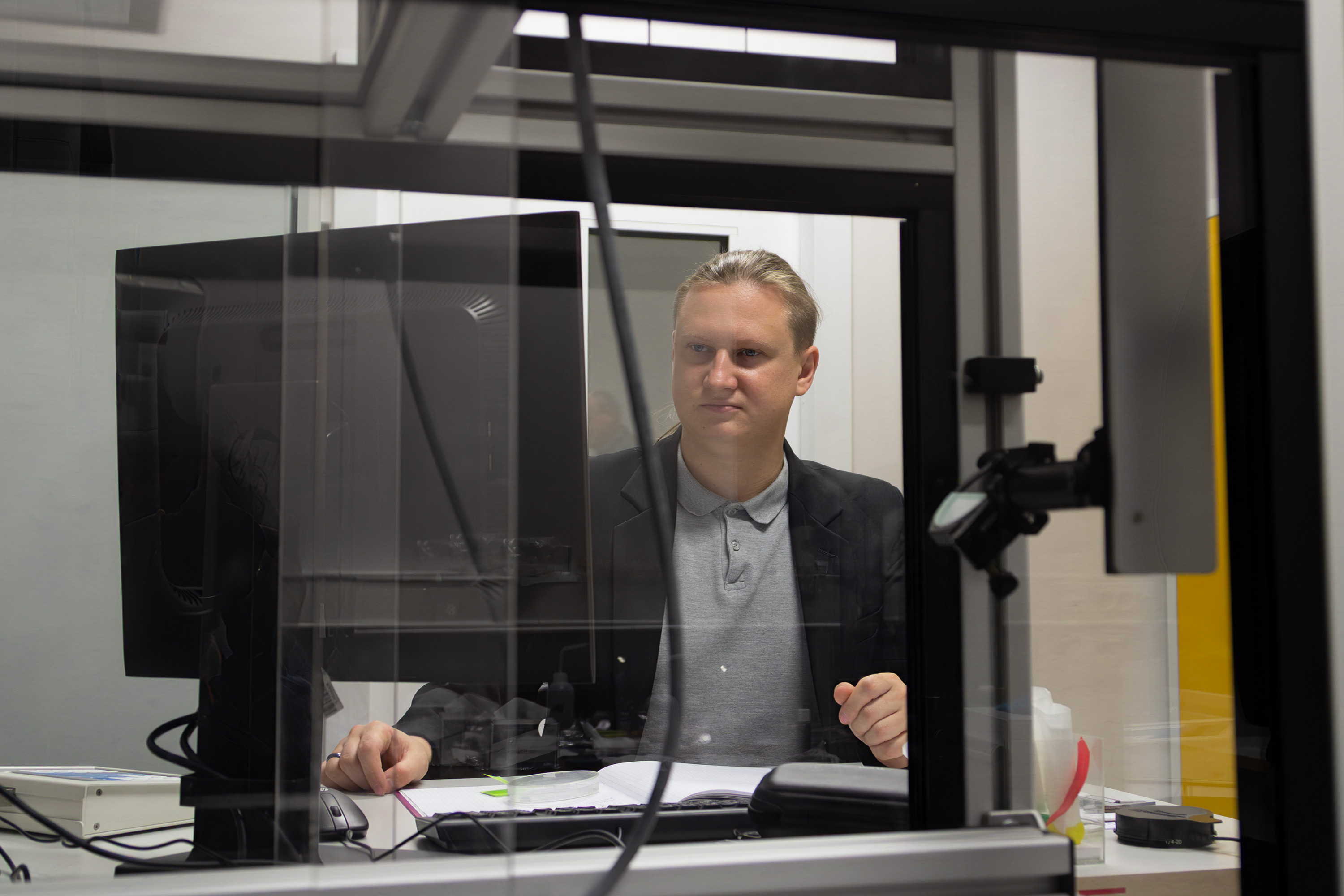
(Dr Vilius Vertelis. Photo: Gabrielius Mackevičius / FTMC)
Stepping into a New Field
This is the first project led by Dr Vertelis. After defending his PhD thesis five years ago, he undertook a research placement at the French-German Research Institute of Saint-Louis (ISL), jointly operated by the French Agency of Defence Innovation and the German Ministry of Defence.
For the past several years, the physicist has continued his scientific career in Lithuania. According to Vilius, one of FTMC's greatest strengths is the wide range of expertise concentrated within a single institution, combined with access to state-of-the-art research equipment:
"If one method doesn't work, another can be tried. If a question arises, there is often someone just a few offices or laboratories away who has already encountered a similar challenge.
At FTMC, we have very extensive infrastructure and researchers from many different disciplines. This allows us to have not only a Plan A but also Plans B and C. There is always someone to consult and explore solutions with. It is precisely this environment that enables us to tackle more complex questions that a single research group might struggle to address on its own."
Even so, as he embarks on this project and takes responsibility for his own team, the FTMC scientist admits to feeling a mixture of nervousness and excitement. He even has a word for it: "nervusiasm". Yet, he says, leadership itself is not what concerns him most.
"In science, you almost never know exactly how to do something, because what you're trying to do is new. The subject of research itself is often uncertainty. Science is simply a systematic way of reducing that uncertainty."
.jpg)
(Dr Vilius Vertelis. Photo: Remigijus Juškėnas / FTMC)
For this reason, the team will play a crucial role in the project. It will bring together early-career researchers, PhD students and postdoctoral fellows from different fields. Some will focus on growing new 2D materials, others on fabricating ultra-thin layers, while others will investigate the electrical and magnetic properties of the resulting structures.
The project will extend beyond Lithuania through international collaborations. Together, the researchers will seek to answer a fundamental question: can materials only a few atoms thick become the foundation of real-world technologies of the future?
This research is carried out within the “My First Research Team” project (No. 10-092-P-0001), implemented in partnership with the Research Council of Lithuania under Progress Measure No. 12-001-01-01-01 “Improving the Research and Study Environment” and co-funded by the European Union.
By Tatjana Švec and Simonas Bendžius