- Home
- News & Events
- News
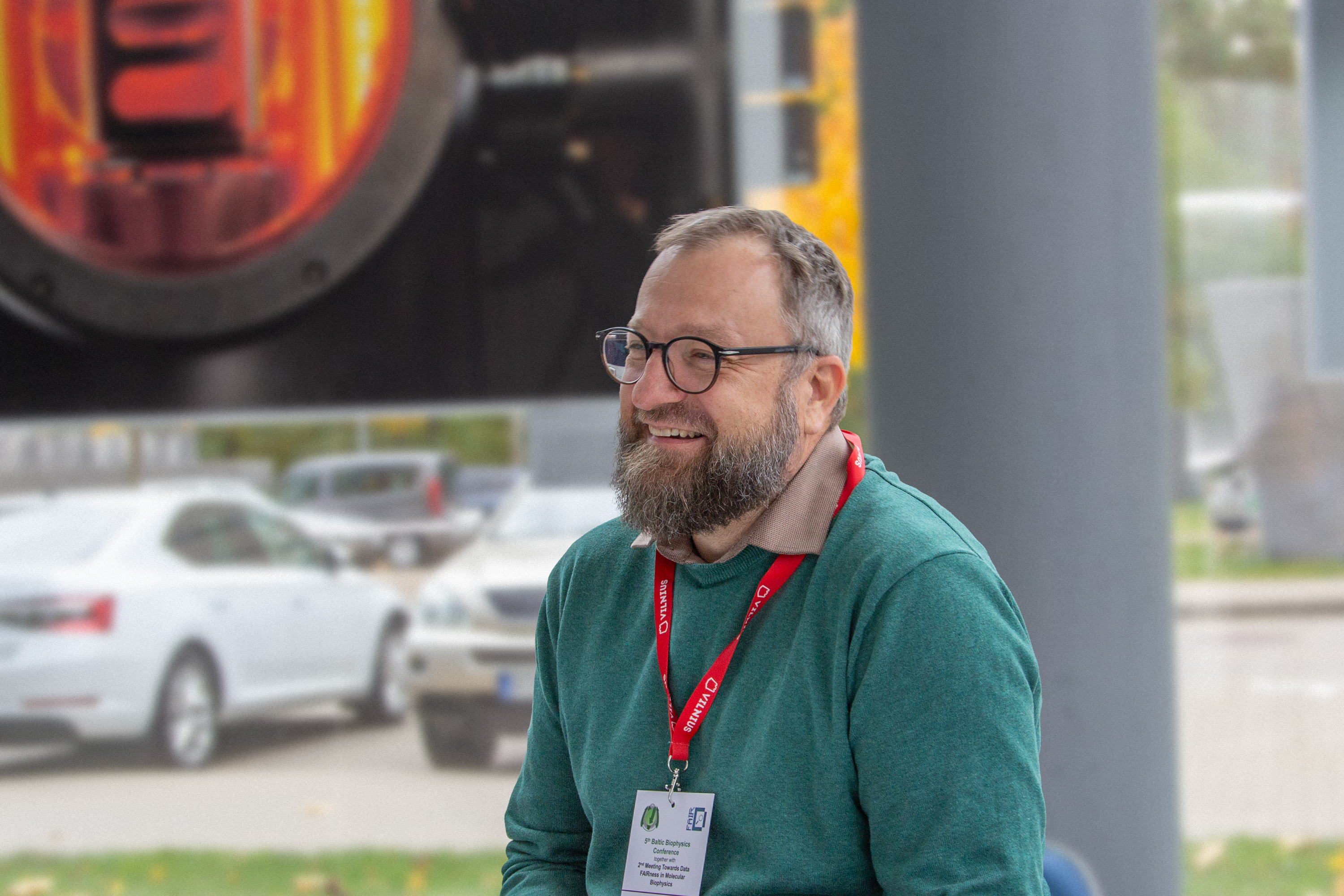
Insights from a Nobel Laureate and the Untapped Potential of Microscopy: Dr Arūnas Stirkė Reflects on the Baltic Biophysics Conference
From advanced microscopy and nanomedicine to molecular and plant biophysics, these and other life science topics were explored at the Baltic Biophysics Conference in Vilnius, which brought together an international community of researchers. The event was organised by the Vilnius University Life Sciences Center, with FTMC as a partner.
“The conference is clearly growing. The number of participants increases every year, bringing together people working at the forefront of scientific research, while at the same time highlighting the strong connection between fundamental science and its practical applications. It is particularly fascinating to see how major scientific discoveries are transformed into tangible instruments and technologies,” says Dr Arūnas Stirkė, a researcher at FTMC Department of Functional Materials and Electronics and a member of the Lithuanian organising committee, who has now contributed to organising this high-level conference for the second time.
He notes that, although the event is often associated with biophysics, it extends far beyond the boundaries of a single discipline. Biology, chemistry, physics and medicine all converge here into a unified whole. Equally evident is the growing importance of artificial intelligence and machine learning. Data volumes are increasing rapidly, their analysis is becoming more complex, and new computational methods are therefore becoming essential.
“It is worth emphasising that this year’s conference attracted an exceptionally large number of renowned microscopy researchers. One could say that a kind of European elite of the field gathered in Vilnius. Lithuanian scientists working in Germany also played a significant role in assembling such a strong international programme. In my view, this raises the bar for the conference and helps establish a new standard,” the researcher observes.
Modern Microscopy Continues to Deliver Surprises
One of the highlights of the event, according to Dr Stirkė, was the remote lecture delivered by Nobel Prize laureate Prof. Dr Stefan Hell, Director at the Max Planck Institute for Multidisciplinary Sciences in Göttingen and the Max Planck Institute for Medical Research in Heidelberg.
The Romanian-German scientist is one of the pioneers of super-resolution microscopy (nanoscopy), having developed methods that overcame the resolution limits of conventional optical microscopes and enabled the observation of individual molecules.
His invention, Stimulated Emission Depletion Microscopy (STED), has become one of the most important tools in modern biomedicine and life sciences. It allows researchers to study cells, proteins and other biological structures at the nanometre scale in far greater detail.
According to Dr Stirkė, microscopy has advanced enormously over recent decades. A modern microscope is no longer merely an optical instrument. It is a complex system that combines optics, lasers, electronics, software and sophisticated data analysis methods.
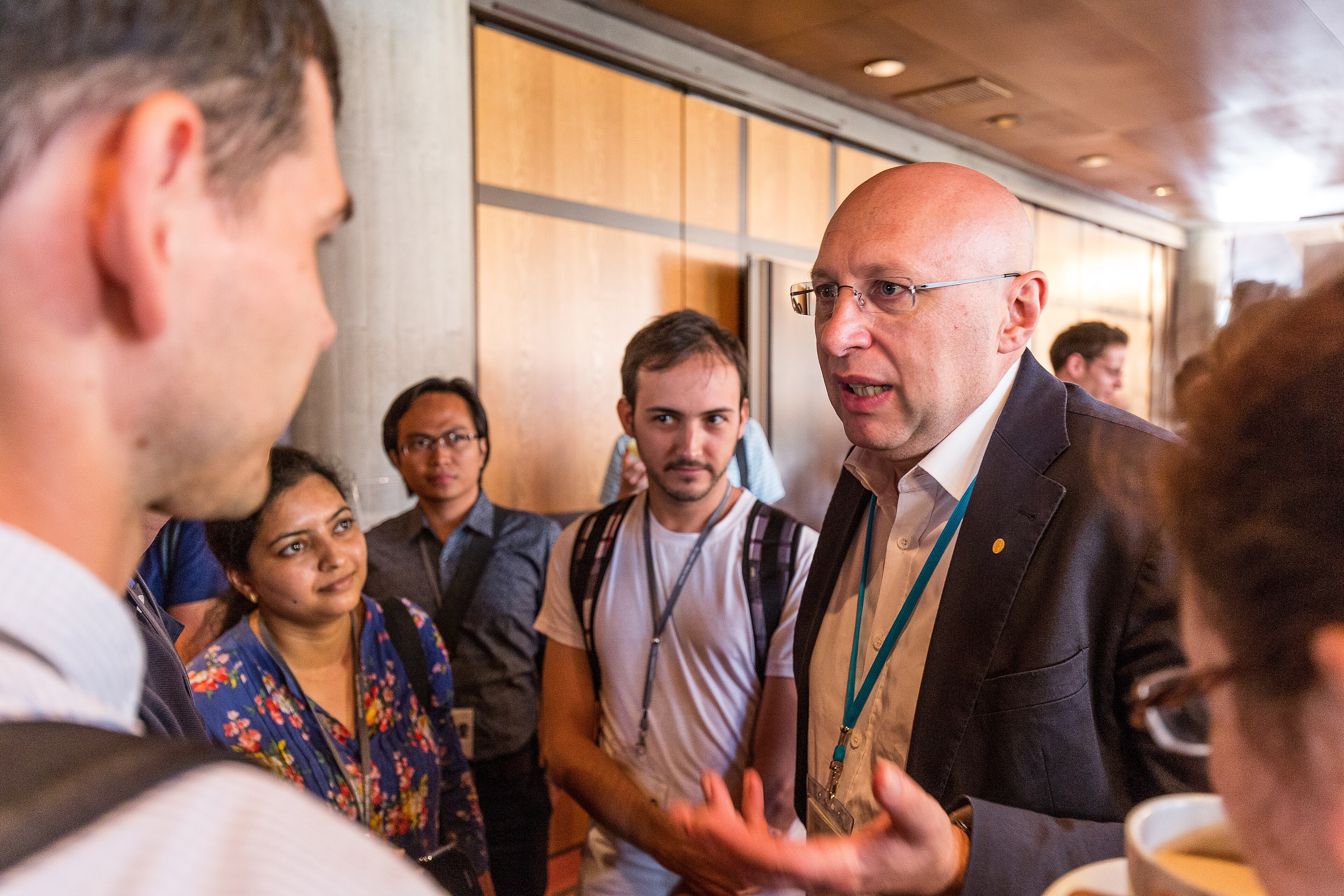
(Prof Stefan Hell. Photo: Ch. Flemming / Lindau Nobel Laureate Meetings / Wikipedia.org)
He explains that the examples presented by Prof Hell vividly demonstrated the new opportunities this creates. Researchers can now observe processes within living cells not only at higher resolution but also at much greater speed, making it possible to detect phenomena that were previously impossible to capture.
“One classic example, familiar to many people, is the kinesin protein found in living organisms, which appears to ‘walk’ along the surface of a microtubule on two tiny ‘legs’. It acts as a kind of cargo carrier, moving along intracellular tracks in microscopic steps and transporting materials to where they are needed within the cell.
What was particularly fascinating in the lecture was the demonstration that even such a seemingly well-understood process still contains many unanswered questions. When scientists were able to observe the process around ten times faster than before, new details emerged: kinesin does not simply move forwards. It sometimes pauses, slows down, or even briefly alters its rhythm of movement. Previously, it was believed to advance regularly from one protein subunit site to the next, but more detailed observations revealed a far more complex picture. Why this happens remains unclear.
These are precisely the kinds of unexpected details that pave the way for new discoveries. Every time technology allows us to look deeper or more accurately, new questions arise. This is important not only for fundamental science and our understanding of how biological systems function but also for disease diagnostics and future biomedical technologies. Conferences such as this help us identify where the breakthroughs of tomorrow may lie,” says the FTMC researcher.
FTMC’s Potential Has Yet to Be Fully Realised
Speaking about FTMC in this context, Dr Stirkė reminds us that the Center has deep-rooted traditions in biophysics dating back to the former Institute of Physics, which was merged with several other institutes to form FTMC in 2010. It was home to the scientific school of Prof. Habil. Dr Leonas Valkūnas and to significant research on photosynthesis and its models. According to the researcher, with additional effort FTMC could achieve a new qualitative leap in this field.
“We have accumulated extensive experience and built a strong scientific foundation. Yet sometimes it feels as though we are not making full use of that potential. The knowledge, expertise and traditions remain, but we do not always find the most effective ways to apply them in today’s context.
FTMC has several very strong microscopy groups. The challenge is that they are spread across different laboratories. For a long time, I have been thinking about the idea of a shared microscopy infrastructure centre, a common platform that would bring together all the expertise and equipment in one place. And I am not speaking only about providing services. The presentations at this conference clearly showed that microscopy is far from an exhausted field. There is still tremendous scope for high-level scientific research. If we could consolidate our existing strengths, we could achieve much more.
We already have excellent examples. Dr Egidijus Auksorius’ group has developed unique instruments and equipment, while Dr Artūras Ulčinas’ team has also built distinctive systems and is advancing solutions in atomic force microscopy. More broadly, many of our laboratories are equipped with advanced microscopes serving a wide range of research fields,” the scientist notes.
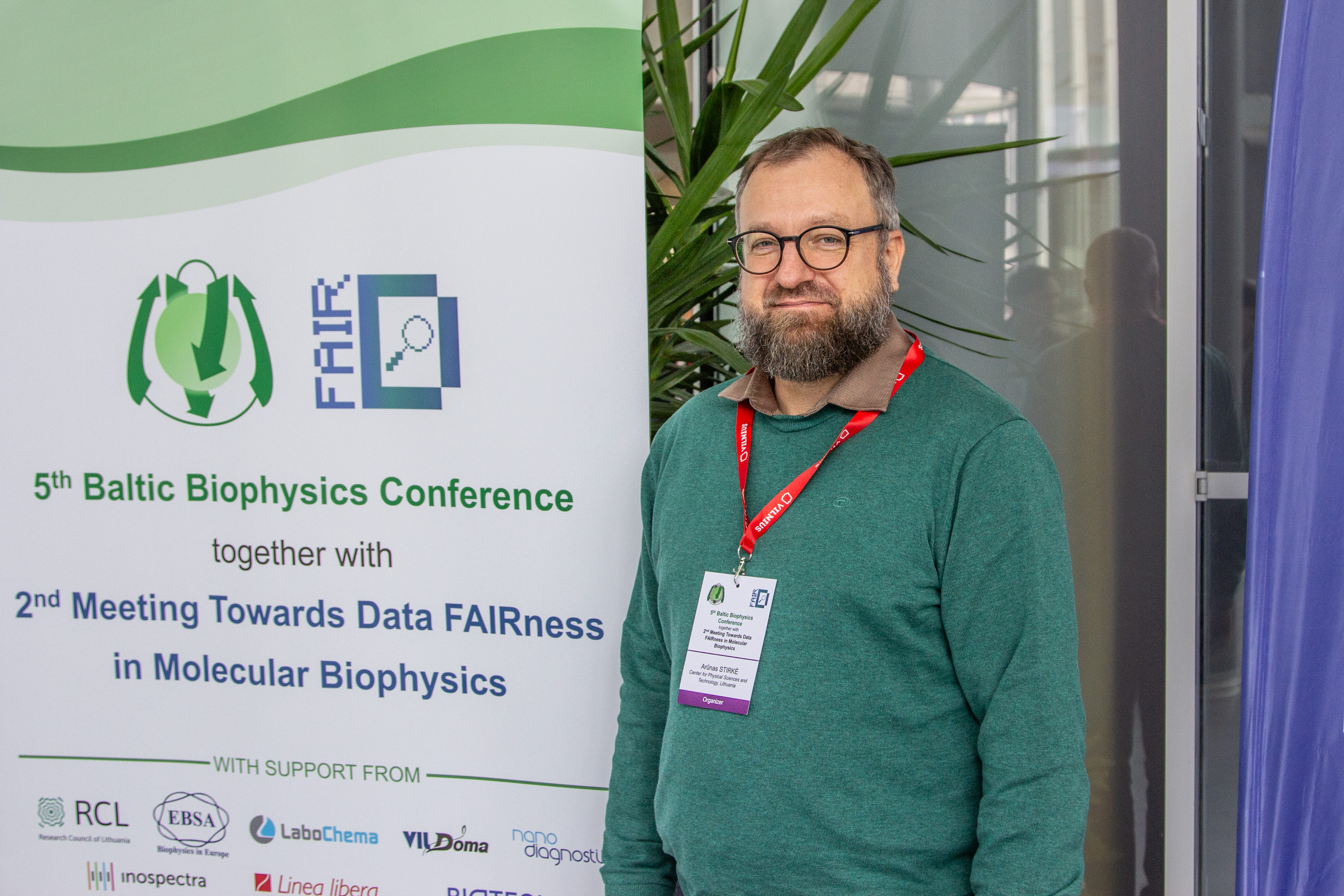
(Dr Arūnas Stirkė. Photo: Gabrielius Mackevičius / FTMC)
International Cooperation Strengthens Lithuanian Science
The Baltic Biophysics Conference provides a meeting place for researchers from different countries and scientific disciplines. Such gatherings enable participants not only to present their findings but also to establish long-term collaborations, exchange methods and share ideas that may develop into joint research projects.
This year’s conference featured particularly strong participation from Italian scientists. As Dr Stirkė explains, this reflects scientific ties cultivated over decades between researchers in the two countries. The conference’s international visibility was further enhanced by the involvement of the Embassy of Italy. The event concluded with a discussion at the Italian Cultural Institute entitled “Biophysics in Italy and Lithuania: Links, Collaborations and Opportunities.”
“The biophysics community in Lithuania, particularly at the National Cancer Institute, has been collaborating with Italian scientists for several decades. As was highlighted in one of the conference presentations, the first Lithuanian-Italian seminars on cancer diagnostics and the application of nanotechnologies in medicine were already taking place towards the end of the last century.
Researchers from Vilnius University have also contributed to these links through many years of cooperation with Italian research institutes. It is therefore no surprise that this year we welcomed a particularly large Italian delegation, accounting for around one-third of all international guests. The Embassy’s event demonstrates that the Baltic Biophysics Conference is receiving attention not only within the academic community but also at the international and diplomatic levels,” says the FTMC scientist.
By Simonas Bendžius