- Home
- News & Events
- News
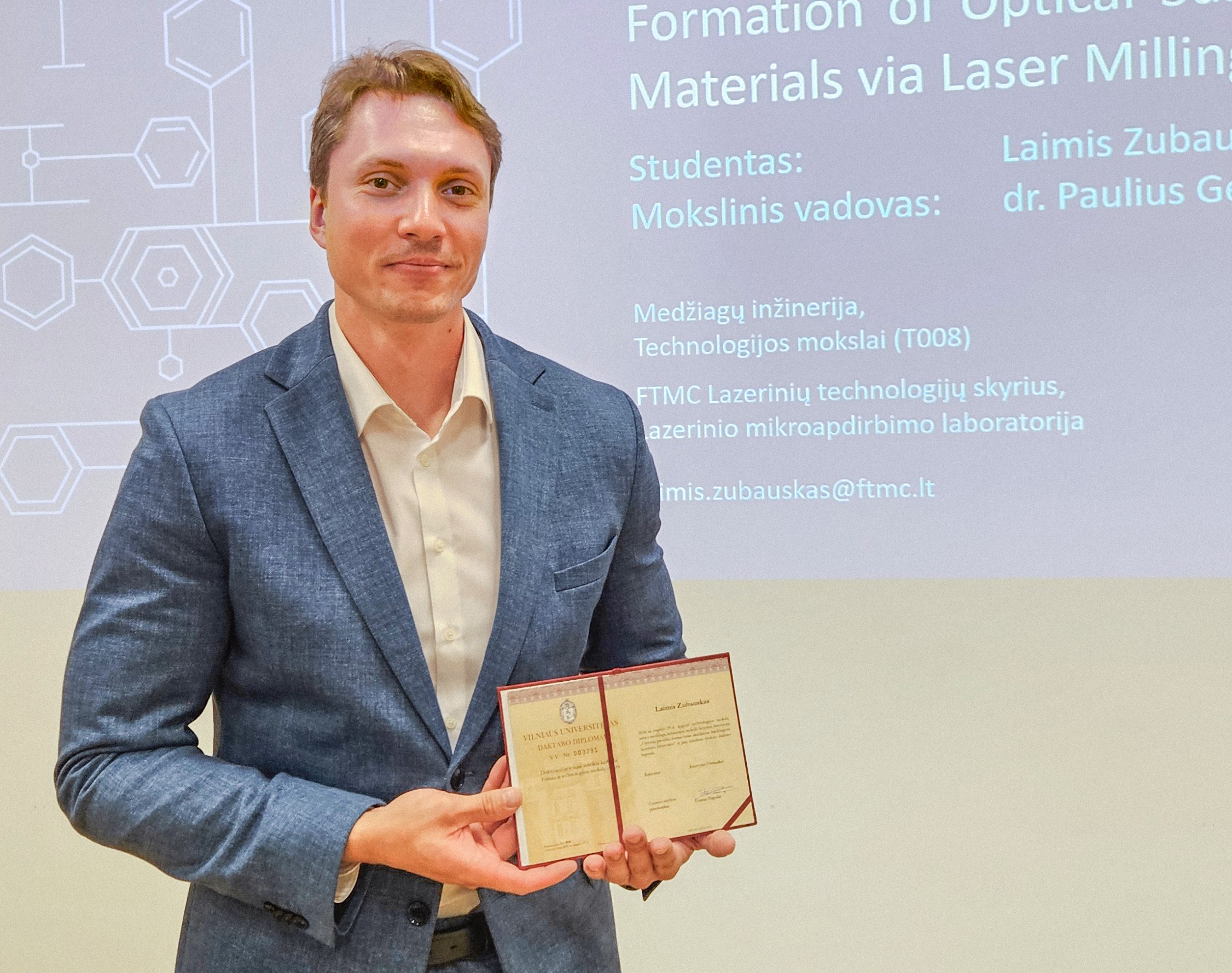
Glass Optical Elements: Faster Manufacturing Methods Earn Laimis Zubauskas a PhD in Technological Sciences
Glass is a widely used material for the fabrication of optical elements, that is, components designed to manipulate light. Owing to its excellent transparency, durability, and resistance to environmental effects, glass is used to produce a wide range of components, including lens arrays employed in imaging, illumination, sensing, and telecommunications systems.
Conventional methods for manufacturing micro-optical elements can achieve high quality, but they often involve complex, multi-stage processes and limit the variety of achievable shapes. As a result, increasing attention is being paid to laser-based technologies, which make it possible to cut, shape, and polish glass within a single system.
This is the field of research pursued by Dr Laimis Zubauskas of the FTMC Department of Laser Technologies, who has successfully defended his doctoral dissertation, “Formation of Optical Surfaces in Transparent Materials Via Laser Milling Technology” (supervisor: Dr Paulius Gečys).
Using lasers, he fabricated complex optical structures from glass, including arrays of numerous small lenses formed on a single glass surface. The key idea was to perform as many production stages as possible with lasers: first cutting the glass, then shaping the desired surface, and finally polishing it with a different laser. Ideally, all of these stages could be integrated into a single manufacturing system combining two different lasers.
“The main challenge is that laser-based glass removal, particularly when using direct laser milling technology, is a relatively slow process. In my dissertation, I investigated ways of accelerating it while maintaining high shaping accuracy and achieving the best possible surface quality. I studied how a thin layer of water affects glass cutting, how surface shaping changes when using laser pulses of different durations, and what occurs when employing bursts of pulses at extremely high repetition rates in the gigahertz (GHz) range.
The goal was not only to investigate these individual processes but also to demonstrate that they can be integrated into a practical and functional manufacturing process for optical elements,” says Dr Zubauskas.
According to Laimis, although the research itself is highly technical, its central idea is straightforward: laser milling can be used to shape glass with great precision, creating surfaces capable of controlling light.
“Such optical elements are used in a wide range of applications, from lighting and imaging to sensors, telecommunications, and other optical systems. The lens arrays produced during my research demonstrated that they could modify the shape of a light beam and distribute its intensity more uniformly.
For example, I fabricated two lens arrays that were used to homogenise the light beam of ultraviolet LEDs, making the intensity distribution more uniform. Initially, the beam exhibited significant intensity variations, but it was possible to produce a uniform rectangular beam profile. These optical elements were integrated into a photolithography system, where light is used to create very small patterns and structures.
Laser-based manufacturing offers considerable freedom in tailoring the shape of optical elements. This is particularly important for the production of complex, customised, or small-batch optical components, which often require specialised tooling, moulds, or intricate production chains when manufactured using conventional methods,” says Dr Zubauskas.
The newly awarded PhD is particularly pleased that the dissertation went beyond experiments and graphs. The research ultimately resulted in a fully functional optical element that could be tested in a real optical system.
“Another significant outcome is that I gained a much clearer understanding of how different laser operating regimes influence glass processing. For instance, under certain investigated conditions, femtosecond pulses provided higher material removal efficiency and better surface quality than picosecond pulses. Meanwhile, the GHz burst regime can increase material removal rates by more than an order of magnitude, but it also significantly degrades surface quality. These findings help determine when such a regime is advantageous and when alternative processing methods are preferable,” notes the FTMC researcher.
The dissertation can be accessed via this link.
Source: FTMC