- Home
- News & Events
- News
FTMC Researchers’ Paper Among the Most Popular at Prestigious Publisher Wiley
The prestigious US publisher Wiley has recognised the most widely read scientific articles published in its journals in 2024–2025.
An article published in 2024 by physicists from the FTMC Department of Optoelectronics in the journal Laser & Photonics Reviews became one of the most read and most highly cited papers of the year.
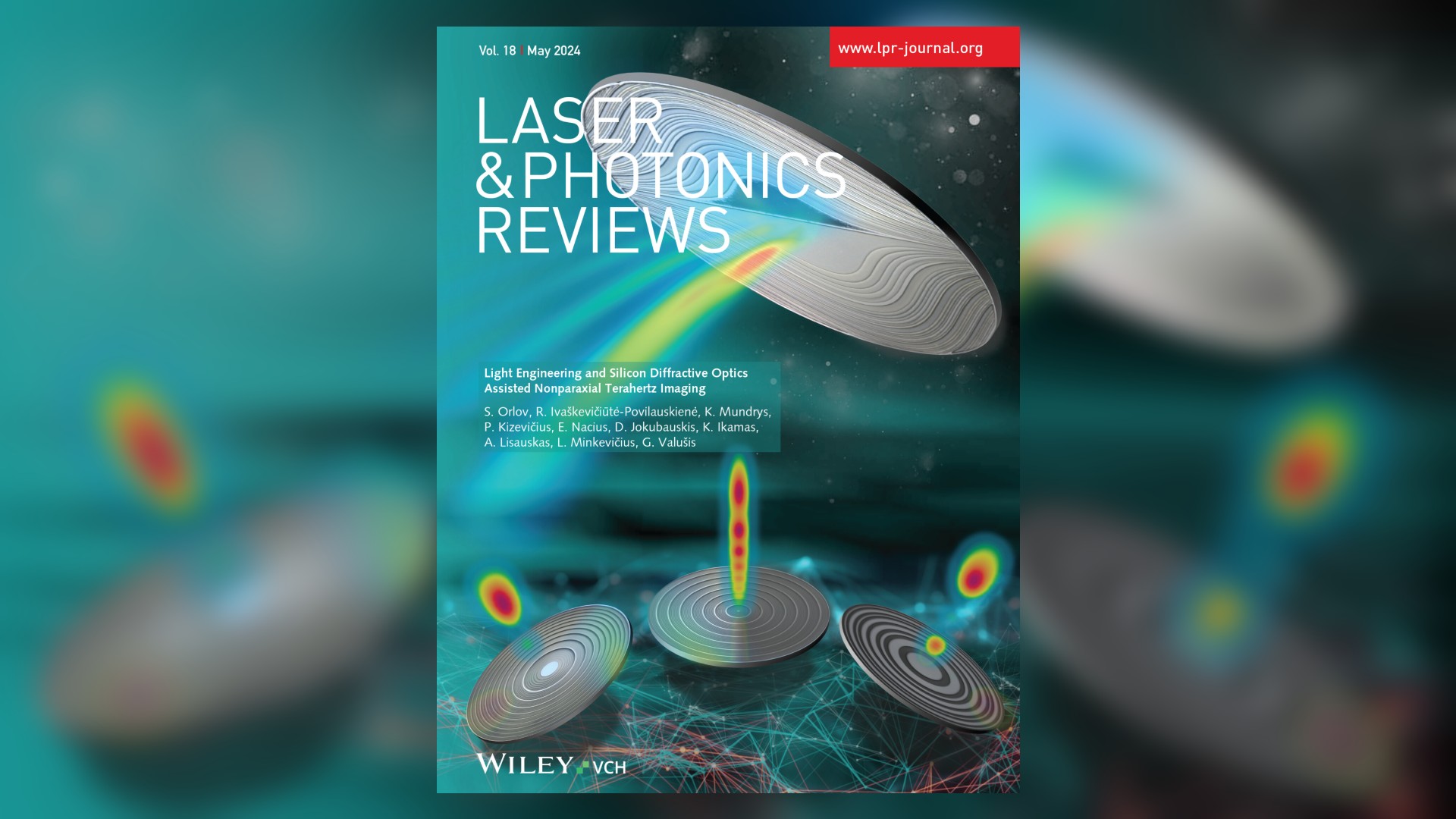
The article, “Light Engineering and Silicon Diffractive Optics Assisted Nonparaxial Terahertz Imaging”, presents new methods for “photographing” (in scientific terms, imaging) hidden objects using invisible terahertz waves.
As conventional cameras cannot operate with such radiation, the researchers reconstruct the image piece by piece and then assemble it using computational methods. Crucially, the team demonstrated that specially designed ultra-thin silicon lenses developed at FTMC enable improved control of terahertz waves, resulting in sharper and clearer images.
The co-authors of the article who received the Wiley certificate are Dr Sergejus Orlovas, Dr Rusnė Ivaškevičiūtė-Povilauskienė, PhD candidate Karolis Mundrys, PhD candidate Paulius Kizevičius, Dr Ernestas Nacius, Dr Domas Jokubauskis, Dr Kęstutis Ikamas, Dr Alvydas Lisauskas, Dr Linas Minkevičius, and Prof. Habil. Dr Gintaras Valušis.
Being published in this journal is already a significant distinction, but the FTMC Department of Optoelectronics team received even greater recognition – the paper was featured on the journal’s front cover. The illustration was created by one of the authors, Dr Ivaškevičiūtė-Povilauskienė.

(Dr Sergejus Orlovas. Photo: Marius Linauskas)
“We see that our article is not only widely read but also frequently cited by other researchers. Various databases assess publications based on the scientific fields from which they are cited – this is referred to as interdisciplinarity. It shows that the paper attracts a broad research audience.
What surprised me most is its popularity among researchers working in artificial intelligence, particularly those applying it to image recognition. At the same time, the era of 6G communication is approaching: I have noticed that telecommunications researchers are citing the paper in this context. This is because the terahertz frequency range we study is also associated with 6G technologies.
All of this is highly motivating. The article is quite extensive and required a great deal of effort, so it is rewarding to see it recognised and used. It allows us to appreciate the added value of our work,” says the lead author of the publication, Dr Sergejus Orlovas.
“The recognition from Wiley shows that the topic we are working on is both relevant and highly visible worldwide, and that researchers are actively interested in it. The paper is of a high standard, and the ideas presented – related to structured light – have attracted considerable attention.
We are very pleased that the research carried out by our department has been so widely noticed,” says Acting Head of the FTMC Department of Optoelectronics, Dr Linas Minkevičius.
You can read more about the article by following this link.
The full paper is available via this link.
Source: FTMC