- Home
- News & Events
- News
From Spent Coffee Grounds to Smart Textiles: Italian Scientist in Lithuania Develops Innovative Technology
Around 8 million tonnes of spent coffee grounds are discarded worldwide every year, with most of them ending up as waste rather than being recycled. Italian physicist Dr Federico Ursino is working on one potential solution to this problem. During his postdoctoral research at the Center for Physical Sciences and Technology (FTMC), he is developing new materials from spent coffee grounds for enhanced thermal energy storage and smart thermoregulating clothing.
“People often do not realise the sheer scale of coffee consumption. It is a huge industry. At the same time, however, it presents wide opportunities for the reuse of coffee waste,” says the researcher.
Choosing Lithuania
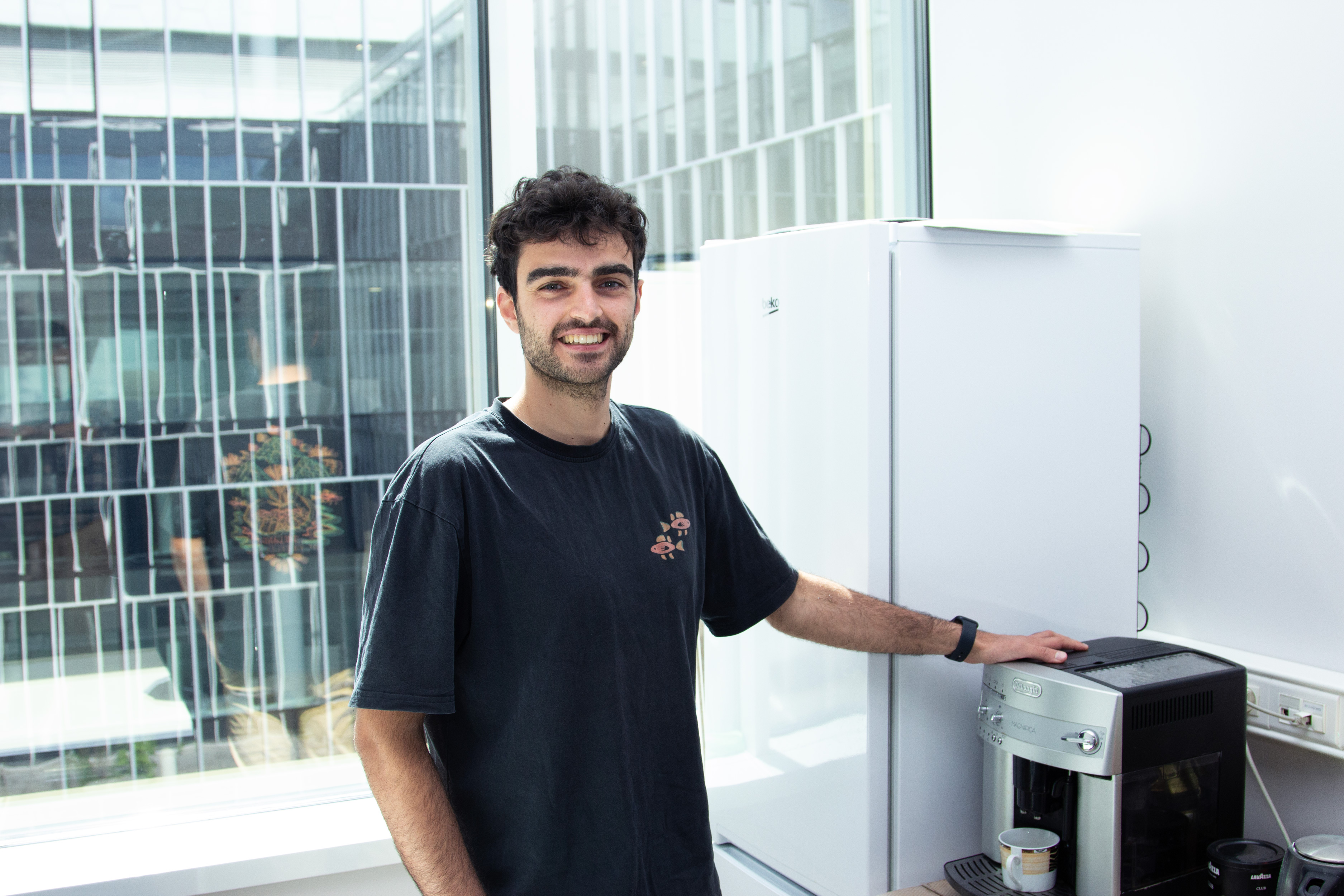
The coffee machine in the FTMC Department of Functional Materials and Electronics has unexpectedly become a candidate for the most famous one in the Center’s history. Every few days, Federico collects its spent coffee grounds and takes them to the laboratory. He is not the only one contributing: other researchers know that the waste is better delivered to their Italian colleague than thrown into a bin.
“I drink a lot of coffee myself every day, which my girlfriend is not particularly happy about. But now I have a solid excuse: ‘I’m doing it for science!’” he laughs.
Behind the humour, however, lies serious research. Sustainability plays a central role in Federico’s scientific outlook, and it also shaped the work he carried out during his PhD studies in Italy. His doctoral research focused on molybdenum-based powders obtained from industrial waste. He used these powders to develop promising nanomaterials for green technologies, including hydrogen production from water and electrochemical energy storage.
While searching for new challenges and a suitable postdoctoral position, Federico came across FTMC on social media. Impressed by the Center’s activities, he contacted Dr Arūnas Stirke, Head of the Bioelectrics Laboratory within FTMC Department of Functional Materials and Electronics, along with fellow researcher Dr Ahmed Taha, and decided to spend the next two years in Lithuania.
“What I like about FTMC is that it brings together physics, chemistry, and materials engineering. This interdisciplinary environment is one of the reasons why a physicist like me eventually joined a group working with biomaterials. The researchers here gave me absolute freedom, and when I reviewed the scientific literature, I realised that nobody had yet used spent coffee grounds for the purpose I had in mind,” Federico recalls.
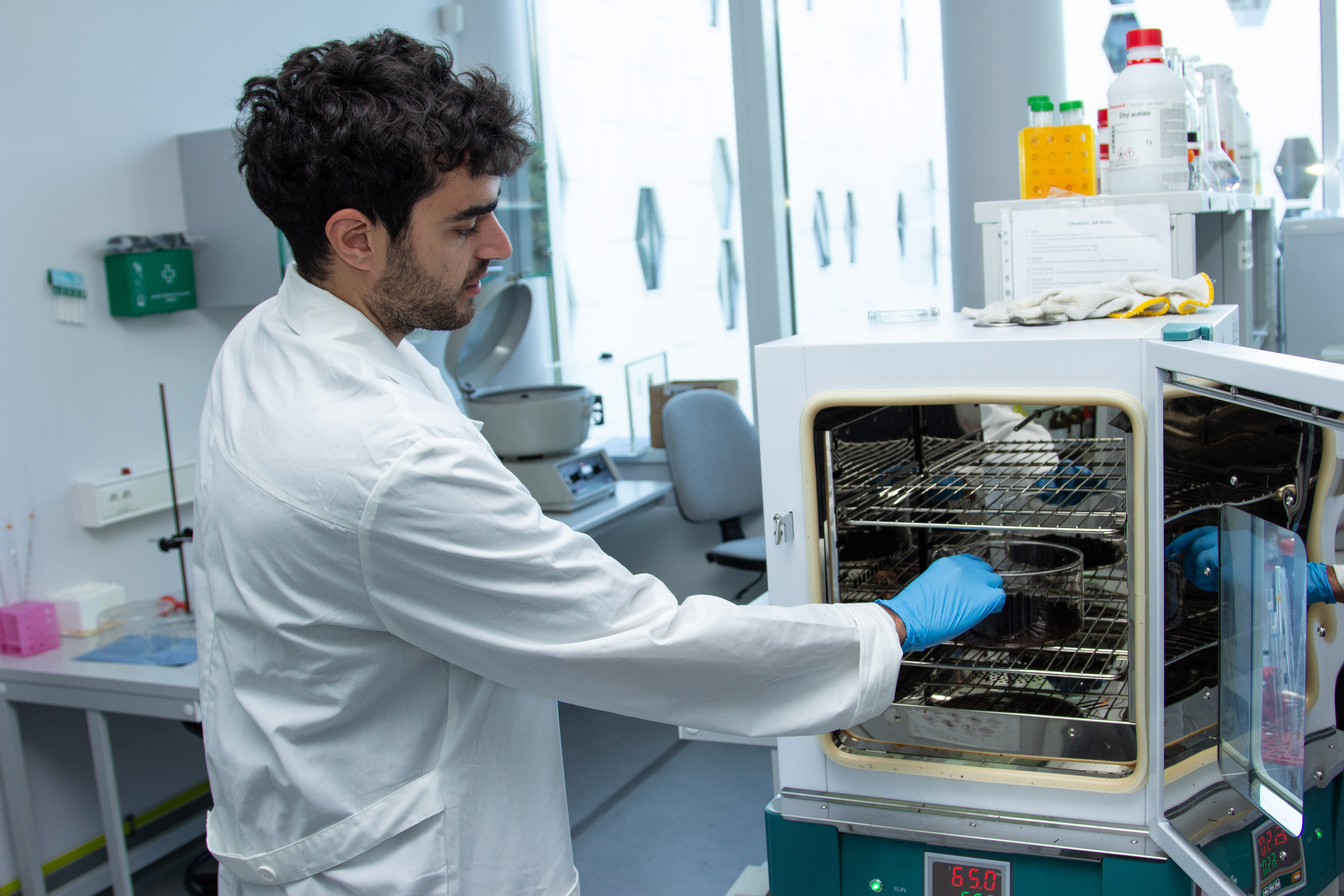
(Dr Federico Ursino. Photo: Gabrielius Mackevičius / FTMC)
How Coffee Grounds Could Benefit Water and the Human Body
The first step in Federico’s laboratory process is extracting oil from the collected spent coffee grounds. All types of coffee contain some oil, and when beans are roasted too intensely, these oils begin to seep out naturally. This is one reason why coffee can develop a more acidic taste.
For this reason, Federico generally works with residues from lightly roasted Arabica coffee:
“If the beans are roasted too much, some of the oil is lost during storage, transportation, or use in cafés. By the time I receive the spent coffee grounds, part of the valuable material is already gone. I want the oil to remain inside the coffee grounds so that I can extract it myself.”
The extracted oil is then converted into a phase-change materials (PCMs) with a tuneable melting temperature.
“These are materials that can absorb and store heat or release it when required. This happens when they change state, for example from solid to liquid or vice versa.
The simplest example is water. When heat is supplied, ice melts and becomes liquid water. When heat is removed, the water freezes and turns back into ice. During this process, large amounts of thermal energy are absorbed or released.
Water also provides a good example of one potential application of my technology. Some homes use solar collectors connected to water storage tanks that accumulate thermal energy. The challenge is that water can store only a limited amount of energy. New PCM materials could be mixed with the water inside these reservoirs, allowing them to store more thermal energy and thereby improve the performance of the entire system,” Federico explains.
Another potential application of these coffee-derived materials is smart textiles. Federico invites us to imagine clothing capable of adapting to environmental conditions: cooling the body when temperatures rise and helping to retain warmth when temperatures fall. Just as water responds to changing temperatures, PCMs embedded in fabric could react in ways that improve human comfort.
“Given climate change and the increasing frequency of extreme heat events, such materials could become extremely useful. I come from Sicily myself, where temperatures can now exceed 45°C,” says the FTMC researcher.
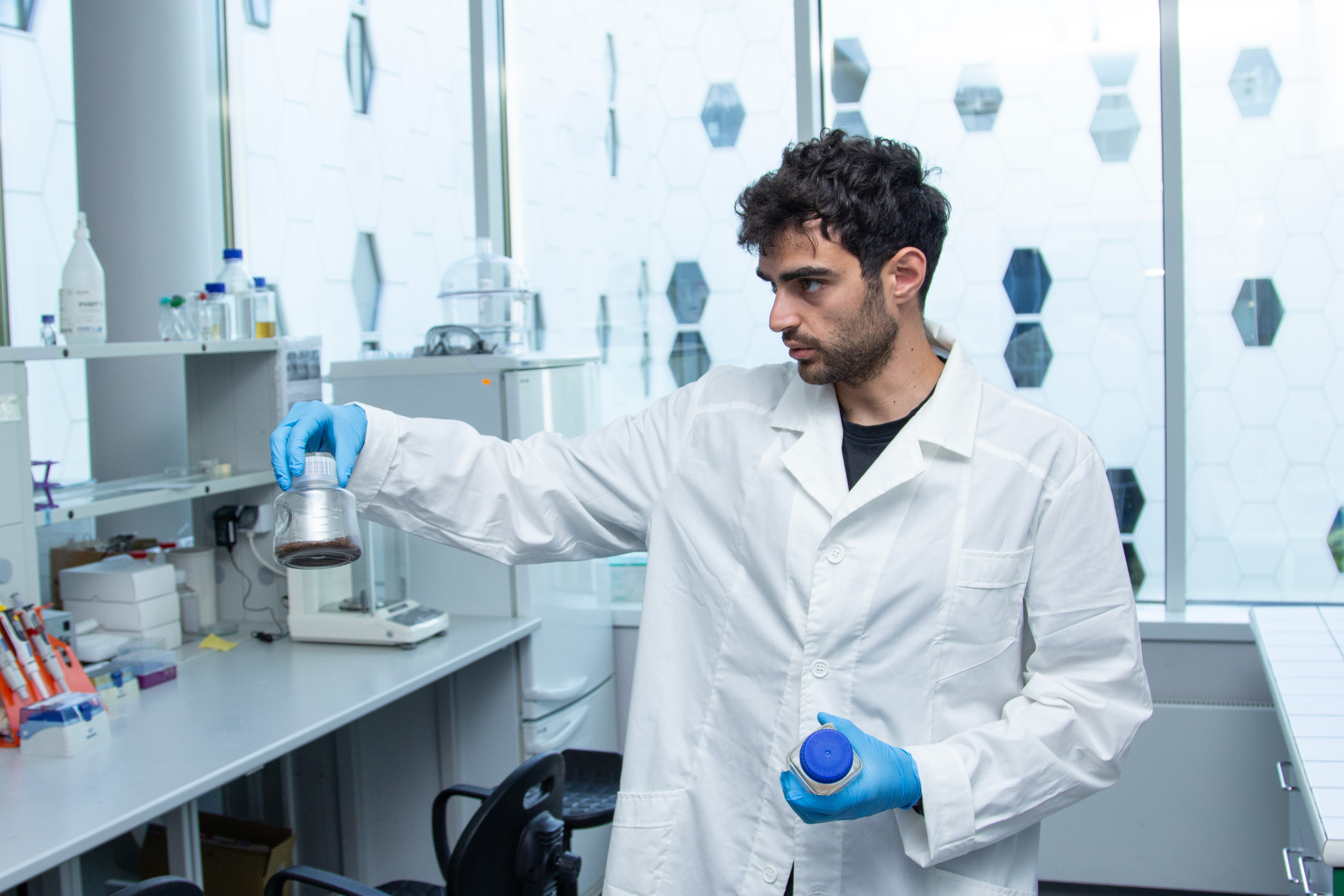
(Dr Federico Ursino. Photo: Gabrielius Mackevičius / FTMC)
Creativity as a Core Part of the Work
How can PCMs be integrated into clothing? Federico describes three possible approaches.
The first resembles 3D printing: a nanomaterial is mixed with cotton to create a composite fibre, which can then be woven into fabric.
The second involves a type of three-layer “sandwich” structure, with PCM placed between two layers of cotton.
The third method starts with an already manufactured textile product, such as a T-shirt. The garment is immersed in a slurry containing PCM, soaked thoroughly, dried and then treated with additional substances that help keep the nanoparticles firmly in place.
“If we are eventually able to patent the technology, that would be great. My primary objective, however, is to develop a material that can realistically be applied in textile applications,” Federico emphasises.
To achieve this goal, he consults with FTMC Department of Textile Technologies in Kaunas. The researchers there specialise in smart clothing and develop garments for both military and civilian applications, ranging from thermal comfort management to protection from enemy radar detection.
“We agreed to continue discussions in a couple of months. First, I need to have enough material ready to provide for testing. I’m currently working on that and already have some promising initial results, which I’m very happy about.
Once I optimise the production process for nano-PCMs intended for smart textiles, I should also be able to develop materials suitable for thermal energy storage systems, such as those used alongside solar collectors or solar energy installations,” the scientist explains.
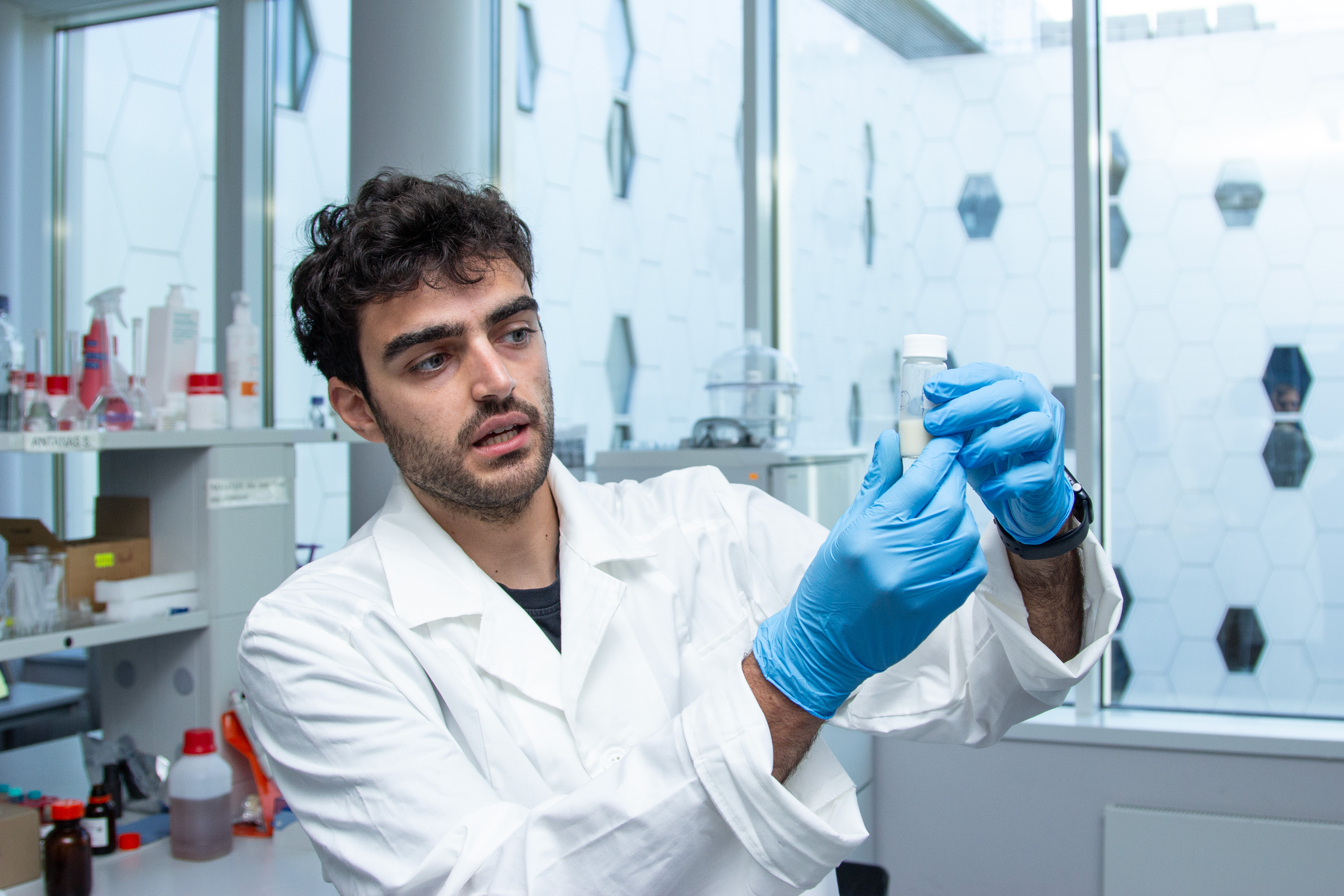
(Dr Federico Ursino. Photo: Gabrielius Mackevičius / FTMC)
Optimistic About the Future
To achieve his two main objectives, Federico will need to develop materials with somewhat different properties.
For example, smart clothing should maintain a temperature of approximately 25-27°C, which is generally considered the most comfortable garment temperature range for the human body.
By contrast, thermal energy storage systems used with solar technologies require nanomaterials with significantly higher melting points, typically above 60°C. This means that the PCM synthesis process will need to follow a different approach.
“There is also a third goal, to understand the underlying mechanisms. I want to test different PCM combinations and determine why certain phase-change materials perform better than others. Unlike the first two goals, which are sequential, the third one runs throughout the entire project.
PCMs have many more potential applications than those I am working on at present. If everything succeeds, the possibilities will be extremely broad. Of course, science advances in small steps. We are unlikely to see these technologies fully realised within the next two years. However, I am convinced that they will become a reality in the not-too-distant future,” says Federico Ursino.
Written By Simonas Bendžius