- Home
- News & Events
- News
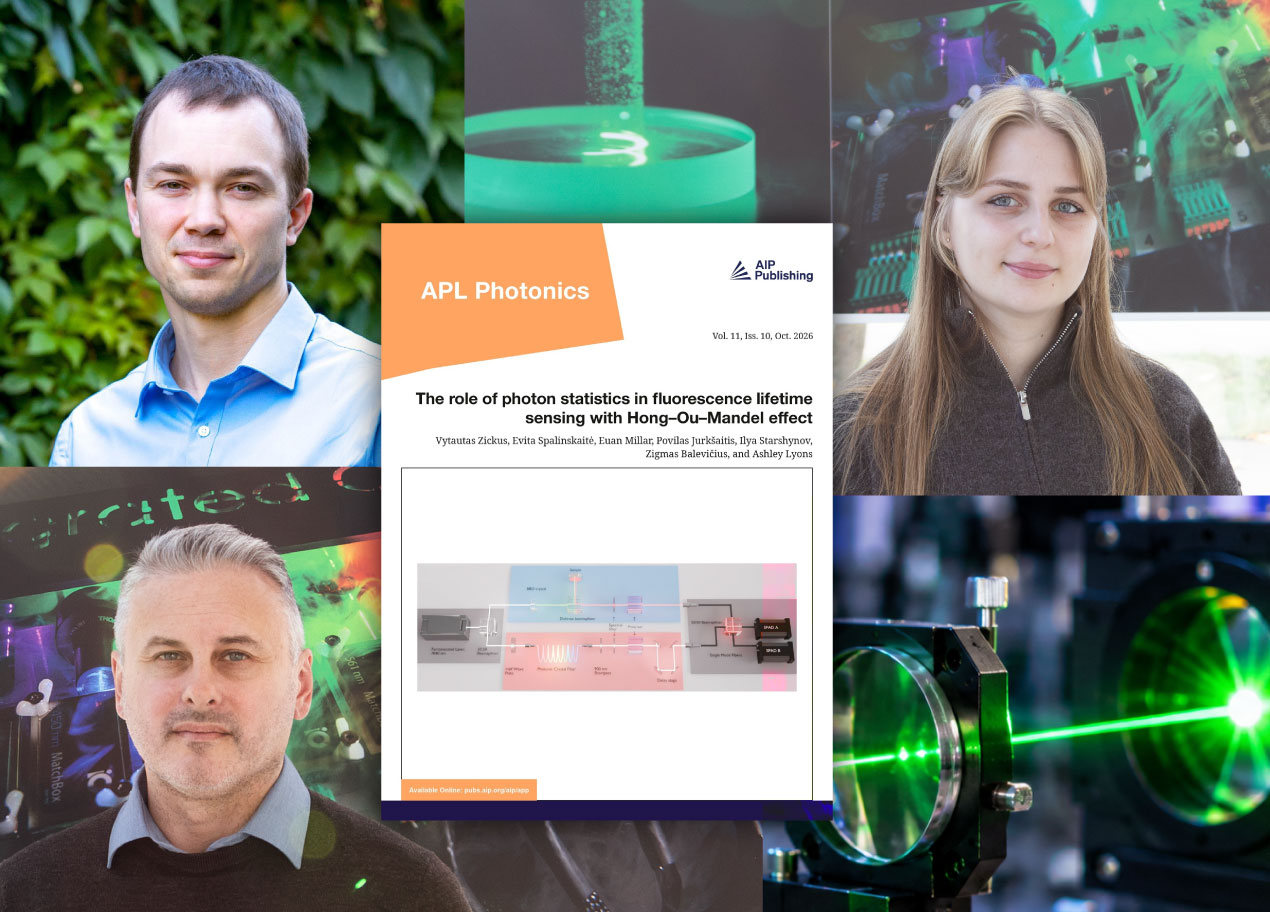
From Quantum Physics to Biomedicine: Research by FTMC and the University of Glasgow Featured on an International Journal Cover
How can a phenomenon from quantum physics be used to study biological cells? Researchers from FTMC and the University of Glasgow (Scotland) have demonstrated that the Hong–Ou–Mandel effect can be used to measure the fluorescence lifetime of molecules. Their proposed approach simplifies the equipment required for such measurements and reduces its cost. The work has also received international recognition, with the prestigious scientific journal APL Photonics featuring the research on its cover.
A quantum phenomenon helps researchers study molecules
One way of investigating processes taking place inside biological cells is through fluorescence lifetime imaging. This technique measures how long a molecule continues to emit light after being excited by a light source. Such measurements help researchers monitor changes in the molecular environment and study interactions between molecules, making the technique valuable for biomedical research.
Implementing this technology typically requires sophisticated laser equipment. Researchers from FTMC and the University of Glasgow set out to find a simpler way of performing these measurements and turned to a phenomenon from quantum physics: the Hong–Ou–Mandel (HOM) effect.
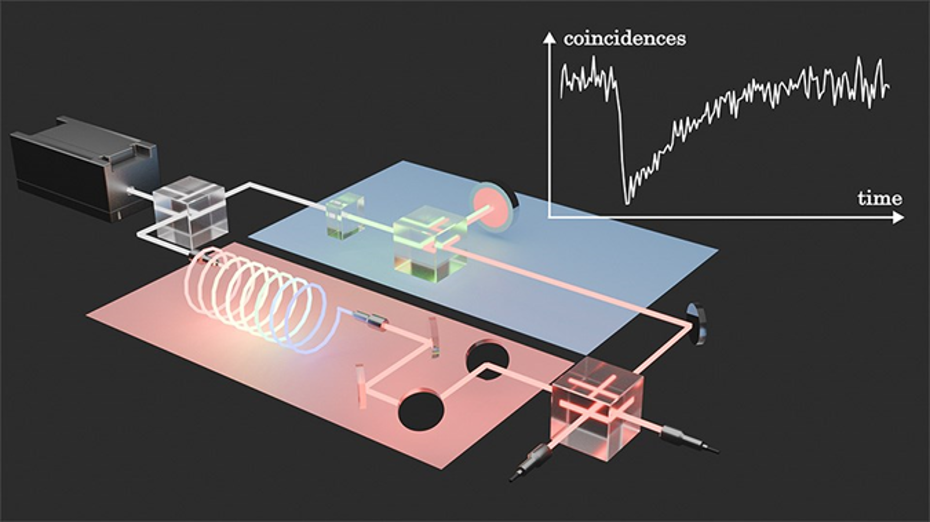
First discovered in 1987, this phenomenon describes the unusual behaviour of two photons – particles of light. When two identical photons arrive simultaneously at a half-silvered mirror from opposite directions, their quantum properties cause them to emerge together rather than separately.
The researchers used this phenomenon as a kind of quantum sensor to measure the extremely short fluorescence lifetimes of molecules, on the picosecond timescale (trillionths of a second).
One laser instead of two
FTMC and University of Glasgow physicist Dr Vytautas Žickus and his co-authors improved a fluorescence lifetime measurement technique based on the HOM effect (FL-HOM). They used a supercontinuum laser source, which makes it possible to generate light at different wavelengths from a single laser.
Previous experiments using this technique required two separate laser sources. The new study demonstrates that just one femtosecond laser is sufficient. Its output is converted into light at different wavelengths using supercontinuum generation, which is then used to investigate photon statistics and quantum interference.
“This not only simplifies the experimental setup but also significantly reduces its cost, opening up opportunities for the wider application of this technique in biomedical research. It could help us better understand processes taking place inside cells, including those associated with diseases and the effects of medicines,” says Dr V. Žickus.
The researchers also found that changing the wavelength of the supercontinuum light makes it possible to control the sensitivity of the quantum-based sensor. This provides greater flexibility when adapting the technique to different measurements.
A Lithuanian contribution – including from a student
The research is the result of a collaboration between FTMC's Plasmonics and Nanophotonics Laboratory (PNL) and the University of Glasgow's Extreme Light Group. The work of the Lithuanian researchers is coordinated by Dr V. Žickus, who works at both institutions. He also leads a research group project funded by the Research Council of Lithuania (project No. S-MIP-24-91), which provided funding to initiate this research.
The project also involved Evita Spalinskaitė, a bachelor's student working at FTMC's Plasmonics and Nanophotonics Laboratory. She carried out key experiments for the study at both the University of Glasgow and FTMC.
“What is particularly encouraging is that a student made a significant experimental contribution to this work. It shows that young people who are still pursuing their bachelor's degrees can also contribute to internationally recognised scientific research,” says Prof. Dr Zigmas Balevičius, Head of the PNL.
The researchers' paper, The Role of Photon Statistics in Fluorescence Lifetime Sensing with Hong–Ou–Mandel Effect, was published in the October 2026 issue of APL Photonics. The research was also featured on the journal's cover.
Scilight 2026, 401109 (2026)
Source: FTMC