- Home
- News & Events
- News
From Optical Mirrors to Quantum Communication: FTMC Researchers Develop Technologies for Space
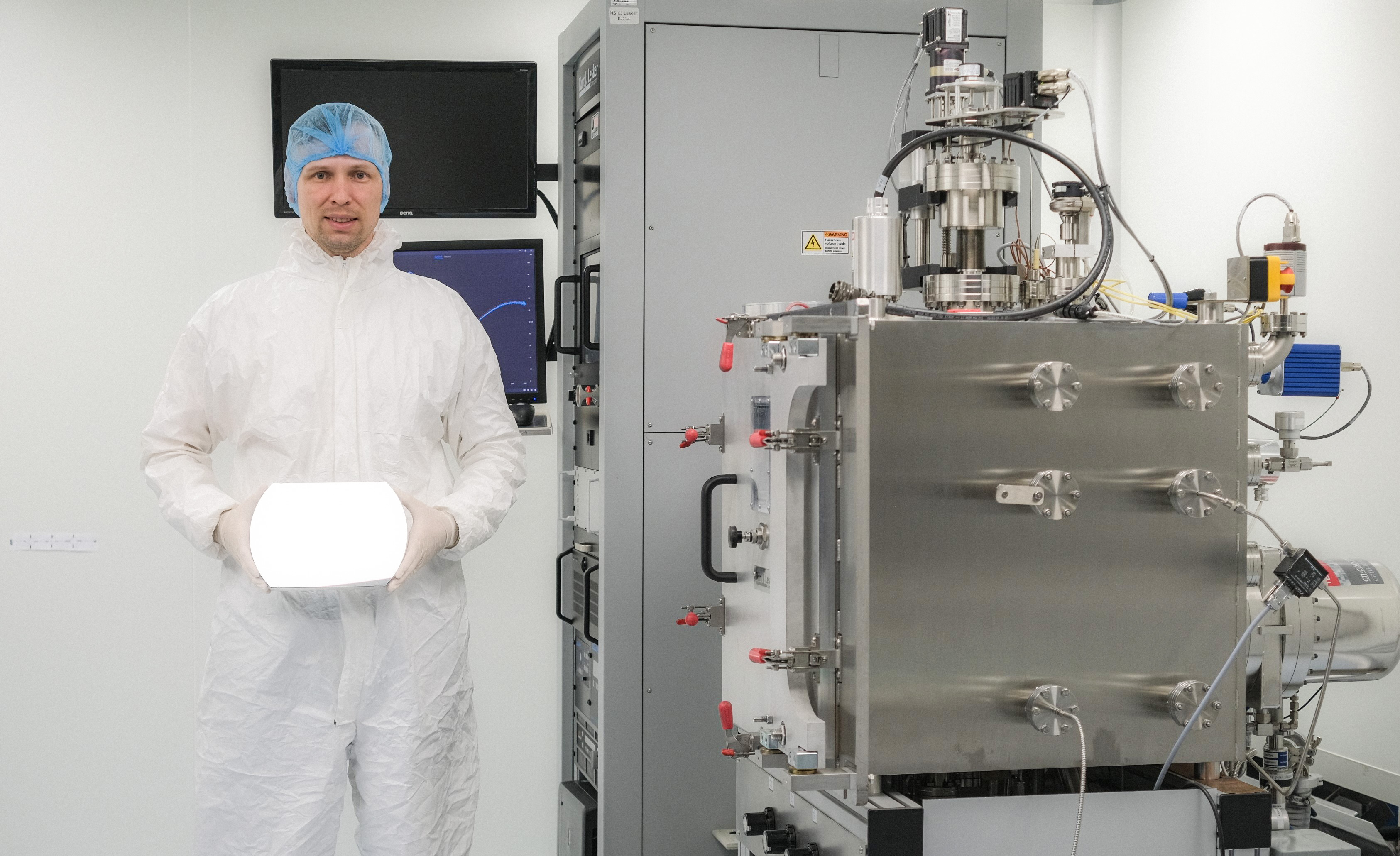
Did you know that light can be used to transmit information over vast distances, for example, between Earth and satellites? However, this requires highly precise optical systems, in which mirrors play an important role. Researchers from the Laboratory of Laser Technologies at the Center for Physical Sciences and Technology (FTMC), Dr Alexandr Belosludtsev and Dr Ignas Bitinaitis, together with their colleagues, are developing and investigating advanced optical components that could be used in future space communication systems, including quantum communication technologies.
This research is being carried out as part of the QuantiCoat project, funded by the Research Council of Lithuania. Its main objective is to develop optical coatings and sets of optical components for laser sources used in quantum cryptography systems, particularly quantum key distribution (QKD). The components developed during the project could also be applied to optical signal transmission on Earth and in space.
Lighter Mirrors with Improved Light Reflectivity
One of the research directions focuses on developing lightweight metal mirrors for advanced optical and laser systems. In a study published in the journal Optical Materials, FTMC researchers demonstrated how combining two technologies – 3D printing and magnetron sputtering – can be used to manufacture mirrors with excellent optical properties.
Such mirrors are particularly important for optical systems where reducing equipment weight, managing heat efficiently and minimising light losses are essential.
How Do Mirrors Withstand the Conditions of Space?
Taking optical components from the laboratory into space presents additional challenges. Satellites orbiting the Earth are constantly exposed to various forms of radiation, which can gradually degrade the performance of their optical systems.
In a study published in the journal Advances in Space Research, FTMC researchers, together with colleagues from Italy, investigated silver and aluminium mirrors designed for space applications. They examined how different coating compositions withstand proton radiation – one of the types of radiation that affect optical components in space.
This is an important step towards developing optical components capable of retaining their properties under the challenging conditions of space.
Why Are Space Mirrors Important for Quantum Communication?
The development of reliable optical components is also important for future satellite communication technologies. Unlike conventional radio communication, optical communication uses light to transmit information. This enables data to be transmitted between spacecraft and ground stations. Quantum communication, meanwhile, opens up opportunities to develop new methods of secure information transmission, such as quantum key distribution.
Quantum key distribution allows two communicating parties to securely share an encryption key, which can then be used to encrypt information. Such systems require highly precise and reliable optical components capable of controlling and transmitting light signals.
The optical coatings and components developed as part of the QuantiCoat project are intended for precisely these technologies. They could be used not only in laser sources but also in optical signal transmission systems on Earth and in space.
“This is the first step towards developing high-speed and secure optical quantum communication technologies. The optical components we are developing could contribute to future communication systems in which information will be transmitted using light,” says Dr Alexandr Belosludtsev.
From Space Technologies to Telescopes Used by Lithuanian Astronomers
The applications of these mirror coating technologies extend beyond satellites and advanced communication systems. The technology developed by FTMC researchers has also been applied to refurbishing the mirrors of telescopes used by Lithuanian amateur astronomers.
From observing distant stars to developing technologies that could one day help satellites exchange information through quantum communication, this research demonstrates how advances in optical materials and coatings can open up new possibilities both on Earth and in space.
This research was funded by the Research Council of Lithuania under contract No. S-MIP-24-15.
Source: FTMC