- Home
- News & Events
- News
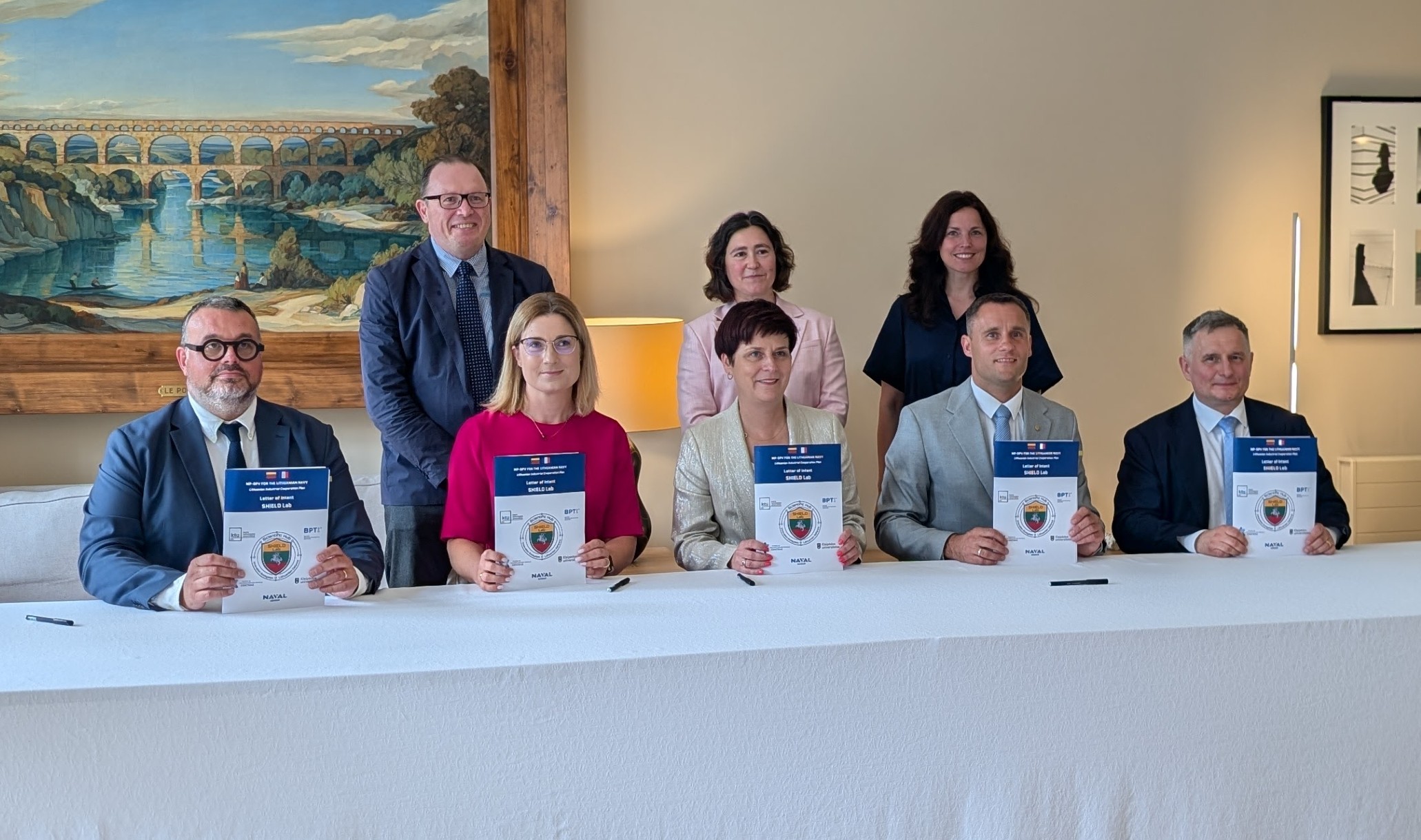
Foundations Laid for Strengthening Lithuania’s Naval Capabilities: FTMC and Partners Sign a Letter of Intent with French Maritime Defence Leader Naval Group
We are contributing to an ambitious international project aimed at strengthening the country’s naval capabilities: FTMC and three Lithuanian partners have signed a Letter of Intent with the French maritime defence giant Naval Group. The meeting took place at the French Ambassadors’ Residence in Vilnius.
The signed document establishes a working group tasked with implementing Naval Group’s SHIELD Lab initiative, focused on advancing maritime innovation and addressing technological challenges faced by the navy in Lithuania.
The laboratory is expected to develop technologies tailored to naval applications, particularly in the fields of drones, laser systems, and counter‑UAV solutions. It will also foster international partnerships with the aim of becoming a significant player in European defence innovation.
The initiative currently involves and has been signed by the Baltic Institute of Advanced Technology, Klaipėda University, Kaunas University of Technology and FTMC.
“Naval Group’s commitment to achieving shared results motivates us even further to join forces for national defence, especially as the geopolitical situation shows that we cannot afford complacency. We welcome the opportunity to seek solutions together with a globally recognised partner,” says FTMC Director Prof. Dr Ramūnas Skaudžius.
The first meeting between FTMC and Naval Group representatives took place in May at our Center, where both sides took the first step towards cooperation by signing a Memorandum of Understanding.
The French company is renowned worldwide, designing, building and maintaining naval vessels and deploying cutting-edge defence systems. In May, Naval Group signed a contract with Sweden to build four FDI‑type frigates for its navy, which will become the largest and most capable warships in the Swedish fleet.
In recent years, FTMC has been actively collaborating with the Lithuanian Navy: this January the Baltic Sea, a team of scientists from the Department of Physical Technologies developed and successfully tested a system capable of detecting ship radars. It is expected to become a reliable tool for identifying and tracking vessels attempting to conceal or alter their identity.
Source: FTMC