- Home
- News & Events
- News

Every Third School in Vilnius Lies in a High Air Pollution Zone, FTMC Study Reveals
37% of primary and secondary schools in Vilnius, the capital of Lithuania, are exposed to harmful air pollutants due to their proximity to major high-traffic roads. This was revealed in the latest study carried out by researchers at the Center for Physical Sciences and Technology (FTMC).
This is the first study in Lithuania to apply satellite-based climate monitoring data alongside machine learning methods to assess air quality around schools. The findings have been published in the prestigious international journal Urban Climate. The authors of the scientific paper are FTMC Department of Environmental Research scientists Dr Mehri Davtalab, Dr Lina Davulienė, Dr Ieva Uogintė, Dr Simonas Kecorius, and the Head of the department, Dr Steigvilė Byčenkienė. Dr Mario Lovrić from the Institute for Anthropological Research in Zagreb also contributed to the team. The study was conducted as part of the EU Horizon project EDIAQI.
The scientists hope their research will serve as a strong signal to schools as well as policymakers to take concrete measures in order to safeguard children’s health.
A New Method to Tackle an Urgent Problem
Air pollution is one of the greatest threats to public health worldwide, particularly in sensitive areas such as schools. In this case, FTMC researchers focused on three pollutants: nitrogen dioxide (NO₂), sulphur dioxide (SO₂), and carbon monoxide (CO).
“These invisible gases act quietly but dangerously,” explains co-author Dr Steigvilė Byčenkienė. “NO₂ weakens the lungs and increases the risk of asthma, CO reduces the oxygen level in the blood, and SO₂ irritates the airways and causes inflammation. Children are the most vulnerable group as their bodies are still developing, making the impact on them particularly severe. What’s worse, when these pollutants appear together, the damage is amplified. That is exactly what we investigated - the combined effect of these compounds in relation to a school’s distance from the road.”

(Dr Steigvilė Byčenkienė. Photo: Hernandez & Sorokina / FTMC)
According to the authors, having reliable tools to assess air quality is essential to protect vulnerable population groups. However, the problem is that the number of ground-level air pollution monitoring stations in cities is limited, which until now has made it difficult to determine the pollution situation around many specific school locations in the capital of Lithuania.
FTMC researchers found a solution: they gathered satellite data on NO₂, SO₂ and CO and combined it with machine learning methods – namely Random Forest and Gradient Boosting Machine algorithms. This allowed them to create detailed air quality classification maps around schools in Vilnius.
“Conventional air monitoring stations often cannot show what is happening right next to a particular school. That is why we turned to an innovative approach - satellite data combined with machine learning. This combination enabled us to pinpoint the locations where concentrations of these pollutants are the highest and to evaluate the situation of schools accordingly,” says lead author Dr Mehri Davtalab.

(Dr Mehri Davtalab. Photo from personal archive)
A Warning Signal
The findings reveal an alarming situation. As many as 97% of schools are located in areas of high road density - that is, within less than 100 meters of a road - where pollution tends to dominate. More worryingly, 37% of Vilnius schools are situated in zones of elevated pollution where NO₂ + SO₂ + CO interact, compounding their harmful health effects. Dr Byčenkienė stresses the importance of this figure:
“Without doubt, this is a serious problem. Children spend six to eight hours a day in these schools, so the health impact is not just theoretical but an everyday reality.
It is also important to look at the broader context: as in other cities, there are practically no areas in Vilnius where air quality is entirely ‘pollution-free’. At best, there are relatively clean zones - mainly where schools (or residential buildings) are close to parks or forests. In such places, greenery acts as a natural filter and improves air quality. Still, the majority of schools face the risk of exposure to pollution on a daily basis.”
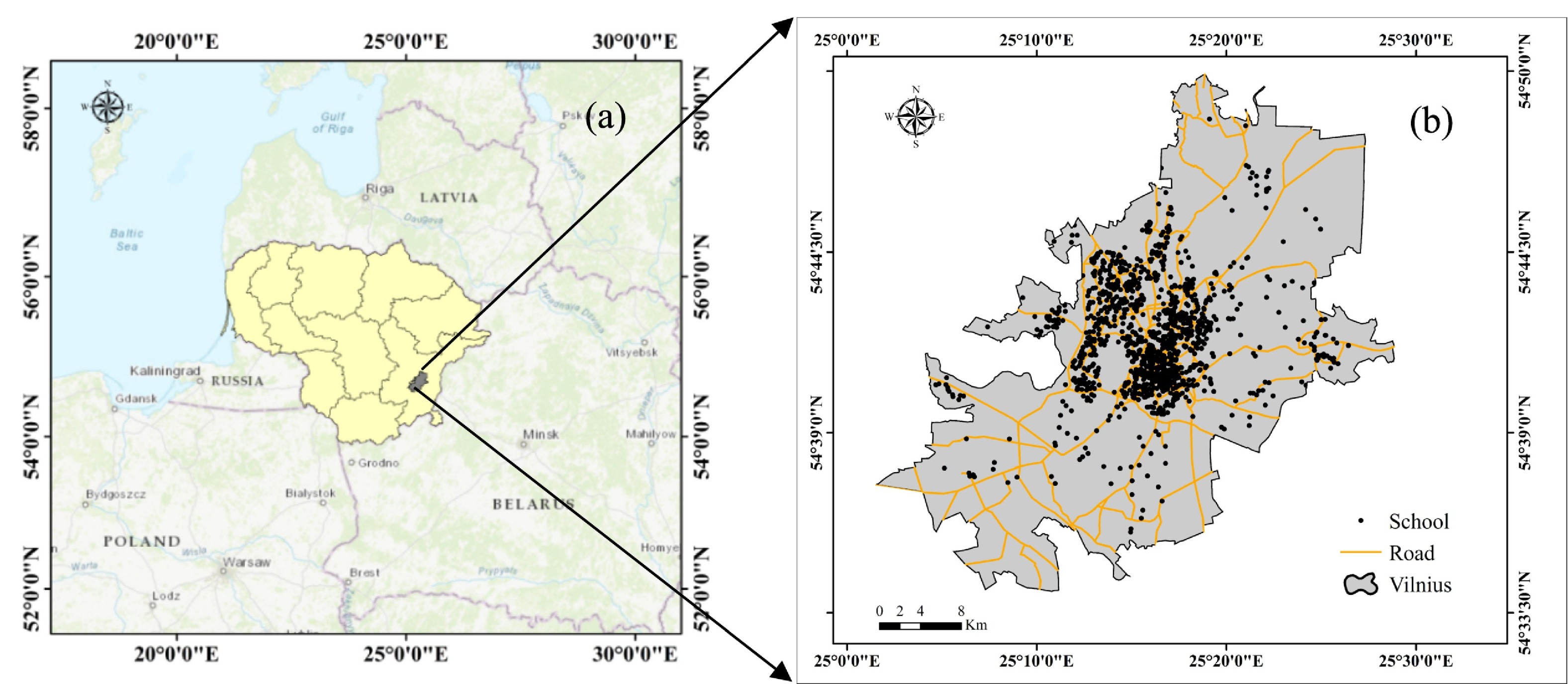
(Schools and roads analyzed in the study. Pictures: FTMC)
The FTMC scientists emphasize that the purpose of their study is not to add another statistic but to spur action. Clean zones make up only a small portion of Vilnius, meaning that most schools must contend with pollution risks every day. The World Health Organization reminds us that there are no fully safe levels of pollutants, which makes the figure of 37% a stark indicator of a systemic problem. According to the authors, this is a clear call for Vilnius to act now: plant more greenery near schools, improve classroom ventilation systems, and restrict car traffic in the vicinity of educational institutions so that children can learn in a healthier environment.
“Even simple measures, such as ventilating classrooms outside of peak traffic hours, can reduce children’s exposure to pollution. Our model could also be adapted to assess other pollutants such as particulate matter (PM2.5 and PM10), not only in Vilnius but in other parts of Lithuania and across the world where permanent air quality monitoring is lacking,” says Dr Davtalab.
The authors also note a positive trend: every year, Vilnius is creating more green spaces, which not only beautify the city but also help reduce air pollution. This shows that with targeted investment in nature-based solutions, it is possible to build a healthier environment for children and city residents alike.
Written by Simonas Bendžius