- Home
- News & Events
- News
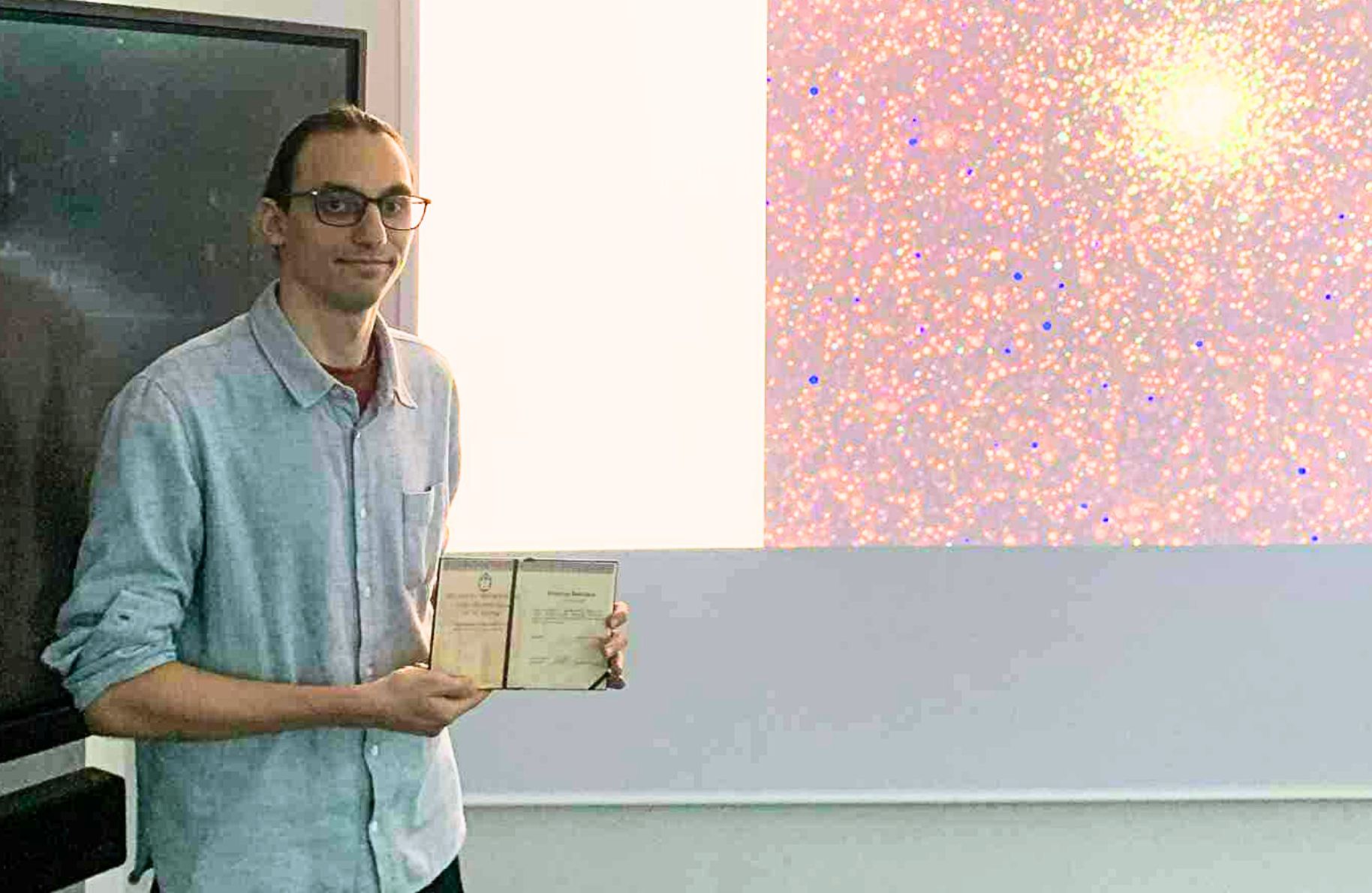
Eimantas Kriščiūnas, Who Studies Star Clusters in the Andromeda Galaxy, Has Earned a PhD
FTMC is launching its autumn “season” of dissertation defences. The first of our new PhDs is astrophysicist Dr Eimantas Kriščiūnas from the Department of Fundamental Research, who successfully defended his thesis on 12 September.
We congratulate our colleague and wish him many new discoveries!
Eimantas’ thesis topic is “Star Clusters in the Disc of the Andromeda Galaxy” (academic supervisor: Prof. Dr Vladas Vansevičius). You can read the dissertation by following this link.
The formation and evolution of galaxies is one of the key problems in modern astrophysics. Since most stars in galaxies are born in star clusters, these objects are widely used to address the aforementioned issues.
However, detailed studies of clusters in our own galaxy – the Milky Way – are limited due to interstellar extinction (a reduction in light intensity) within the galactic disc. What does this mean?
The Milky Way’s disc contains a large amount of interstellar dust and gas. These “dim” and weaken the light coming from star clusters, making it hardly possible to observe them clearly and study them accurately from Earth. For this reason, the FTMC researcher focused on clusters in the Andromeda Galaxy – because Andromeda is partly similar to our own Galaxy, studying its clusters provides information that cannot be obtained in the Milky Way due to obscuration.
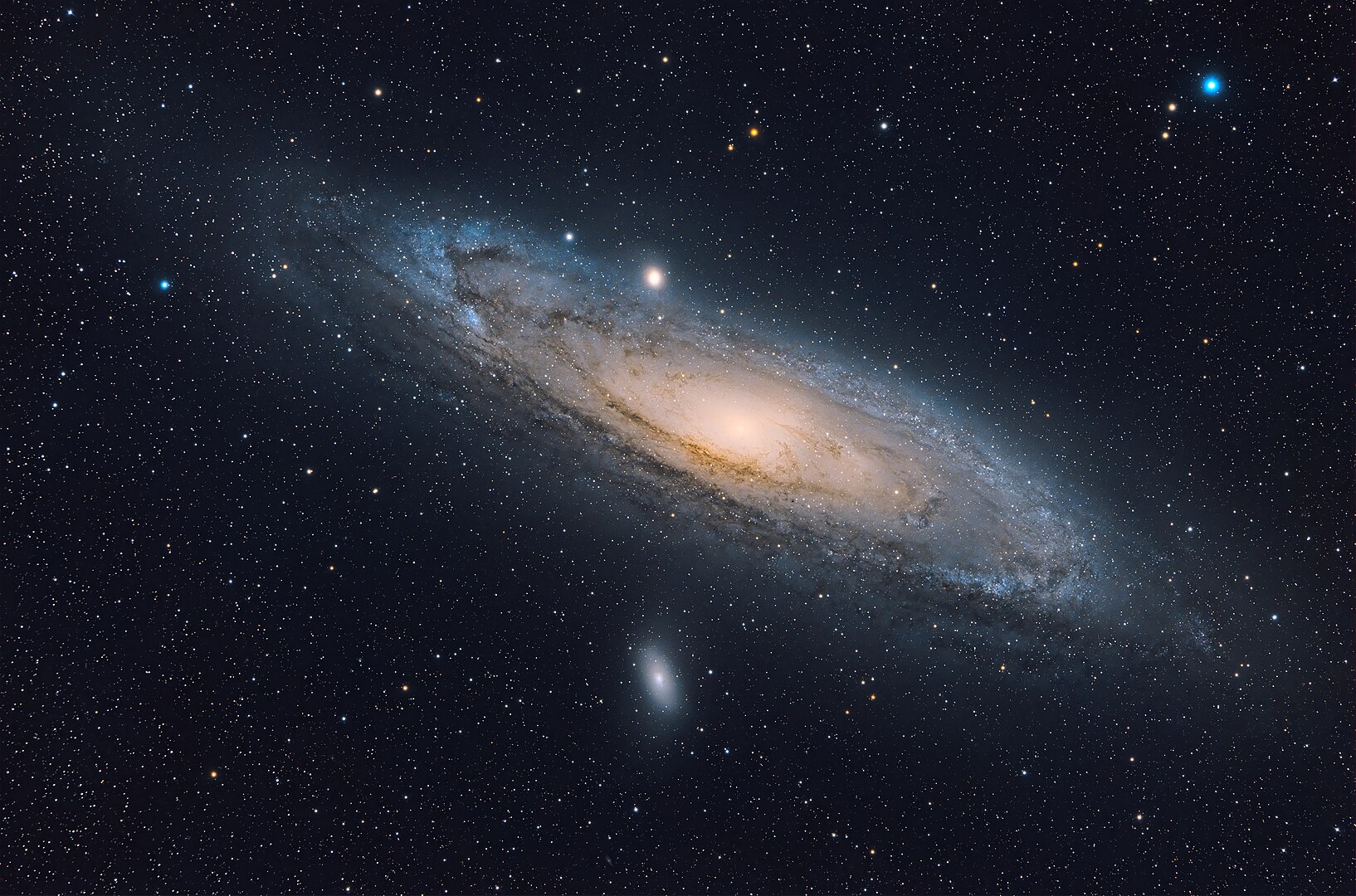
(A visible light image of the Andromeda Galaxy and two satellite galaxies. Photo: Wikipedia.org)
“We analyse the clusters using data from the Hubble Space Telescope and have investigated their formation history, mass function, and spatial distribution. This is essential for understanding the patterns of star formation in galactic discs,” explains Kriščiūnas.
As the most important result of his work, the astrophysicist highlights the creation of the world’s largest catalogue of Andromeda’s star clusters, including photometric and physical parameters (age, mass, extinction). In addition, FTMC scientists were the first to show that around 200 million years ago there was an increase in Andromeda’s star formation, which may have been triggered by interaction with the neighbouring galaxy M32.
Why might the results of this dissertation be interesting to all of us?
“This research provides an opportunity to better understand how star clusters form and how these processes relate to the evolution of a galaxy. Since the Andromeda Galaxy is partly similar to our Milky Way, the results help us imagine how our own Galaxy might have evolved. Perhaps for the general public, such findings are interesting because they help us grasp the broader principles of how the Universe works,” says Eimantas.
Information by FTMC