- Home
- News & Events
- News
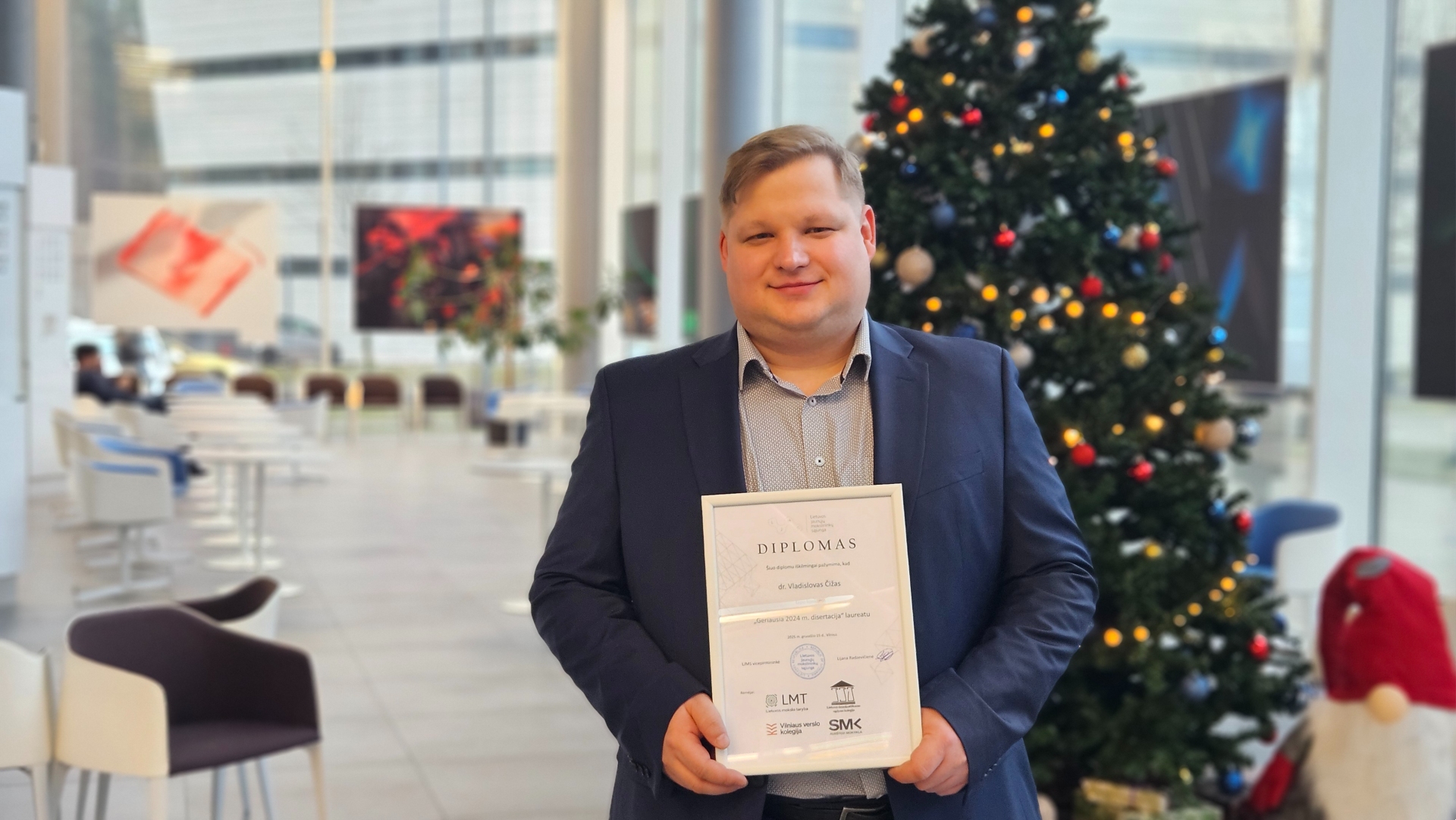
Dr Vladislovas Čižas Recognised for the Best Doctoral Dissertation of 2024!
The Lithuanian Society of Young Researchers (LSYR) has honoured the authors of the best doctoral dissertations of 2024. We are delighted that one of this year’s laureates is Dr Vladislovas Čižas, a physicist from the FTMC Department of Optoelectronics!
Our colleague received the award in the category of Natural Sciences, Technology, Medicine and Health, and Agricultural Sciences. His dissertation is entitled “Coexistence of High-Frequency Parametric and Bloch Gain in Doped GaAs/AlGaAs Superlattices” (academic supervisor: Prof. Habil. Dr Gintaras Valušis).
Dr Čižas is not only a talented researcher but also an active science communicator, one of FTMC STEAM ambassadors who frequently visits schools or hosts young people in his laboratory.
“My greatest thanks go to my PhD supervisor, Prof. Gintaras Valušis, to the other members of the team from the Terahertz Photonics Laboratory and the Department of Optoelectronics as a whole. Of course, the entire FTMC supported me. Thanks to my family for their patience – and for continuing to show it,” Vladas says with a smile.
“Regardless of whether I had received the award or not, the inspiration in my work is immense. We never stop and continue working for the benefit of science and the Center,” the scientist adds.
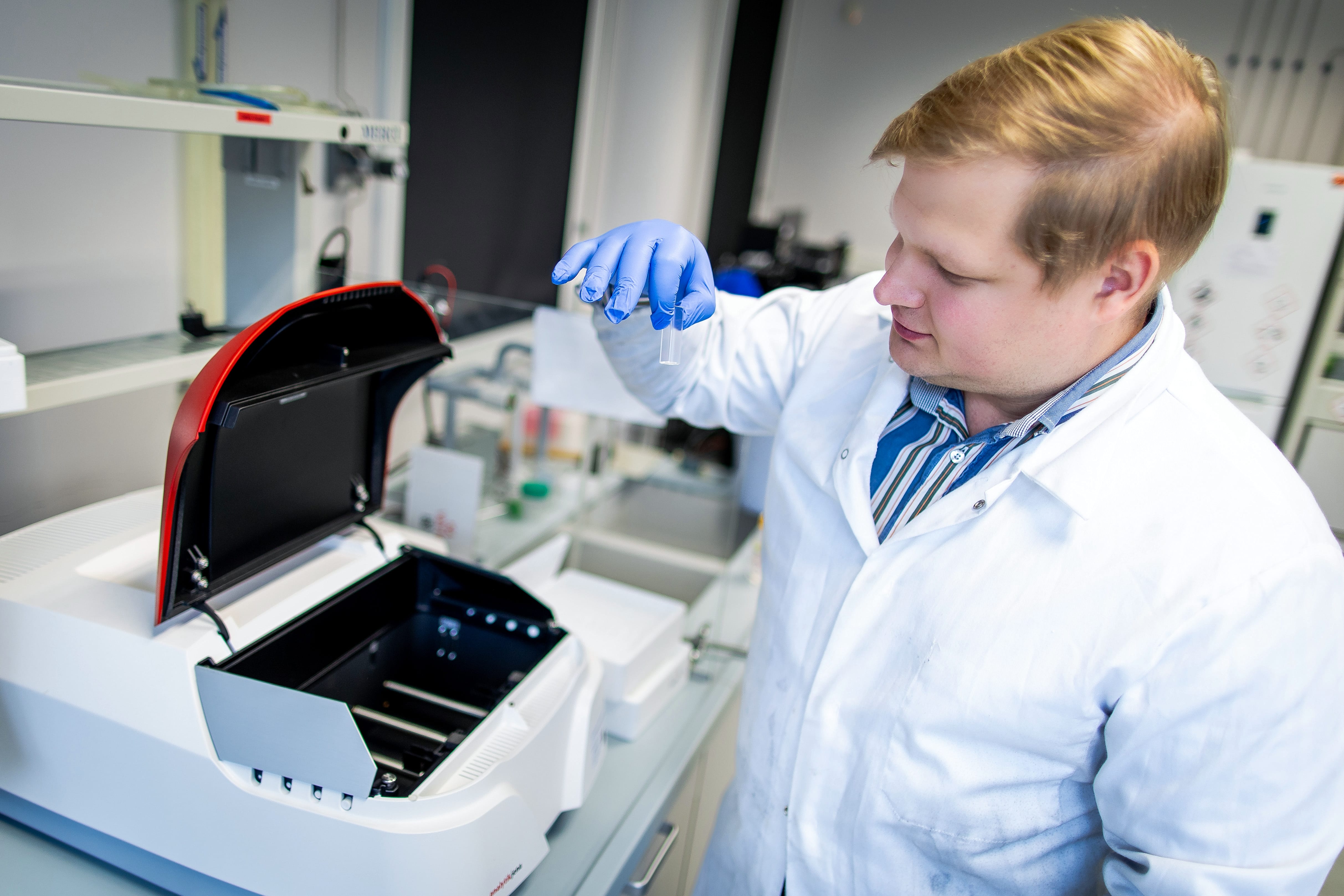
(Dr Vladislovas Čižas. Photo: FTMC)
His PhD supervisor, former FTMC Director and Head of the Department of Optoelectronics, Prof. Habil. Dr Gintaras Valušis, says that Čižas’s work is exceptional.
“The main results have been published in the world’s leading physics journal, Physical Review Letters, which says a great deal. It is not easy to get published there – the competition is enormous – so you have to create something truly outstanding to be accepted.
In his work, Vladas demonstrated extraordinarily broad competences, and the text is written in a solid scientific style, so I am very pleased that the jury noticed this. I believe this is a step forward on the path to a strong scientific career. Congratulations to Vladas – it is very good news just before Christmas,” says Valušis.
In his dissertation, Vladislovas developed new sources operating in the terahertz (THz) frequency range. What does this mean? THz radiation consists of harmless electromagnetic waves that scientists investigate with the aim of applying them in a variety of fields: next-generation data transmission, security systems, medicine, pharmaceuticals, quality control, and more.
An essential part of THz technologies is the source, the device that emits these electromagnetic waves. For this purpose, Dr Čižas and his colleagues used quantum superlattices: square-shaped structures invisible to the naked eye, made from gallium arsenide crystal. Thanks to their properties, it is possible not only to generate THz waves, but also to amplify them by up to a thousand times!
Building on this discovery, FTMC scientists patented the technology in 2023 – and it later became the basis of the doctoral dissertation.
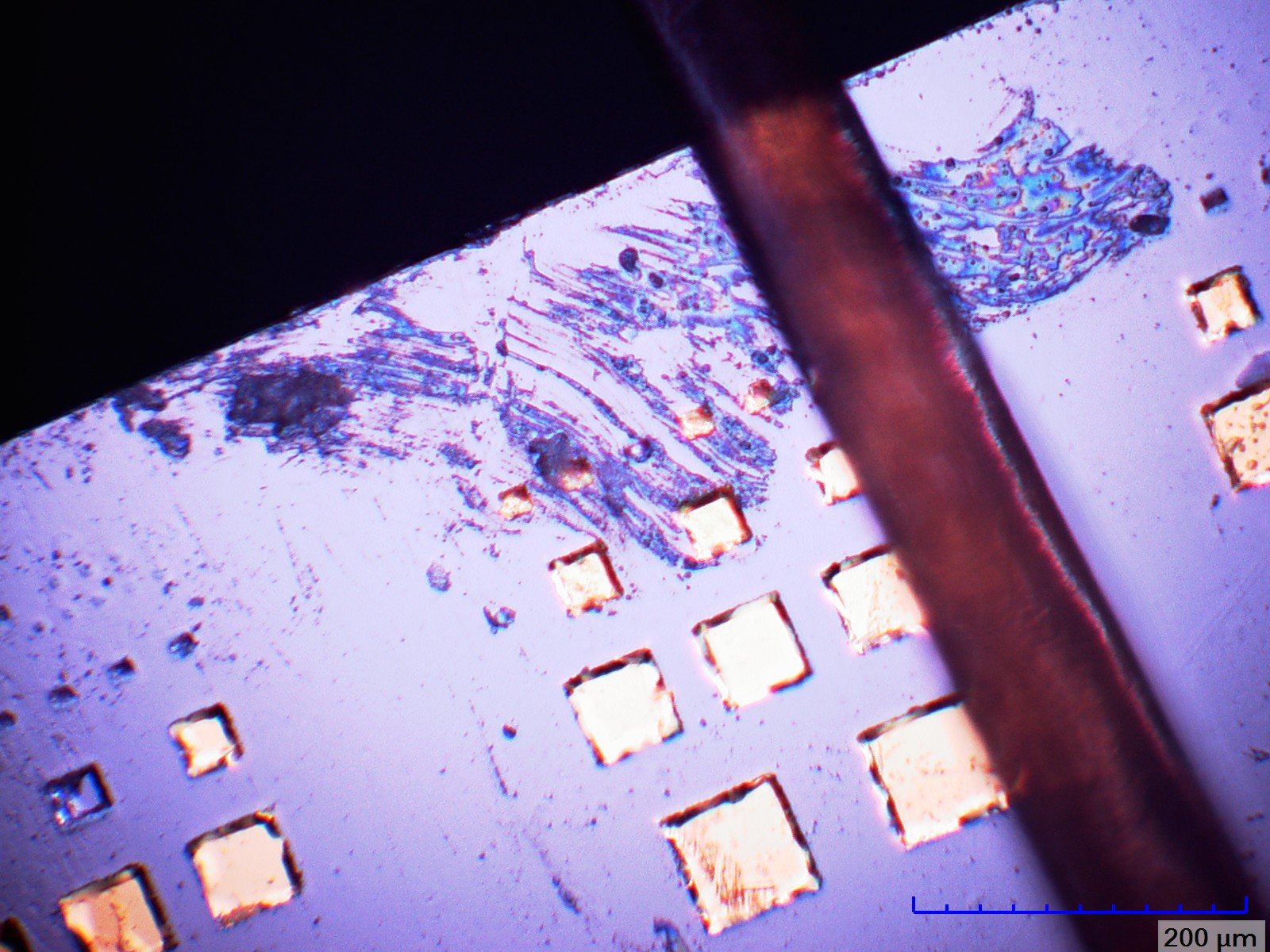
(Square quantum superlattices created by Dr. V. Čižas, magnified under a microscope, and a human hair on the right. Photo: FTMC)
This is the fourth consecutive year that FTMC researchers have received this distinguished award. The 2024 laureate was chemist Dr Gintarė Gečė; in 2023 the award went to chemist Dr Agnė Zdaniauskienė; and in 2022 to physicist and laser scientist Dr Lina Grinevičiūtė.
In the LSYR 2024 “Best Dissertation” competition, 245 experts evaluated 101 submissions. Ten outstanding dissertations from various scientific fields were selected as laureates.
The aim of the competition is to encourage doctoral students to prepare high-level scientific dissertations that gain recognition not only in Lithuania but worldwide, to promote interinstitutional and interdisciplinary cooperation, and to increase the motivation of young Lithuanian researchers to carry out scientific work of the highest quality and societal relevance.
You can read the dissertation by following this link.
Information: FTMC and LSYR