- Home
- News & Events
- News
Dr Mindaugas Karaliūnas’ Chapter on Oil Investigation Highlighted in International Terahertz Research Book
The international publishing house World Scientific has released a book titled Terahertz Spectroscopy and Its Applications. The volume contains chapters written by scientists from across the globe, presenting the latest advances in applying terahertz spectroscopy in physics, chemistry, materials science and engineering. The book is aimed at postgraduate, doctoral and postdoctoral researchers.
Terahertz spectroscopy is a method that uses electromagnetic waves in the terahertz frequency range to study the properties of materials. Although terahertz waves are invisible to the naked eye, with the right equipment they can reveal the vibrations and structure of molecules within substances.
The book was edited by Professor Carlito Jr Salonga Ponseca – a Filipino-born researcher currently working at the Gulf University for Science and Technology in Kuwait. As he writes in the introduction, twenty years ago terahertz waves were regarded as a “gap” between the more familiar radio and visible light frequencies. And with reason – in 2005, only about a hundred scientific papers on terahertz waves had been published worldwide. Today, there are around 20,000, and interest in the field is still growing rapidly.
In this latest review of the field, scientists discuss how terahertz waves can be better utilized and how this form of spectroscopy helps study materials ranging from solar cells to semiconductor nanostructures. The book’s final chapter describes how terahertz waves can be used to examine the optical properties of various oils, lubricants and fuels.
Significantly, the author of this chapter is a Lithuanian physicist – Dr Mindaugas Karaliūnas from the Center for Physical Sciences and Technology (FTMC) in Vilnius, working in the Department of Optoelectronics. What makes his research in this field both interesting and relevant?
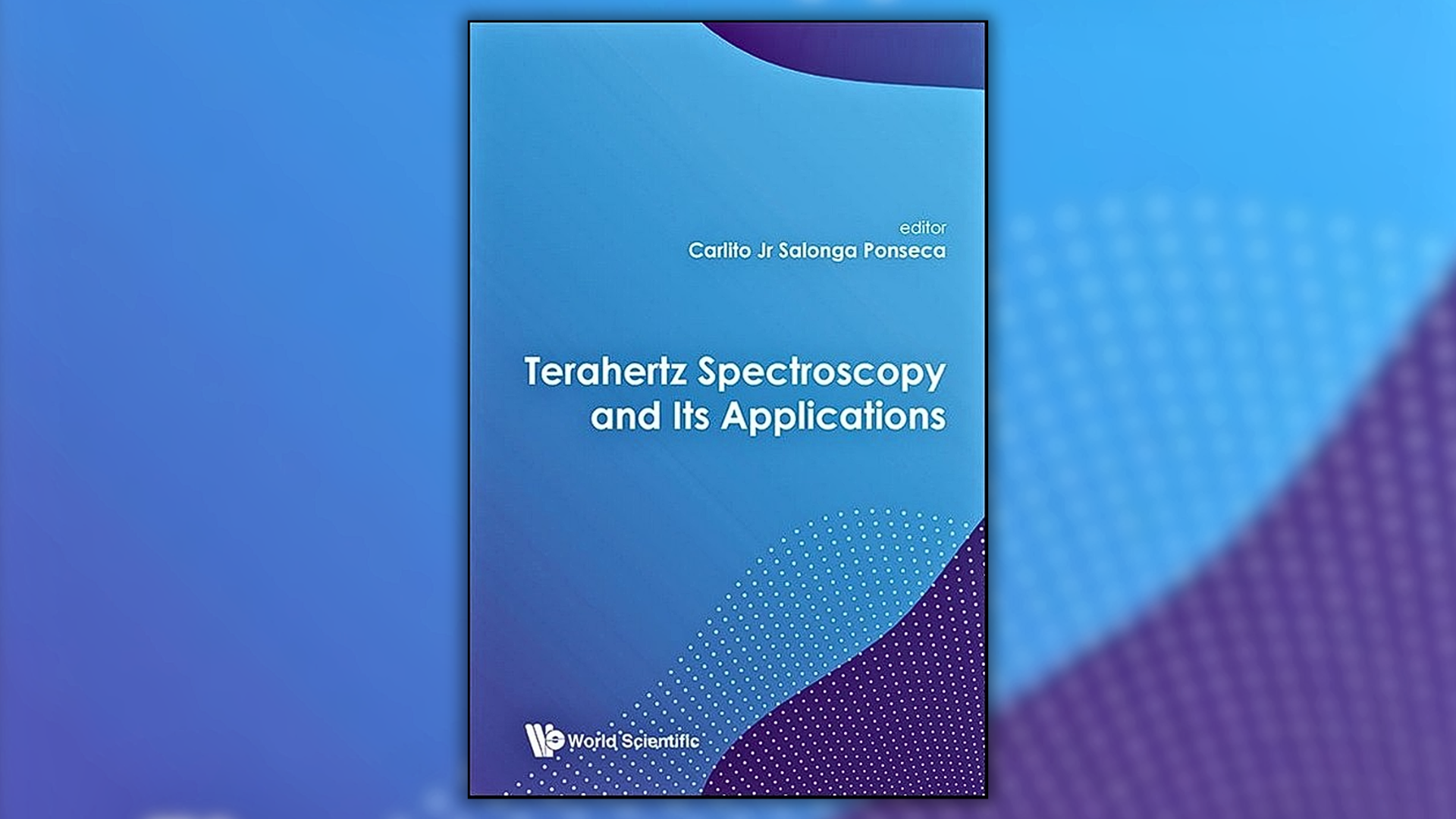
(Book cover. Photo: Worldscientific.com)
Preventing Fraud
“It felt as if I were writing my PhD thesis all over again. It was challenging but also very enjoyable – I’m really pleased,” recalls Mindaugas.
The story began much earlier. To understand his work better, we need to go back to 2013, when, having completed his doctoral studies, the young scientist joined the FTMC Terahertz Photonics Laboratory.
Terahertz waves are unique because they can “see through” certain materials, making them useful for a wide range of studies – from airport security screening to the analysis of material composition. The laboratory’s main mission is to develop new terahertz devices that can help identify the composition, quality, and changes in materials more precisely.
“One day, our lab head Dr Irmantas Kašalynas came by and said, ‘Have a look at what could be done with oils.’ So I began measuring the properties of vacuum pump oil. Terahertz waves really don’t ‘like’ water – they can’t penetrate it – but oils and fats, as it turned out, are very suitable for such investigations,” says Dr Karaliūnas.
What started as a curiosity gradually turned into serious research. The goal was to compare the internal properties of fresh and used oils and lubricants. The fruitful collaboration started with the FTMC chemists, namely the late Dr Svajus Asadauskas and his team – one of Lithuania’s best-known tribologists, who had recently returned from the United States. Together they examined not only lubricants but also refined and unrefined edible oils from shops, including linseed, hempseed and fish oils.
“I remember buying camelina oil for experiments – Svajus had recommended it in a conference talk as a possible replacement for technical lubricants, especially given rising prices,” smiles Mindaugas. “It also helps to avoid legal restrictions: plants grown for food can’t be used for technical purposes, but camelina is classified by the EU as a technical crop. And it’s edible too!”
(Photo: Canva.com)
According to Dr Karaliūnas, terahertz studies of oils and lubricants are also relevant in another important area: developing a spectroscopic method to determine whether these substances are still usable or already degraded. He gives an example from food safety:
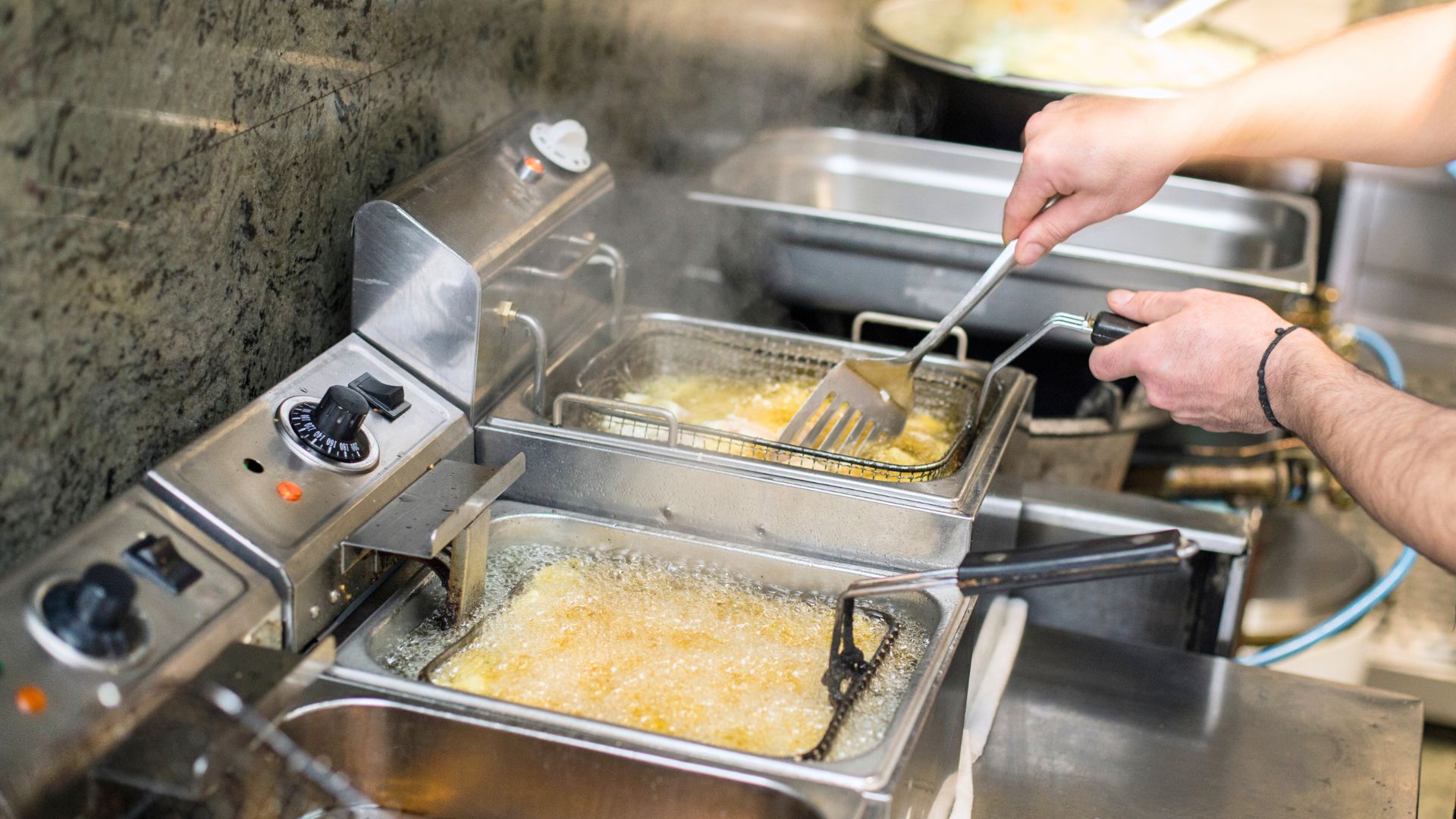
“In China, deep frying is very popular. There’s a known illegal practice where used oil from restaurants is collected, reprocessed restoring it’s color and odor – and the next morning it’s sold again as new. But it’s full of carcinogens! Therefore it’s called swill-cooked dirty oil. So it’s vital to have a method for recognizing swill-cooked dirty oil from edible oil and prevent fraud.
Chinese researchers have even tried using artificial intelligence to assess whether oil is still fresh, but such methods can be unreliable – AI can overestimate the prediction results. Careful human analysis remains essential to attribute spectral features to the chemical properties,” says Mindaugas.
Results Published in a Prestigious Journal
In brief, here’s how such studies are conducted: scientists illuminate oil non-invasively with terahertz waves of specific wavelengths and measure how the radiation interacts with the material. The oil partially absorbs and partially transmits the radiation, and these changes are recorded as data or curves known as absorption spectrum.
Every substance has a unique spectrum depending on its composition. As oil ages, its chemical composition changes – and so does the shape of its spectrum. Spectroscopy enables researchers to detect these variations.
“We used terahertz time-domain spectroscopy. This method allows us to determine two key optical parameters: the absorption coefficient (how much radiation a material absorbs) and the refractive index (how much the radiation slows as it passes through). Each material has characteristic values for these parameters.
We could obtain both parameters from a single measurement and then compare different samples. Imagine two bottles – one with technical oil and one with cooking oil. They look identical, but spectroscopy can tell them apart by their internal structure. Even more importantly, systematic measurements allowed us to determine whether an oil or lubricant was still fresh,” explains the physicist.

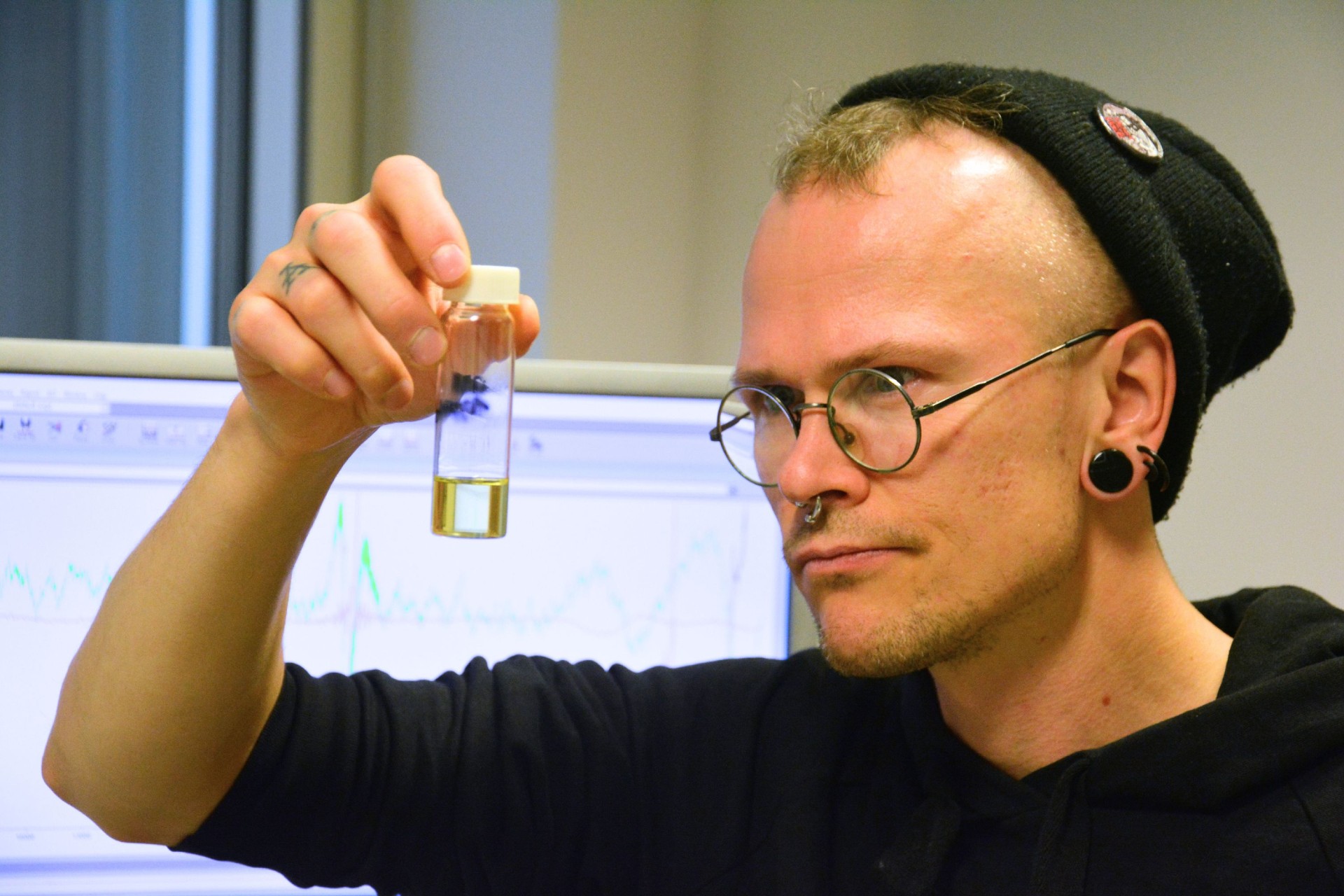
(Dr Mindaugas Karaliūnas. Photo: FTMC)
At first, Mindaugas planned to age oils himself – heating them for one, three, or five hours to observe the changes. However, this method would be unscientific from chemistry point of view and even dangerous, since overheated oil can ignite. Therefore chemist Dr Asadauskas proposed an alternative: using oil with added hydrolysis products, which form when oil interacts with water (for example, during frying) and break down its molecules.
This leads to a sort of “micro-explosion” – instead of a uniform molecular structure, the oil forms reverse-micelles, or macro-molecular bubbles made of free fatty acids. The research team demonstrated that this structural change could be detected using terahertz spectroscopy – a novel finding at the time. This was back in 2018.
Dr Karaliūnas and his colleagues published the discovery in a paper that gained unexpected recognition – it appeared in Scientific Reports, a prestigious journal from the Nature Publishing group.
“Oils and lubricants have been studied using terahertz waves since 2005, and it seemed there was nothing new to discover. But when researchers tried to determine the ‘age’ of oil, they found it difficult – data were often inconsistent, making it hard to pinpoint when exactly degradation occurred. Our paper contributed valuable insight to this scientific discussion, and it was gratifying that Scientific Reports acknowledged it,” says Mindaugas.
He adds that much work remains to be done – terahertz waves are not yet a fully reliable tool for determining the precise age of oils and lubricants, with many technical and scientific challenges still ahead. Nevertheless, Lithuanian researchers have helped to deepen global understanding of these subtleties.
Samples from Kuwaiti Oil Fields and Vilnius Petrol Stations
This was the background to a new opportunity: this year, the FTMC physicist presented his work to the international community through a chapter in Professor Ponseca’s book Terahertz Spectroscopy and Its Applications.
Dr Karaliūnas first met the Professor when Ponseca was teaching at Vilnius University (while working at Linköping University in Sweden). Mindaugas was an assistant helping to run seminars and lab sessions. As a terahertz spectroscopy specialist, Ponseca often visited the FTMC lab. Later he and his family moved to Kuwait to establish a spectroscopy centre there.
Having kept in contact, Ponseca invited the Lithuanian physicist to contribute a chapter to his upcoming book.
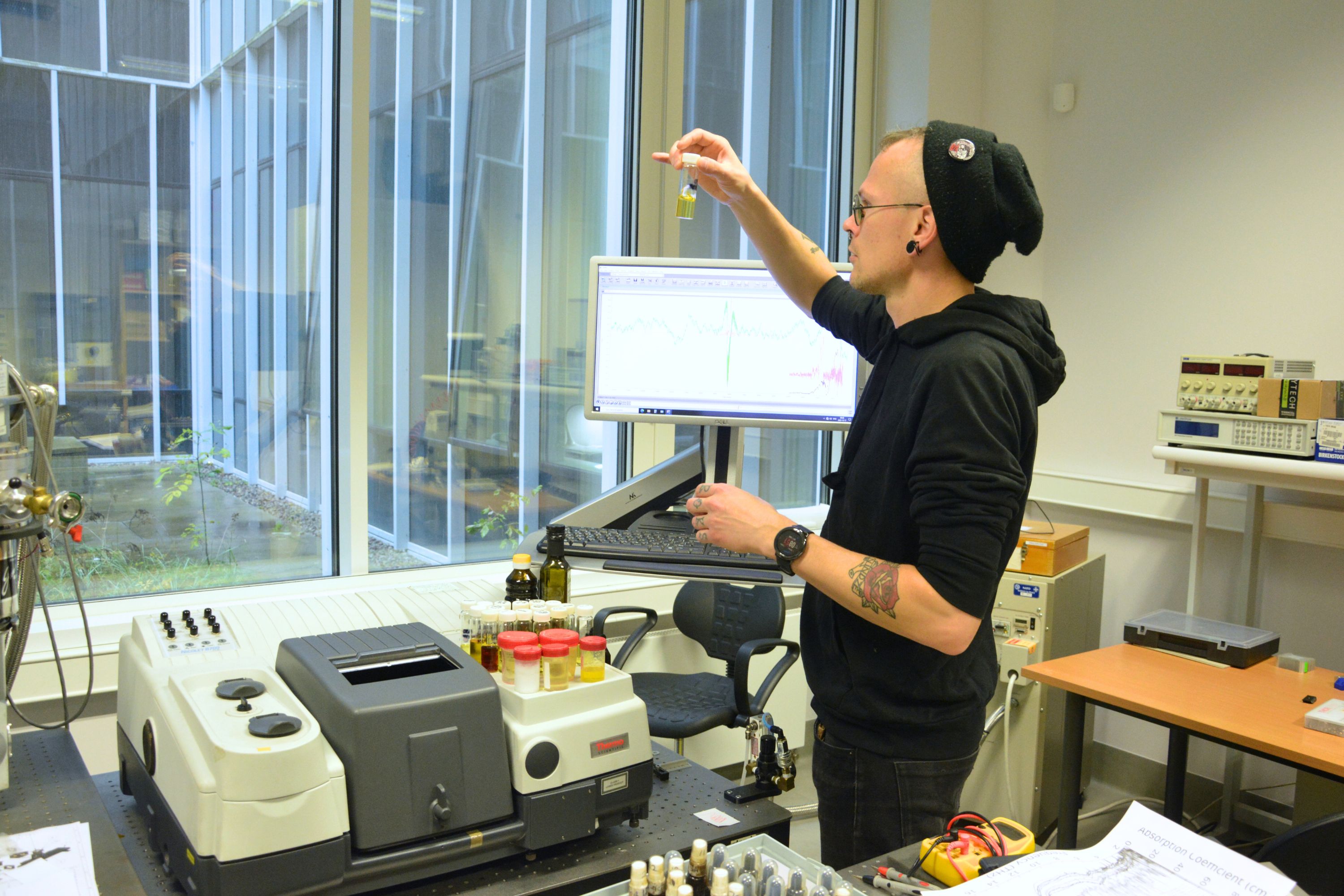
“After learning about my work on oils and my Scientific Reports paper, he sent me sixty different crude oil samples from Kuwaiti oil fields to analyze using terahertz spectroscopy. Obtaining such samples is extremely difficult. I used a slightly different technique – Fourier-transform terahertz spectroscopy – which works on a different principle and frequency range.
About half the samples weren’t suitable for this method, but the other half produced fascinating results. One sample, for instance, turned out to be pure water! It seems water and oil travel together from the well – or perhaps the sample was intentionally prepared that way to test the measurement technique,” says the FTMC physicist.
(Dr Mindaugas Karaliūnas. Photo: FTMC)
Later, he involved Vilnius University students in the experiments, helping them gain hands-on laboratory experience – even if not all results were successful. For comparison, he also collected “Lithuanian” samples: petrol and diesel from Vilnius gas stations. “The funny thing is, I was driving around collecting fuel samples in a rented electric car,” he laughs.
So what is the significance of his contribution? The Lithuanian’s chapter summarizes the latest knowledge on applying terahertz technology to the study of oils, lubricants and fuels, covering raw material composition analysis, monitoring of processing technologies, quality control, and assessment of wear levels.
“The topic is quite broad – especially in English, where the word ‘oil’ covers what in Lithuanian are separate terms for cooking oil, lubricant and petroleum. But it’s not just a linguistic issue – we’re dealing with the vast realm of organic chemistry, whose compound diversity is practically limitless,” notes Mindaugas.
Nonetheless, he managed to systematize and describe the latest advances in terahertz technology for analyzing oils, lubricants, fuels, and petroleum products. The chapter not only reviews global progress but also details the FTMC Terahertz Photonics Laboratory’s work, expanding on findings from earlier papers. It also covers the basic principles of terahertz spectroscopy and the data analysis methodologies used – highly valuable for postgraduate and doctoral researchers, since the material is based on his experience teaching at Vilnius University Faculty of Physics.
As for the practical significance of this research? “One goal,” says Mindaugas, “could be to develop a reliable scientific tool for identifying the source of petroleum. This is a complex but highly relevant challenge – when crude oil spills occur, it would help determine who is responsible.
Despite the global push for sustainability, oil extraction continues to grow. Even if we all drive electric cars, we’ll still need crude oil for plastics and other industries. And where there’s industry, there are accidents – for instance, crude oil spills at sea. Not every company is willing to admit responsibility. Reliable scientific tools could help identify the source and hold the right company accountable for clean-up.
Moreover, terahertz spectroscopy could be integrated into crude oil refining plants to monitor processes in real time and make them more efficient. These are still theoretical discussions – but with determination, such technologies could help us move towards a cleaner future,” concludes Dr Karaliūnas.
Written by Simonas Bendžius, FTMC Public Relations and Communication Specialist