- Home
- News & Events
- News
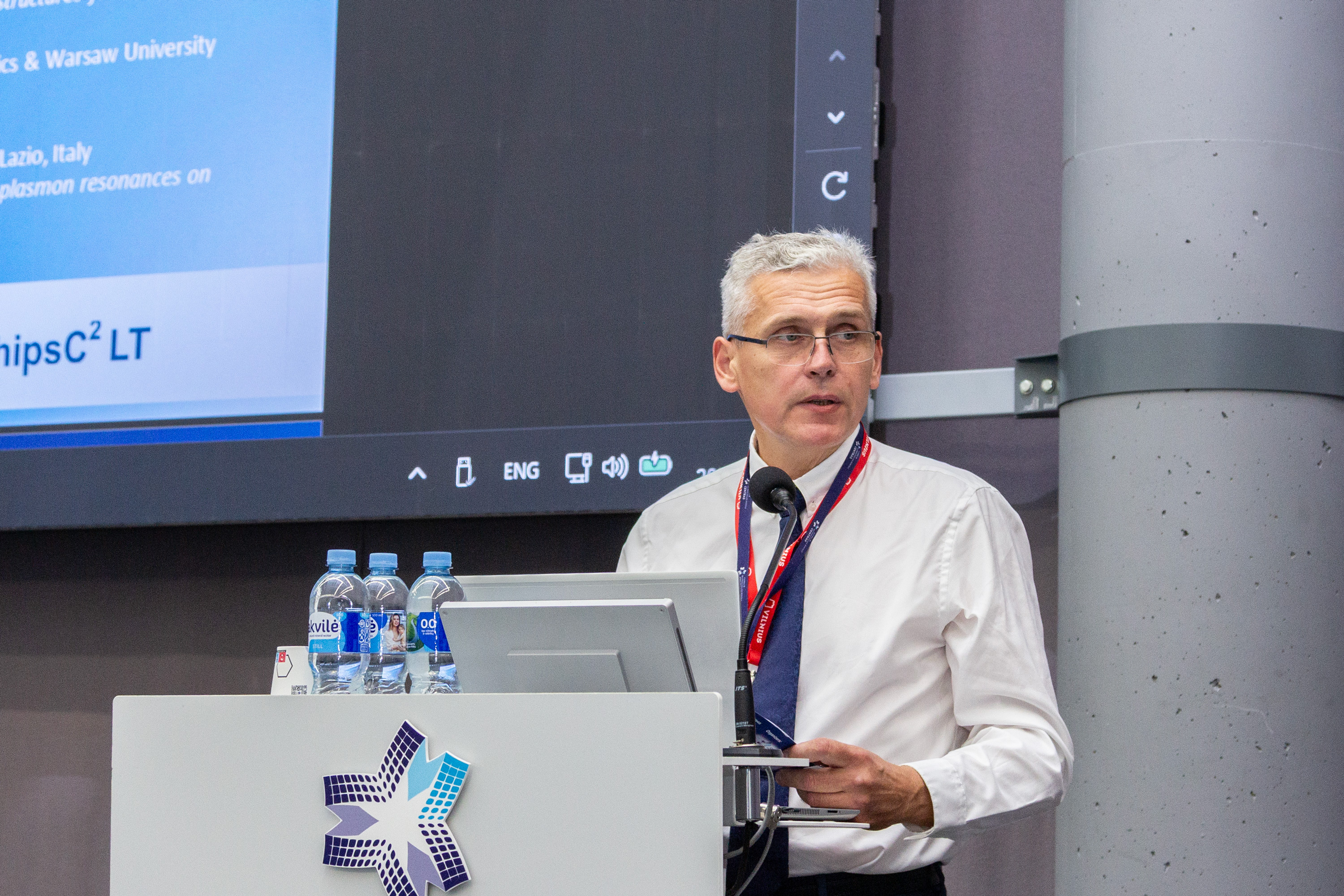
Dr Irmantas Kašalynas, Organiser of the Prestigious APROPOS Conference, on Lithuanian Science: “We Are Right at the Nose Cone of the Rocket”
FTMC, together with the ChipsC²-LT and HERMES projects, organised the 20th edition of the prestigious international scientific conference APROPOS. The event brings together leading researchers and technology developers from around the world to discuss the latest advances in semiconductors, photonics, optoelectronics and terahertz technologies, as well as their applications in future communication systems, sensing technologies and other advanced fields.
This year, the conference welcomed experts from Lithuania and abroad, including some of the most prominent figures in terahertz science and technology, such as Professor Xi-Cheng Zhang of the University of Rochester (USA), Professor Tadao Nagatsuma of the University of Tokyo and Osaka University (Japan), and Professor Willie Padilla of Duke University (USA).
Terahertz are electromagnetic waves located between radio waves and visible light in the spectrum. They can penetrate many materials while remaining non-ionising, making experiments involving them completely safe. This “invisible light” can transmit vast amounts of data and help investigate a wide range of materials, offering significant potential in areas such as communications and 6G technologies, security systems, electronics and medicine.
These and many other topical issues were discussed in Vilnius by around 120 conference participants.
Science Fiction Becoming Reality
According to the Chair of the Conference, Dr Irmantas Kašalynas, Head of the FTMC Terahertz Photonics Laboratory, the presence of internationally renowned scientists was among the event's greatest successes.
“Personally, I was particularly impressed by the discussions on communications and wireless technologies. I would especially highlight Professor Nagatsuma's presentation on terahertz communications. He is regarded as one of the leading figures in the field. As he himself noted, he has been working in this area for more than twenty years and now, for the first time, clearly sees a genuine breakthrough: both the demand for the technology and its potential applications are growing exponentially,” the scientist says.
According to Dr Kašalynas, the topic is closely linked to the significant European project HERMES, in which FTMC is also a partner. By 2029, the international team aims to develop next-generation short-range terahertz wireless communication systems based on graphene and graphene-enabled components.
Most communication technologies today are designed to maximise transmission distance. HERMES, however, pursues a different goal: transmitting enormous volumes of data over short distances at extremely high speeds. The project aims to achieve data rates of up to 100 gigabits per second, significantly surpassing the capabilities of current technologies.
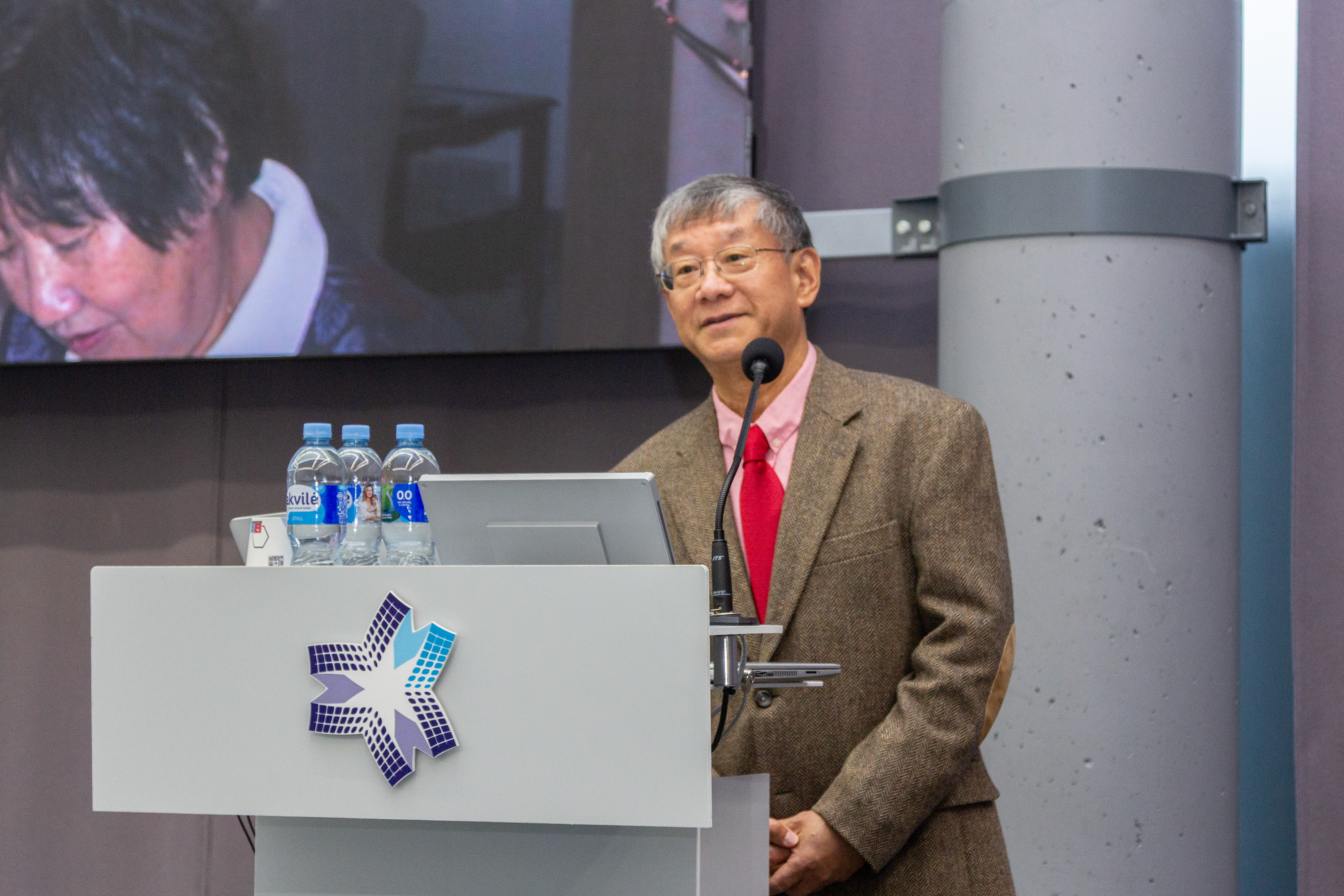
(Prof Xi-Cheng Zhang. Photo: Gabrielius Mackevičius / FTMC)
“Professor Xi-Cheng Zhang also delivered an exceptionally strong presentation. He spoke about generating terahertz waves using liquid helium, which is a highly exotic medium. We are talking about temperatures of around 3 K, or approximately -270 °C. Turning helium, which is normally a gas, into a liquid and then generating terahertz radiation from it sounds almost like science fiction.
It is like discussing a future mission to Mars. Yet this is exactly how major breakthroughs happen. The professor explained that within the next year or two he hopes to carry out this experiment and see how the idea performs in practice,” says the Chair of the APROPOS.
Strategically Important Partnerships
According to Dr Kašalynas, Lithuania's close connections with the achievements of leading international researchers are no coincidence. Current and former members of FTMC Department of Optoelectronics are among the global leaders in terahertz research and constantly keep pace with the latest scientific and technological developments. As a result, an important objective when designing the conference programme was to showcase FTMC's strategic collaborations with some of the world's strongest universities and research organisations.
“For example, we hosted guests from Japan's RIKEN Institute. In a sense, it is similar to FTMC, only on a much larger scale. We also welcomed speakers from another exceptionally strong organisation, VTT Technical Research Centre of Finland.
It was important for us to present not only universities ranked among the world's top institutions, but also research centres that shape technological development in their countries and help translate scientific discoveries into practical applications.
Overall, I believe the conference was highly successful, both in terms of the quality of presentations and the geographical diversity of participants. It also provided an opportunity to reflect on FTMC's own strategy over a longer time horizon, looking five or even ten years ahead,” says Dr Kašalynas.

(Participants of the APROPOS 2026 Conference. Photo: Gabrielius Mackevičius / FTMC)
We Are Larger Than We Sometimes Think
According to the physicist, large-scale events such as APROPOS demonstrate that international colleagues see FTMC as a dynamic organisation that evolves rapidly and adapts successfully to changing circumstances. Lithuania attracts attention because its researchers remain open to innovation, continuously seeking new ideas, partnerships and approaches to scientific research.
A similar view was expressed by Japan's Ambassador to Lithuania, Shinsuke Shimizu, who noted during the conference that Japan regards Lithuania as an attractive partner for cooperation. This perception has developed over many years, from the historical ties associated with Chiune Sugihara to Lithuania's present-day strengths in lasers, semiconductor technologies and medicine.
Around ten participants travelled from Japan to attend the conference, while students from Japanese universities regularly come to FTMC for research placements and longer-term internships.
“Sometimes we may see ourselves as a small country, but from the outside it is clear that our international partners hold us in very high regard. When world-class scientists come here, take an interest in your work and look for opportunities to collaborate, you begin to see your own place in the international landscape differently.
Of course, when we move from science towards technology and enter the commercialisation stage, the situation changes. At that point, we are competing with giants such as Nokia, RIKEN and Germany's Fraunhofer Institute. Matching their financial and human resources is extremely difficult. In such circumstances, we must offer something distinctive, unique and authentic.
Yet in the early stages, when new ideas emerge, the first experiments are conducted and the first prototypes are created, we stand right at the forefront. As I often say, we are at the nose cone of the rocket. The key challenge is staying there, because there is never much room at the very tip,” the APROPOS organiser says with a smile.
By Simonas Bendžius