- Home
- News & Events
- News
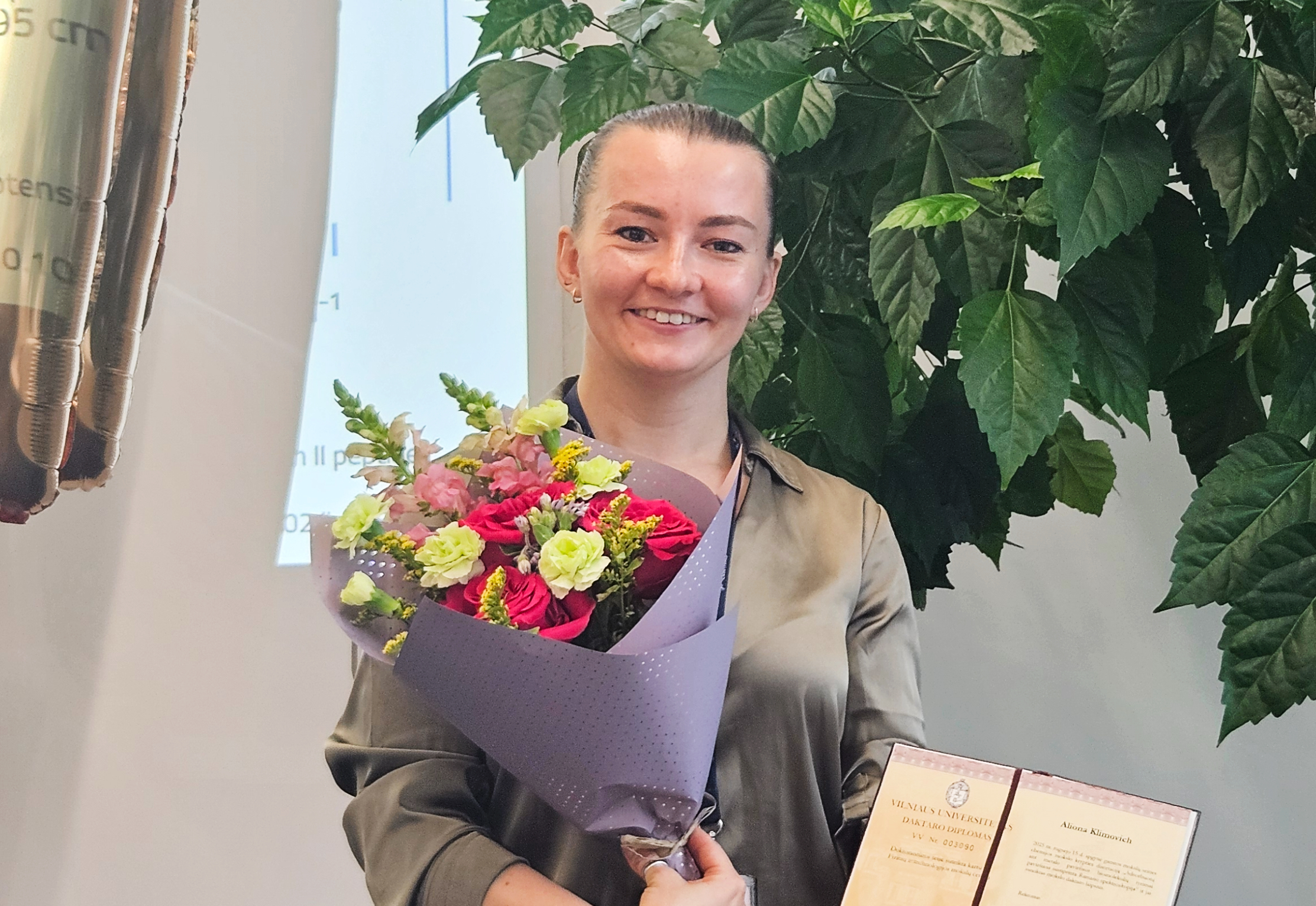
Dr Aliona Klimovich: the New PhD Exploring a Medically Promising Molecule
On 15 September, Aliona Klimovich, researcher at the FTMC Department of Organic Chemistry, defended her PhD in Chemistry.
Her dissertation topic: “Surface-enhanced Raman Spectroscopic Study of Adsorbed Biomolecules at Metal Surfaces” (academic supervisor: Dr Ieva Matulaitienė).
Congratulations to our colleague – wishing her a successful scientific journey ahead!
In her work, Aliona investigated a molecule of high relevance to medicine – the Urotensin II peptide. The author emphasizes that the diversity of biological molecules is a fundamental part of the basis of living organisms. These molecules perform a variety of vital functions and take part in chemical reactions.
Science and technology have made it possible to better understand how these molecules function. Research helps to determine their structure, role, and how they interact with each other. Some molecules have become useful scientific tools or even medicines.
One such molecule is the aforementioned Urotensin II peptide. It is known for constricting blood vessels, but also acts a neurotransmitter and neuromodulator. “Elevated concentrations of this peptide in the context of kidney, liver, and heart diseases make it a promising research target for drug development,” says Klimovich.
In her study she used advanced light-scattering methods – Raman and SERS spectroscopy. The chemist notes with joy that, during her dissertation, the characteristic Raman spectrum of the Urotensin II peptide in its native state was obtained for the first time. In other words, it was the first time the molecule’s ‘fingerprint’ was captured – showing how it looks when illuminated, in its natural, unmodified form. In addition, by applying SERS and EC-SERS methods, a mechanism of U-II adsorption (attachment) on various metal surfaces was proposed, and the influence of anions and metal type on this adsorption process was examined.
“This knowledge suggests a 'molecule-receptor' interaction pattern, which could facilitate the creation of synthetic analogs with similar properties. Also this is an interesting molecule, which do not break the S-S bridge (a bond between two sulphur atoms that keeps the protein in a particular shape) during adsorption process and this feature can be interesting for other researchers,” says the new PhD in Chemistry.
Info: FTMC