- Home
- News & Events
- News
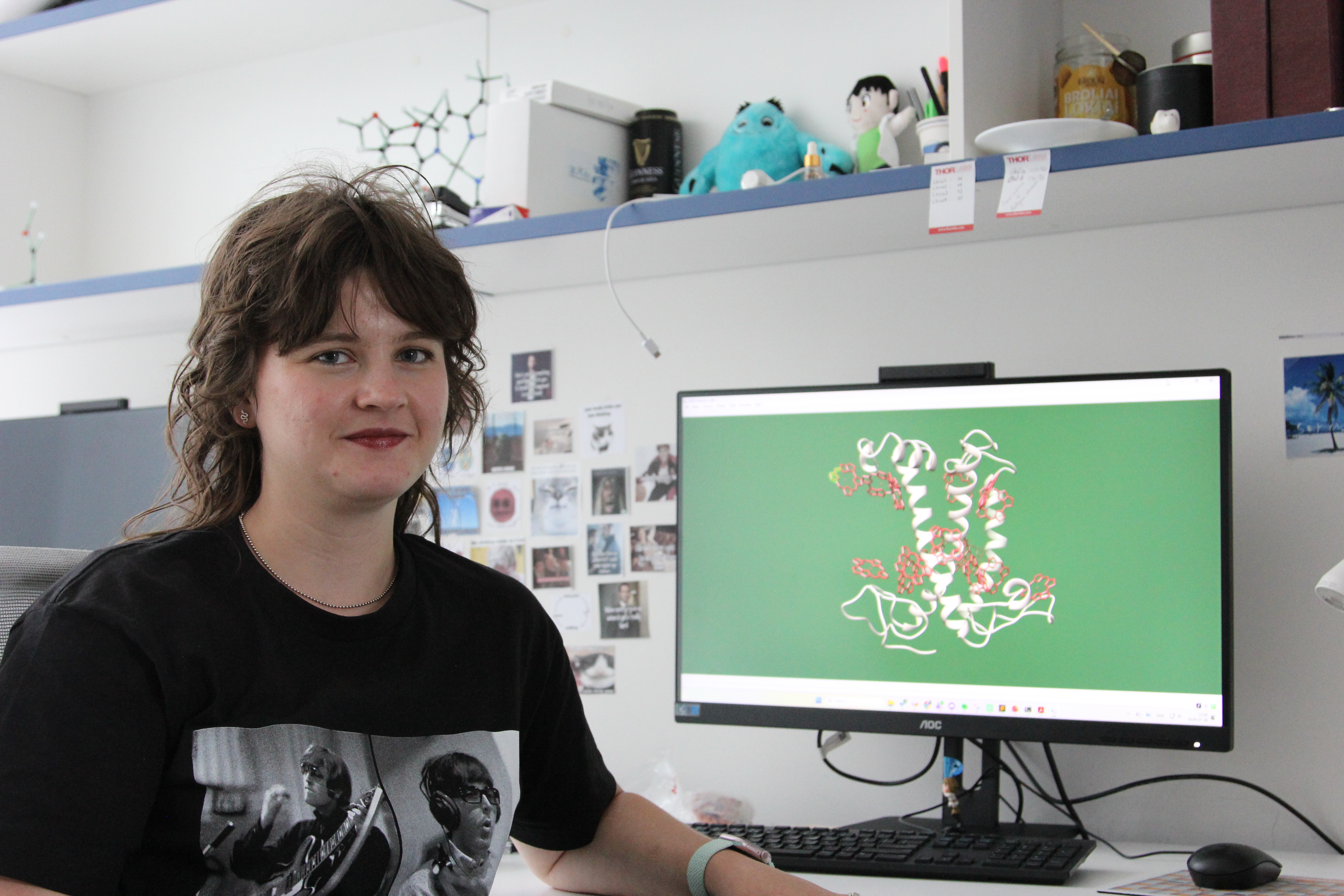
Could We Learn Solar Cell Design from Plants? FTMC PhD Student Gabrielė Rankelytė Receives International Recognition
How can the efficiency of solar cells, which under real-world outdoor conditions typically reaches no more than 25%, be improved? One possible answer is to take inspiration from plants, which are remarkably efficient at harnessing light energy and converting it into food.
Gabrielė Rankelytė, a PhD student at the FTMC Department of Molecular Compound Physics, investigates the natural mechanisms that take place before photosynthesis begins and seeks to determine how these processes might be transferred to human-made technologies.
Her work has already received international recognition: her presentations were awarded Best Poster prizes at international scientific conferences held in May and July.
What Happens Before Photosynthesis Begins?
The FTMC doctoral researcher focuses on photosystems, which are found in plants, algae and cyanobacteria. Photosystems are complexes of pigments and proteins that absorb sunlight and convert its energy into chemical energy, which is later used in photosynthesis, the process by which organisms produce nutrients.
Plants, algae and cyanobacteria contain two photosystems. The first of these, Photosystem I, absorbs light energy and excites electrons, initiating the processes that supply photosynthesis with the energy it requires.
This initial stage is precisely what Gabrielė studies. According to her, it involves a number of fascinating mechanisms, and a deeper understanding of them may prove valuable for the development of renewable-energy technologies.
“The efficiency of Photosystem I is close to 100%. This means that almost every absorbed photon is successfully transferred as energy.
This is remarkable because no human-made technology, including solar cells, comes anywhere near this level of efficiency. That is why it is so interesting to understand why this energy transfer is so rapid and what conditions are necessary to achieve such performance,” she explains.
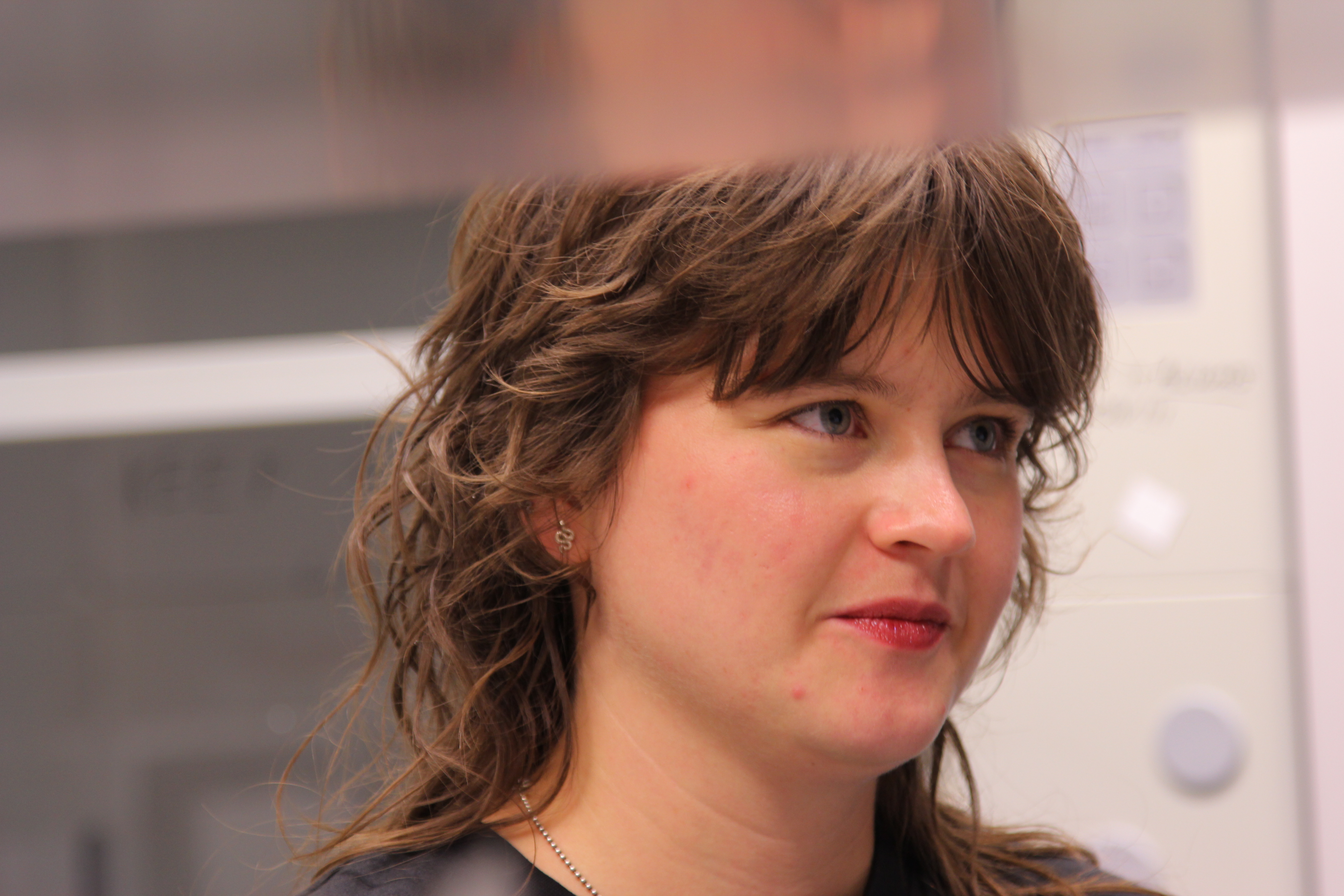
(Gabrielė Rankelytė. Photo: Gabrielius Mackevičius / FTMC)
Gabrielė searches for theoretical solutions by building and analysing computational models. According to the researcher, such experiments are currently only possible in a virtual environment because the photosystems under investigation are only a few dozen angstroms in size. For comparison, one angstrom is ten million times smaller than a millimetre, and the unit is commonly used to measure atoms and molecules.
“We can illuminate a system and measure light absorption, fluorescence or other parameters, but we cannot directly observe which chlorophyll molecule the light energy travels through.
That is why modifications are often introduced. For example, researchers may model what would happen if a particular pigment were removed or analyse protein mutations that alter the energetic properties of pigments. The resulting changes are observed through the light spectra that are produced.
I try to model these spectra theoretically so that they can later be compared directly with large-scale experimental data. If the theoretical results match the experimental findings, we can assume that our proposed model of energy transfer is correct,” says Gabrielė.
Her current primary goal is to understand exactly how light energy travels from photosystems, which “capture” sunlight, to the so-called reaction centre, where photosynthesis begins.
“A wide range of different mechanisms are involved. It is important to identify which of them operates under particular conditions, when specific processes are activated, and which are faster or slower. These are important questions that have not yet been fully resolved.”
.jpg)
(Gabrielė Rankelytė. Photo from personal archive)
Meeting Leading Scientists
The FTMC researcher’s work has already received its first international accolades. In May, she attended a scientific conference in Gaeta, Italy, and in July another conference in Liverpool, where she won awards for Best Poster Presentation. The latter event, Light Harvesting, organised by the International Society of Photosynthesis Research (ISPR), was particularly large, featuring around one hundred scientific posters.
The conference focused on how photosystems absorb light and how the captured energy is transferred onwards.
“I am delighted every time my presentations receive recognition. It makes me very happy.
Liverpool was especially memorable. When I learned that my presentation had been selected as one of the best, I was thrilled because it was directly related to my own field of research. Many renowned scientists were there, people whose papers I read and cite daily. I knew they were among the leading names in this area. Being recognised as the author of the best poster was therefore a particularly meaningful achievement,” says Gabrielė.
According to the researcher, much careful and systematic work still lies ahead. A single calculation will not immediately lead to the development of a new generation of solar cells. However, if we gain a better understanding of why plant photosystems operate so efficiently, some of their principles might eventually be adapted for technological applications.
“I am trying to contribute, step by step, to the collective advancement of science. And when it comes to renewable energy, I believe we can learn a great deal from plants.”
By Simonas Bendžius