- Home
- News & Events
- News
17 July, 2025
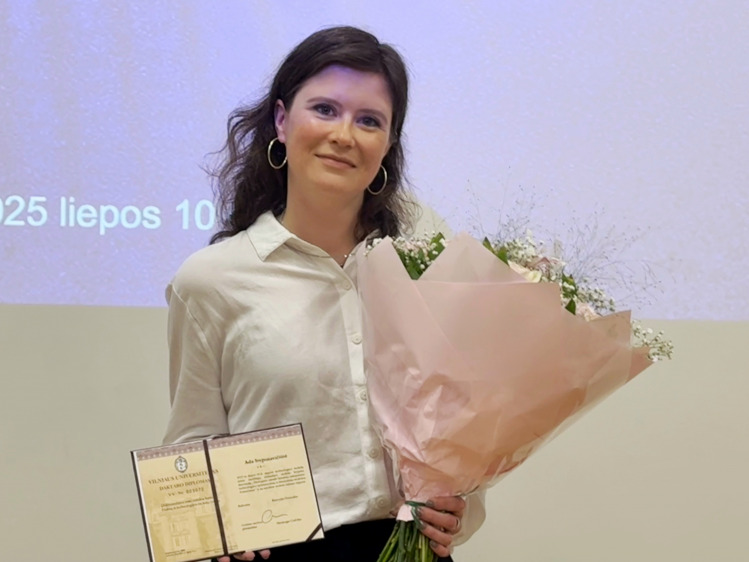
A. Steponavičiūtė Defends Dissertation on Metal 3D Printing and Bimetallic Structures
On July 10, Ada Steponavičiūtė, a PhD student at the FTMC Department of Laser Technologies, successfully defended her doctoral dissertation in the field of materials engineering titled “Optimization of Direct Metal Laser Sintering Technology and Formation of Bimetallic Structures” (Academic supervisor: Dr Genrik Mordas).
We sincerely congratulate our colleague on earning her Doctor of Science degree in technological sciences and making a significant contribution to the field of additive manufacturing and smart structure research!
In her dissertation, Steponavičiūtė investigated the Direct Metal Laser Sintering (DMLS) technology, which is one of the most advanced and widely used methods of metal additive manufacturing (3D printing). This technology enables the creation of complex geometry objects by forming layers directly from metal powders. Ada’s research included experimental optimization of the DMLS process and the formation of bimetallic structures using 17-4 PH stainless steel and the Fe29Ni17Co alloy. “The combination of these two materials is remarkable in that they possess different thermomechanical properties – this allows for the creation of structures that deform or change shape predictably in response to temperature variations,” notes scientist.
According to Steponavičiūtė, DMLS technology enables the efficient production of multifunctional components with lower material consumption. She marks that “unlike conventional manufacturing methods, where material is removed from a workpiece, additive manufacturing adds material layer by layer only where it is needed. By combining different alloys within a single object, it is possible to tailor properties – ensuring greater strength, elasticity, or temperature resistance in specific areas. Such solutions are relevant in aerospace, aviation, automotive, and medical fields – where lightness, reliability, and durability are crucial.”
One of the most significant outcomes of Steponavičiūtė’s dissertation is a new achievement in the field of bimetallic structure formation. “The most gratifying thing is that, using DMLS technology, it was possible to successfully print bimetallic structures from 17-4 PH and Fe29Ni17Co alloys for the first time. Combining these materials is technically challenging because their thermal expansion coefficients differ by almost double – when exposed to temperature, steel expands almost twice as much as Fe29Ni17Co, which causes large internal stresses and can lead to defects," explains Ada. She is pleased that “despite these challenges, strong and cohesive joints between different metals were achieved, and the optimized process parameters helped reduce surface roughness and improve product quality.” According to scientist, such bimetallic structures can be used in temperature-sensitive passive mechanisms, optical systems, or other engineering applications where a controlled response to environmental changes is required.
This dissertation marks an important step forward in both advanced additive manufacturing and the study of smart structures sensitive to temperature changes.
FTMC Information