- Home
- News & Events
- News
A New Chapter in Galaxy Evolution Research: FTMC Astrophysicists Make a Significant Contribution to an International Study
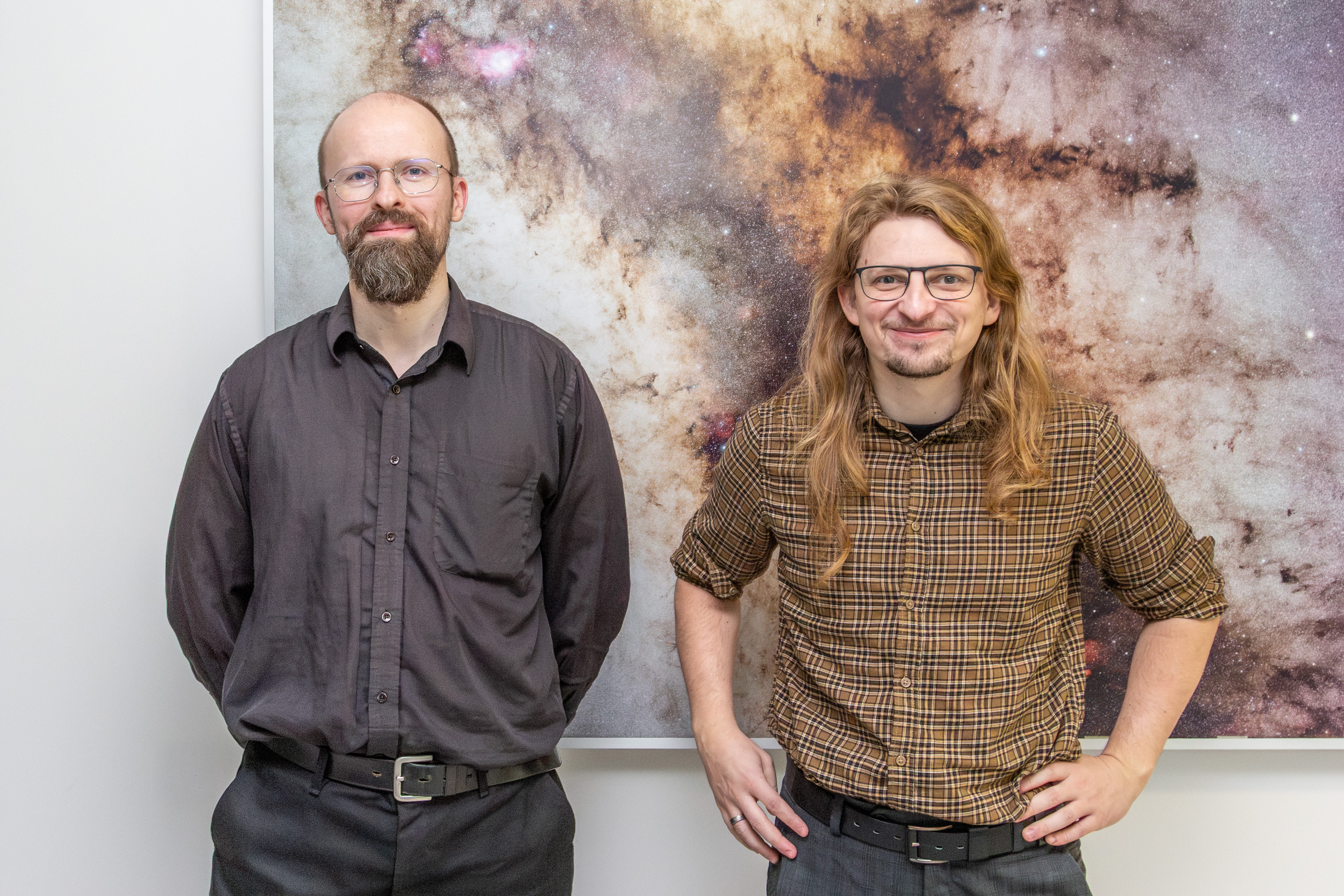
An international team of scientists, including FTMC astrophysicists Dr Kastytis Zubovas and Dr Matas Tartėnas, has revealed a new picture of the multi-million-year history of an active galaxy. By analysing NGC 1068, one of the nearest active galaxies, the researchers determined how the energy released in its nucleus is transferred to gas throughout the galaxy, and how this process has changed over the last several million years. The study is published in the prestigious journal Astronomy & Astrophysics.
“NGC 1068 is about 11 megaparsecs away, roughly 14 times farther than the Andromeda galaxy,” says K. Zubovas from the FTMC Department of Fundamental Research. “It has attracted a great deal of attention from astronomers, for two reasons. First, we see it nearly ‘face-on’, which allows us to observe both its outskirts and its central regions. Second, it has an active nucleus: a supermassive black hole that is rapidly swallowing the surrounding gas. This gas heats up and releases enormous amounts of energy, which drives gas outflows and can affect the evolution of the entire galaxy.”
Outflows are observed in many galaxies, but NGC 1068 is among the closest, which yields observational data of exceptional quality. Detailed observations alone are not enough, however: a large fraction of the outflowing gas can be hidden behind thick layers of dust, making it hard to detect. To obtain a clearer view of the outflow structure, an international team led by Dr Cosimo Marconcini of the University of Florence combined infrared observations from the James Webb Space Telescope with optical and millimetre-wave data from the Chile-based VLT and ALMA.
The infrared observations were particularly important because galactic dust absorbs this radiation less strongly, giving a more accurate view of the gas distribution. The broad spectral coverage allowed the astronomers to detect several dozen spectral lines emitted by two kinds of gas: cold gas composed of hydrogen, carbon monoxide and other molecules, and hot ionised gas, whose atoms have lost one or more electrons. The ratios of line intensities reveal which processes ionised the gas; the authors used them to show that the ionising source is the active nucleus rather than radiation from young stars. This suggests that the outflow, too, is most likely driven by nuclear activity.
The telescopes' high spatial resolution allowed the researchers to determine where the gas is located and how fast it moves at different distances from the galaxy's centre. Although the outflow in NGC 1068 was known previously, the new data revealed a wealth of detail. For example, its velocity was measured at 2,000 km/s, several times the speed needed to escape the galaxy's gravitational field, so the outflowing gas, totalling millions of solar masses, is leaving the galaxy for good. The velocity is not uniform: moving outward from the centre, it first increases, then decreases between 150 and 400 parsecs, before rising again.
To explain these changes, the researchers used MAGNOFIT, a numerical model developed by FTMC astrophysicists and designed specifically for analysing galactic outflows that extend over hundreds of parsecs or more. The model indicated that, between 150 and 400 parsecs from the centre, the gas in NGC 1068 is most likely denser than elsewhere in the galaxy, which slows the outflow. Once this obstacle is cleared, the gas can accelerate again.
“The location of the gas overdensity identified by our model matches a peak in the molecular gas emission observed in this galaxy,” says Dr M. Tartėnas. “This agreement was not built into the model in advance, which makes the results more trustworthy.”
A more detailed analysis of the gas distribution showed that the total mass of the outflow exceeds estimates from earlier studies by hundreds of times, and its energy by tens of times. According to this new estimate, the outflow can noticeably influence the evolution of the entire galaxy: by removing gas, it hinders the formation of new stars.
“Spatially resolved observations of galaxies and their outflows open a new page in galaxy evolution research,” says K. Zubovas. “The theoretical and numerical models we are developing at FTMC help to interpret these data, improving our understanding of the processes that govern galaxy behaviour.”
Astrophysics research at FTMC is funded by the Research Council of Lithuania under the project "The origin, evolution and impact of multiphase galactic outflows" (grant No. S-MIP-24-100).
Source: FTMC