- Home
- News & Events
- Events and ads
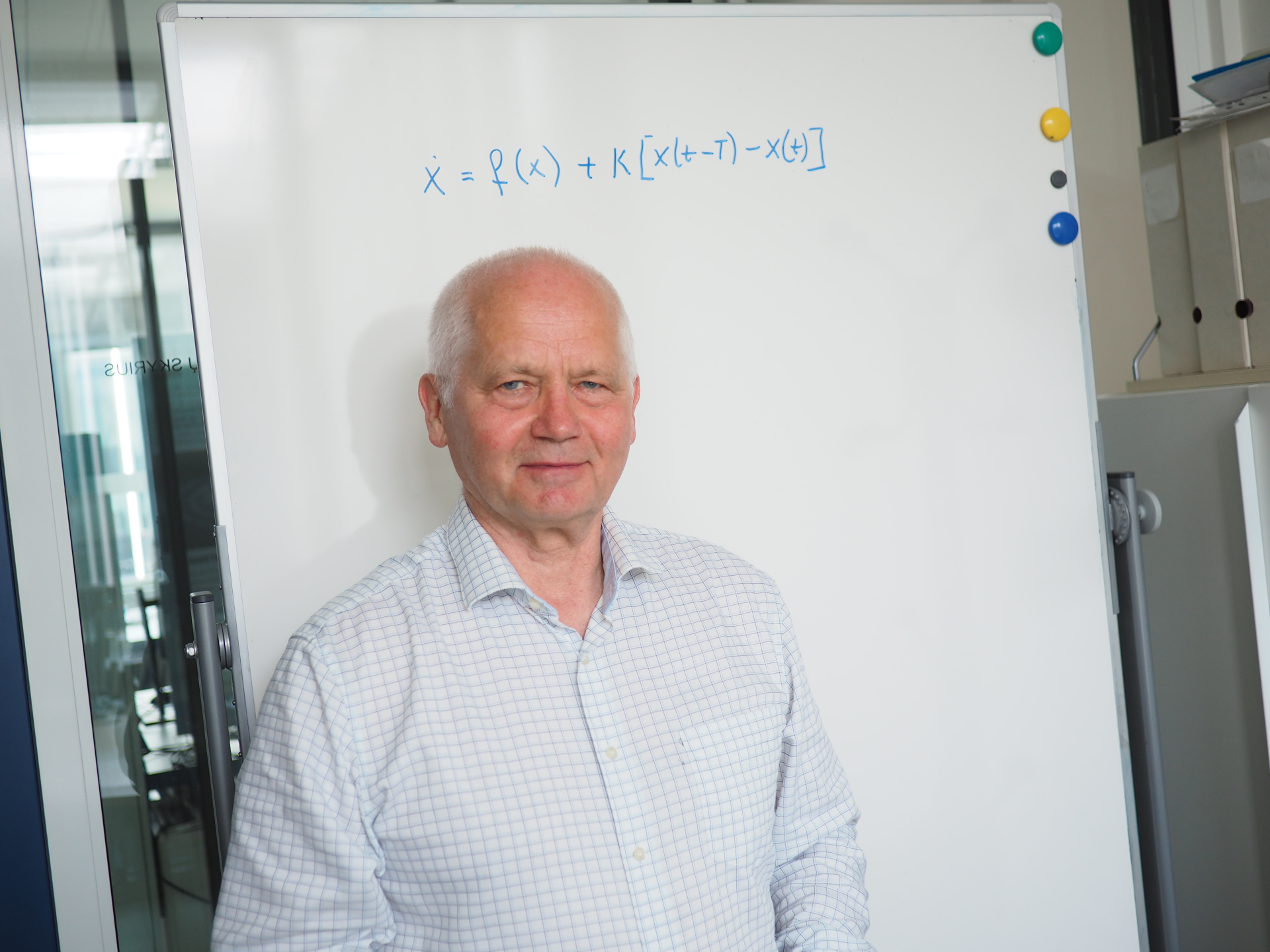
Seminar by Prof Kęstutis Pyragas: “Reservoir Computing: A New Approach to Artificial Neural Networks”
We invite you to the Sunrise Valley Quantum Research Seminar, which will be delivered by Prof. Habil. Dr Kęstutis Pyragas of the FTMC Department of Fundamental Research, one of the most highly cited Lithuanian scientists of all time.
Seminar title: Reservoir Computing: a New Approach to Artificial Neural Networks
Date: 8 October, 14:00
Venue: Room D401, FTMC (Saulėtekio Ave. 3, Vilnius)
The seminar will be held in Lithuanian, with presentation slides in English.
“In recent years, machine learning algorithms and artificial neural networks have been increasingly employed in scientific research. In this seminar, I will present a machine learning method based on reservoir computing (RC). The concept of RC emerged in the early 2000s to avoid the complex training procedures required for recurrent neural networks. In recent years, physicists have also been actively developing RC methods, as the reservoir can be implemented using a wide range of physical systems. Five years ago, a next-generation reservoir computing (NGRC) approach was proposed, in which the conventional reservoir is eliminated altogether,” explains Prof Pyragas.
Key questions addressed in the seminar:
- How did the concept of reservoir computing develop historically?
- How can RC be used to predict the dynamics of chaotic systems?
- Is it possible to predict system dynamics based solely on partial observations?
- Can the stability of a prediction model be guaranteed?
Seminar outline: Historical overview of RC development → Fundamentals of RC and NGRC algorithms → Results of our research.
Info: FTMC